

On this page
In a coaching batch you are surrounded by people, but most of the work happens alone. A study partner can help in specific ways, or quietly eat your evenings. Here is what the research says, how to pick someone, and a session plan you can start this week.
Should you have a study partner for JEE or NEET?
For most students, yes, with conditions. A good partner keeps you to your plan, tests what you think you know, and makes you explain it.
Accountability. A 2016 meta-analysis in Psychological Bulletin pooled 138 randomised studies with 19,951 participants and found that monitoring progress towards a goal helped people reach it (Harkin et al., 2016). The effect was larger when progress was reported or made public, and when it was physically written down. Writing a daily target list that a partner sees every evening does both.
Doubts. In a university genetics course, students answered a concept question, discussed it with their neighbours, then answered a similar new question on the same concept alone. The results showed that discussion improved understanding, even when no one in the group had known the right answer at first (Smith et al., Science, 2009). Talking a doubt through builds understanding; it is not just copying.
Explaining. People who studied a passage expecting to teach it recalled more and answered more questions about its main points than people expecting a test, even though nobody actually taught (Nestojko et al., 2014).
Testing each other. Quizzing is retrieval practice. Students who took recall tests on a passage remembered substantially more after two days and after a week than students who reread it, even though rereading made them feel more confident (Roediger and Karpicke, 2006).
When is a study partner a bad idea?
You are at very different points in the syllabus, so one of you always waits.
Sessions turn into comparing ranks.
It replaces solo practice. You sit the exam alone, so most problem solving stays solo.
One person always asks and the other always answers.
If comparing yourself with a partner starts making you anxious or low for days at a time, talk to a parent, teacher or counsellor. Tele MANAS is a free, 24x7 national mental-health helpline on 14416 (IIT Kanpur counselling service).
How do you choose the right study partner?
Check these before you ask anyone:
Same exam and roughly the same syllabus pace. Someone in your batch is easiest.
Similar seriousness, not identical marks. Different strengths help: organic chemistry for one, mechanics for the other.
Reliable about time.
Comfortable saying "I don't know" out loud.
Not necessarily your closest friend. Friends drift into chatting.
A script for asking: "Want to try a 40-minute session three evenings a week? We quiz each other on that day's class and each bring one doubt. Two weeks, then we decide." The trial makes it easy for either of you to stop without awkwardness.
Parents deciding about evening study at home can read should I allow my child to study with friends.
What ground rules keep it productive?
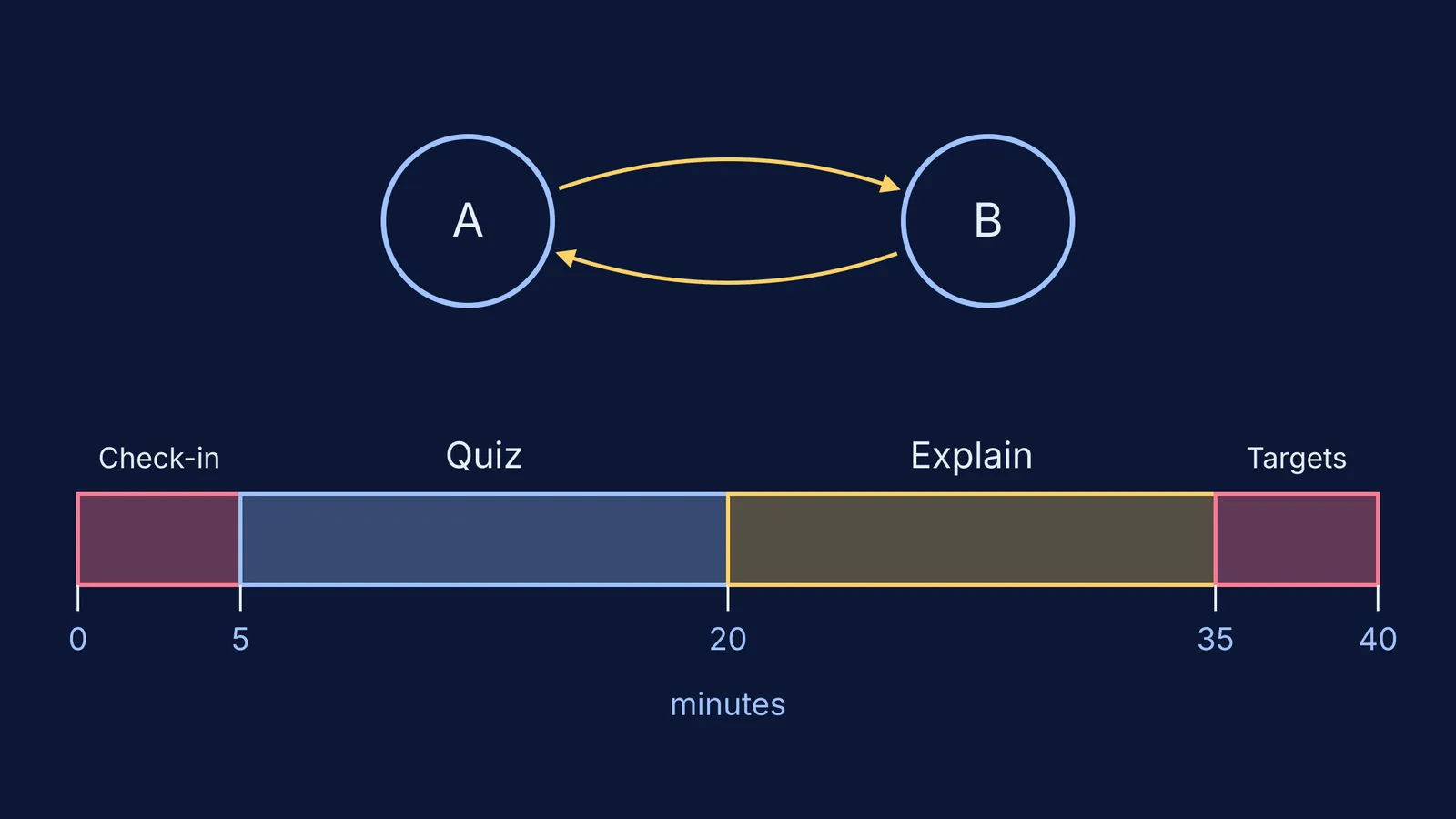
Check-in (5 min): each reads out yesterday's written target and what actually got done.
Quiz (15 min): each brings five short questions from that day's class. Answer without notes.
Explain (15 min): each picks one doubt. The person who did not ask explains it on paper. If neither of you can, write it on a list for your teacher.
Targets (5 min): each writes tomorrow's target where the other can see it.
Also: never do each other's homework, put stuck doubts on the teacher list instead of arguing for half an hour, and review the arrangement every Sunday.
An example: two partners in a JEE batch get stuck on why the normal force on a person in a lift changes when it accelerates downward. It goes on the teacher list. For a doubt like this, the Fermi Problem Library has worked problems with a step-by-step solver that explains the reasoning rather than printing an answer, so you can check the method before class.
How should study partners review a test together?
Do not compare answers straight after the paper; a short solo routine first is better (should you discuss answers after an exam). The next day, each brings their three most costly mistakes and labels them: concept, calculation or misreading. Swap papers and explain each other's mistakes in your own words.
Calculation and misreading errors get a fix you both check in the next test. Concept gaps need relearning: take them to your teacher (how to discuss a test paper with your coaching teacher) or open the topic in the Fermi Concept Library, which has a lesson for every concept in physics, chemistry, biology, mathematics and computing.
Pick one person from your batch this week, offer the two-week trial, and run the first 40-minute session before the next coaching test.


