

On this page
When a teenager asks to "go study with friends," parents often picture an afternoon of chatting and phone scrolling rather than serious academic work. Yet, educational psychology shows that peer learning is one of the most powerful tools available to students preparing for board exams, JEE, or NEET. The challenge is ensuring the group actually studies.
Should I allow my child to study with friends?
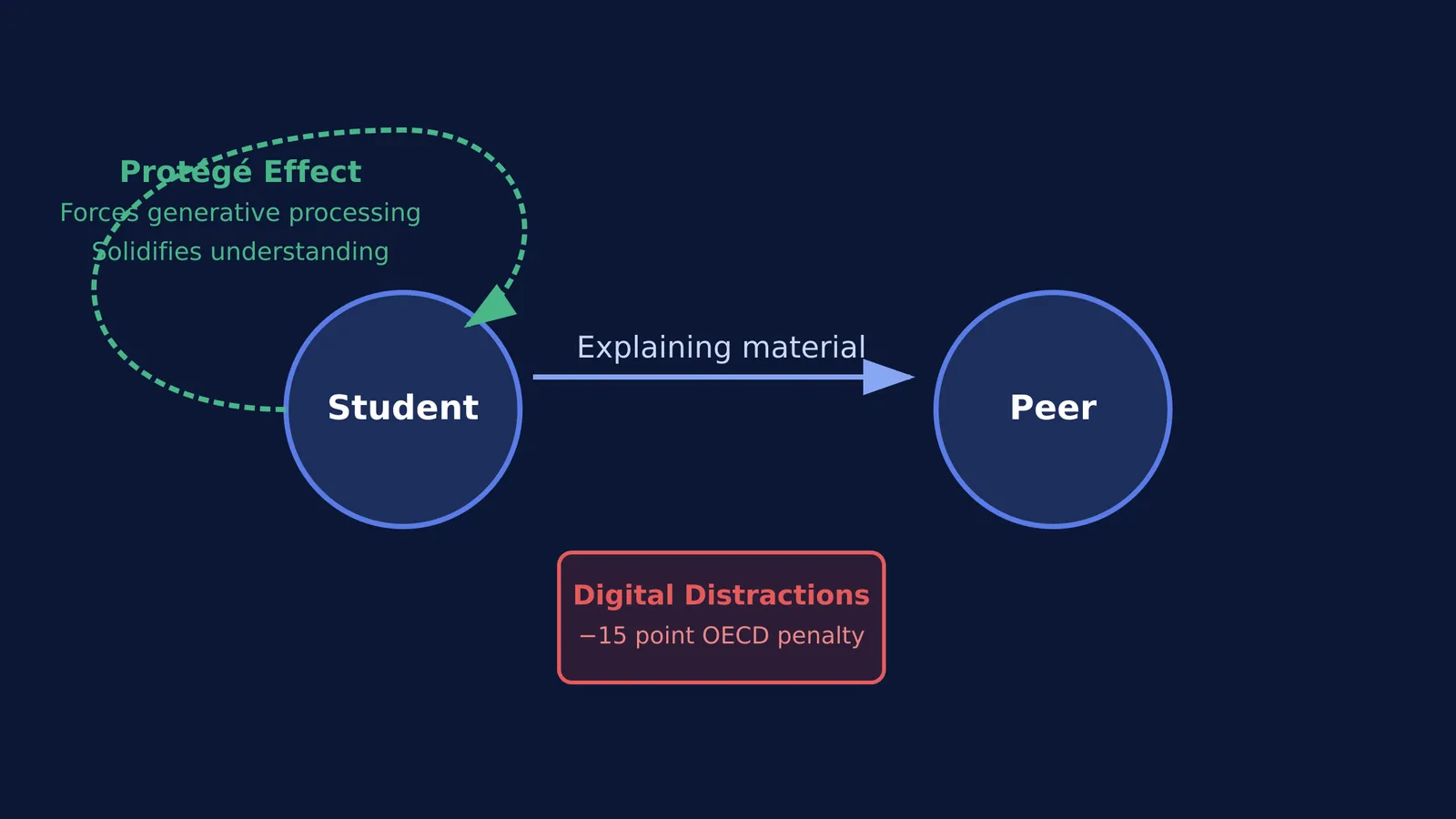
The short answer is yes, but with boundaries. Research consistently shows that students learn material more deeply when they have to explain it to someone else. This is known as the "protégé effect," a psychological phenomenon where individuals put more effort into learning material when they prepare to teach it to others than when they study it just for themselves (Chase et al., 2009).
The act of teaching forces generative processing. It requires the student to retrieve information from memory, organize it logically, and face their own knowledge gaps. If your child is struggling with a complex physics derivation or a dense biology chapter, explaining it to a peer is a highly effective way to solidify their understanding.
When does group study help?
Group study is most effective when it is structured and equitable. A 2017 study found that students' perception of group dynamics strongly predicts their individual performance. When students felt comfortable in their group and perceived the work as fair, they performed significantly better on individual assessments (Theobald et al., 2017). Comfort allows students to ask questions without fear of judgment, which is crucial for tackling difficult STEM subjects.
However, the same study identified a major risk: the "dominator" effect. If one student takes over the conversation and prevents others from contributing, it undermines the equity of the session. For a study group to be effective, every member must actively participate and contribute, rather than relying on one high-achieving student to provide all the answers.
What are the signs it has become social time?
The line between a study group and a social hangout is easily crossed, and the academic cost of distraction is steep. The OECD's PISA 2022 Results found that students who reported being distracted by other students using digital devices in every or most mathematics lessons scored 15 points lower on average than those who were rarely or never distracted (OECD, 2023).
Distraction is contagious. If one student in the group starts scrolling through social media or watching videos, it breaks the focus of everyone else in the room. A clear sign that a study group has devolved into social time is the presence of phones on the desk or conversations that drift away from the syllabus for more than a few minutes.
How do you set up a group study session at home?
To harness the benefits of peer learning while minimizing distractions, parents and students should agree on a clear structure before the session begins. Here is a practical checklist to keep the group focused:
Define a specific goal: "Studying chemistry" is too vague. A better goal is "Completing 30 stoichiometry practice problems" or "Testing each other on the p-block elements."
Put phones in another room: Given the 15-point penalty for digital distraction found by the OECD (2023), phones should be physically removed from the study space.
Use the right tools: When the group gets stuck on a difficult concept, they need a reliable way to move forward without waiting for a teacher. Fermi's AI tutor works out what the student knows and builds a plan for the session, or the group can consult the Fermi Problem Library for worked problems with a step-by-step solver that explains the reasoning rather than printing an answer.
Set a schedule: Use a timer to structure the afternoon. Work in focused blocks of 45 to 50 minutes, followed by a 10-minute break where the students can socialize and relax.
By treating a group study session with the same discipline as a solo study session, your child can take advantage of the protégé effect while avoiding the pitfalls of social loafing.
Read more:


