

On this page
A hot room does not just feel bad. It slows your thinking. A 2018 study in PLOS Medicine followed 44 university students in the Boston area through a 2016 heat wave. Students in rooms without air conditioning averaged 26.3°C indoors, against 21.4°C for those with it. During the heat wave, the non-AC group's reaction times rose 13.4% on a colour-word test and 13.3% on simple arithmetic, compared with the AC group.
A study of US students by Park and colleagues found that without air conditioning, a 1°F hotter school year reduced that year's learning by 1 percent. A meta-analysis of 18 classroom studies estimated that lowering classroom temperature from 30°C to 20°C would improve performance on psychological tests and school tasks by about 20% on average. Its authors say this holds only for temperate climates.
You cannot change the weather. You can change when, where and what you study.
When is the best time to study in summer heat?
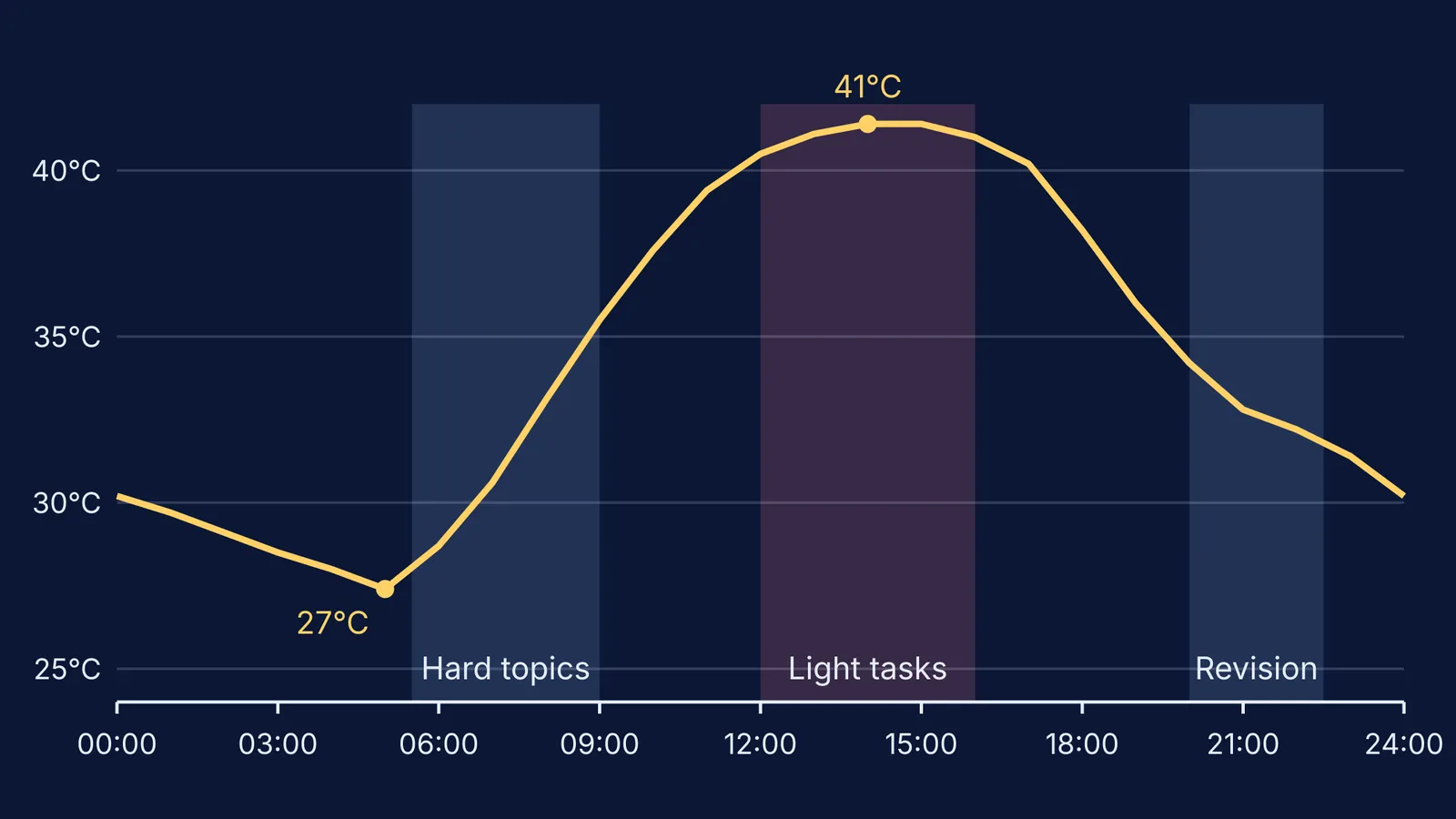
Look at a real hot-season day. Using hourly ERA5 reanalysis data from Open-Meteo for central Delhi, we averaged every hour of May 2024. The coolest hour was around 5 am, at about 27°C. From 1 pm to 4 pm it averaged about 41°C. By 9 pm it was back near 33°C.
That curve gives you three windows:
5:30 to 9 am: hard topics. New chapters, long derivations, timed practice. This is the coolest stretch of the day.
12 to 4 pm: light tasks only. The hottest hours. The Health Ministry's 2026 heat advisory says to avoid going out in the sun, especially between 12 noon and 3 pm, and to keep outdoor activity to the morning and evening.
8 to 10:30 pm: revision. Windows can open again. Test yourself from memory, then check.
If school or coaching fills your mornings, keep the shape: hardest work in whatever cool slot you have, lightest work in the hottest one.
How do you set up the coolest spot in the house?
The same heat advisory has most of the answers. Use this checklist:
Pick a room on the lowest floor, away from the sunny side of the house. The advisory suggests staying on lower floors during the day.
Keep windows and curtains closed during the day, especially on the sunny side. Open them at night to let cooler air in.
Keep a water bottle on your desk. The advisory says to drink water even if you are not thirsty, and to avoid tea, coffee and fizzy or sugary drinks.
Keep a damp cloth nearby. The advisory lists damp cloths and notes that putting your feet in 20°C water above the ankle cools the body quickly.
Run the fan only below 40°C. The WHO heat and health fact sheet gives this limit: above 40°C, fans heat the body.
If a sticky day feels worse than a dry one, our explainer on why humid heat feels worse shows why.
What should you study in the hottest hours?
Sort every task by one question: does it need a fresh brain?
Needs a fresh brain (morning): a new chapter, multi-step numericals, a full mock test, anything you keep getting wrong.
Works when you are tired (afternoon): flashcards, rewriting a formula sheet, sorting notes, updating your mistake log, rewatching a lecture you already follow.
A worked example for a Class 12 student: two hours on a new physics chapter and 45 minutes of chemistry numericals in the morning; biology flashcards and a task list for tomorrow in the afternoon, then rest; one hour of recall on the morning's chapter at night.
For building that task list, see our guide to breaking a chapter into tasks. If you sit down at 5:30 am and do not know where to start, Fermi's AI tutor can work out what you already know and build a plan for the session, so the cool hours go on learning, not deciding. For the numericals block, the Fermi Problem Library has worked problems with a step-by-step solver that explains the reasoning.
If you still nod off in the afternoon, read what to do when you feel sleepy while studying.
When is heat a health problem, not a study problem?
The 2026 advisory lists warning signs of heat stress: dizziness or fainting, nausea or vomiting, headache, extreme thirst, dark yellow urine, and fast breathing or heartbeat. If you notice any of these, stop studying, move to a cool place, drink water and get help from an adult. If someone has a high body temperature and is confused, unconscious or has stopped sweating, the advisory says to call 112 immediately.
If heat and exam pressure together leave you low or anxious for days, talk to someone you trust. Tele MANAS is the Health Ministry's free, 24x7 mental health helpline on 14416.
Tonight, close the curtains on the sunny side, fill a bottle, and put your hardest chapter on tomorrow's 5:30 am slot.


