

On this page
"Finish Work, Energy and Power" is not something you can start at 6 pm on a school day. "Solve the work-energy solved examples, 40 minutes" is. That is the whole method: small tasks, a time estimate on each, placed on days and ticked off.
Why do chapter study plans run late?
The planning fallacy is the tendency to predict that your own tasks will take less time than they actually do, even when past tasks ran late. In a 1994 study by Roger Buehler, Dale Griffin and Michael Ross, 37 psychology students at the University of Waterloo were asked when they would finish their honours thesis.
Among the 33 who finished, the average best guess was 33.9 days, and the theses actually took 55.5 days on average (Buehler, Griffin and Ross, 1994). Only 29.7% finished by the date they had predicted. Even their "everything goes as poorly as possible" estimate, 48.6 days, came in short.
In a later experiment in the same paper, the optimistic bias disappeared when people were told to connect relevant past experiences to their prediction. So a record of how long your own tasks really took gives your next guess something real to lean on.
How do you break a big chapter into study tasks?
A useful task has four features:
It starts with a verb: read, solve, write, test.
It has a visible end: "solved examples in section 2", not "energy".
It fits in one sitting, roughly 20 to 60 minutes.
Someone looking at your notebook could tell whether it is done.
To build the list:
Skim the chapter: list the section headings and count the solved examples and exercise questions.
For each section, make one task to read and take notes, and one for its solved examples.
Split the exercise questions into sets you can finish in one sitting.
End with a mistake review and a closed-book self-test.
Listing parts helps you spot hidden work. A 2014 paper by Constantinos Hadjichristidis and colleagues describes Kruger and Evans's finding that people do not naturally unpack many-part tasks in enough detail, and that listing the parts raised their time estimates. Their own studies add a caution: listing typical steps you would have thought of anyway left estimates unchanged. The list finds the work; timing yourself helps make the guesses realistic.
How long should each study task take?
Write a guess beside every task. Time the first three or four tasks and divide the real time by your guess: that is your personal ratio. If 40-minute tasks keep taking 60 minutes, your ratio is 1.5, so multiply the remaining estimates by 1.5.
With no record yet, use the thesis students' gap: they took about 1.6 times their best guess (55.5 divided by 33.9, from Buehler and colleagues). Then add one empty buffer day per chapter.
A worked example: one physics chapter over six days
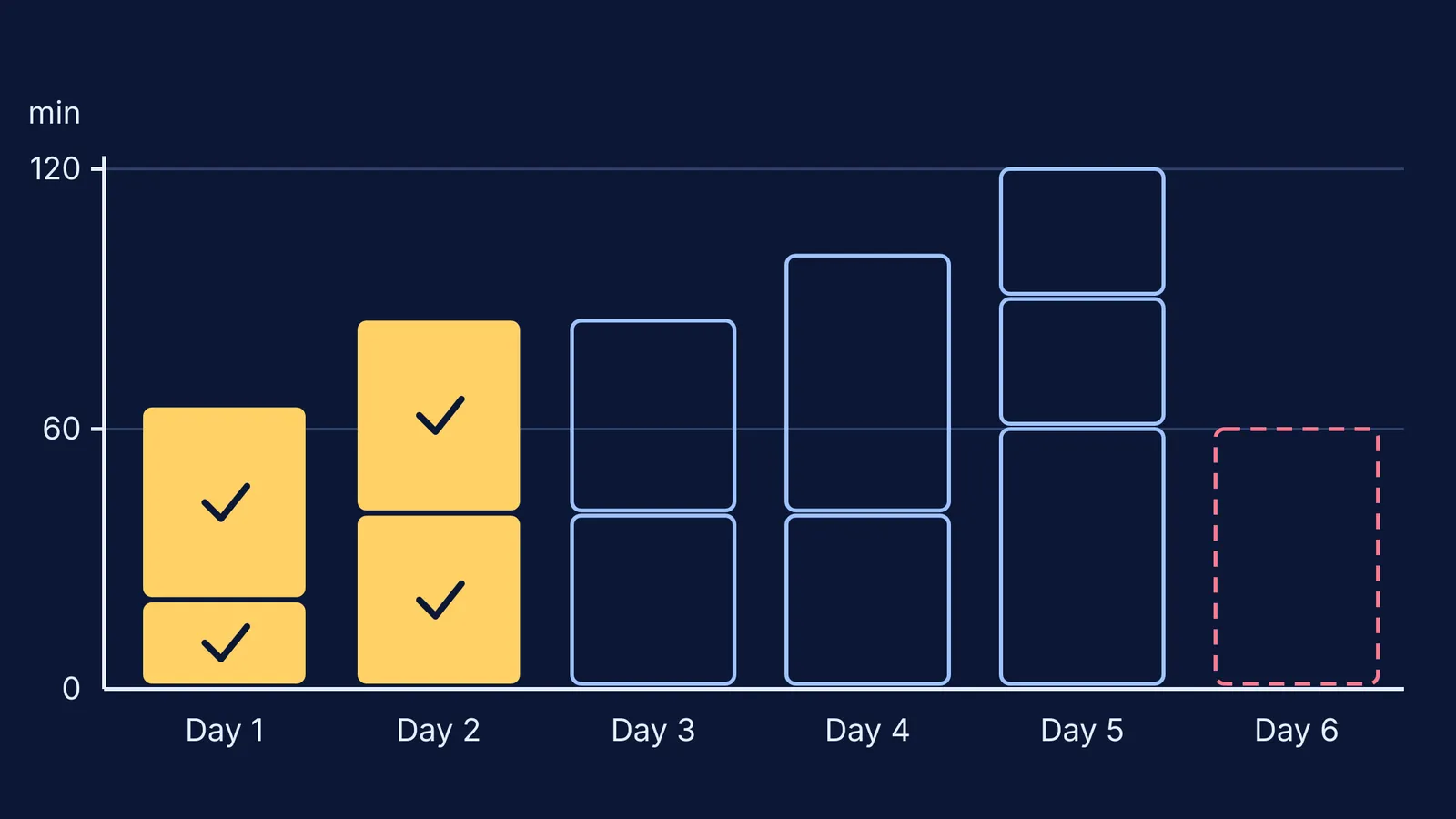
Here is a plan for a Class 11 chapter on work, energy and power, with first-guess estimates:
Day 1: skim, list headings, count examples and exercises (20 min); read and make notes on work and the work-energy theorem (45 min).
Day 2: solved examples on that section (40 min); read potential energy and conservation of energy (45 min).
Day 3: solved examples on conservation (40 min); read power and collisions (45 min).
Day 4: solved examples on collisions (40 min); first half of the exercise questions (60 min).
Day 5: second half of the exercises (60 min); mistake review and a one-page summary (30 min); closed-book self-test (30 min).
Day 6: buffer for overruns and anything you got stuck on.
That is 11 tasks and about 7.5 hours of first guesses. After Day 2, check your ratio and move tasks if needed. If a section still makes no sense after its read task, the Fermi Concept Library has a lesson for each concept. If you cannot see where to begin, Fermi's AI tutor can work out what you already know and build a plan for the session, so you sit down to a clear next step.
For a chapter that has never made sense, start with learning a chapter you've never understood. If you keep avoiding even the first task, read why procrastination is about feelings, not laziness.
How do you track progress on a chapter?
Keep the list on paper and tick each task when done. A meta-analysis by Benjamin Harkin and colleagues pooled 138 studies with 19,951 participants and found that monitoring progress helped people reach their goals. The effect was larger when progress was physically recorded and when it was reported to others or made public.
So keep the ticks visible and say the count: "4 of 11 done." Parents can ask a smaller question. Instead of "Have you finished the chapter?", try "Which task is next, and how long do you think it will take?"
When the last task is ticked, set up a 4-week spaced revision schedule for the chapter so it stays learned.


