On this page
You can take a full bachelor's degree in Japan without first becoming fluent in Japanese. The harder parts are finding the right course and paying for it. Here is what the official sources say, and a plan you can start in Class 11.
Can you study a bachelor's degree in Japan in English?
Yes. Japan's official Study in Japan portal, run by the Japan Student Services Organization (JASSO), says the number of bachelor's degrees taught entirely in English has grown in recent years. The English scores it gives for undergraduate programmes are TOEFL iBT 71-80 or IELTS 5.5-6. Most degrees take four years, and the academic year starts in April, though some universities also admit students in September or October.
The portal's search for schools with degree programmes in English returned 76 institutions when we checked in October 2026, including Kyoto, Nagoya, Hokkaido and Hitotsubashi universities. The list is supplied by schools and is not complete, so confirm details on each university's own page.
Indian students are still a small group. JASSO's International Student Survey 2025 counted 2,095 students from India on 1 May 2025, up from 1,685 a year earlier, out of 408,069 international students in total.
How do you apply from India?
The Study in Japan exams page explains the pieces:
Shortlist three to five programmes and note whether each starts in April or September.
Book an English test. The portal says most Japanese universities ask for proof of English, such as TOEFL, IELTS, TOEIC or Eiken.
Check whether your programme needs the EJU (Examination for Japanese University Admission). Its science, maths and Japan and the World papers can be taken in English, in June or November, including in New Delhi.
Look for pre-arrival admission, which the portal describes as applying and receiving an offer while you stay in your own country.
Gather what each university lists: marksheets, recommendation letters and essays.
Which scholarships can Indian students get for Japan?
The largest is the Japanese Government (MEXT) Scholarship. According to the Study in Japan MEXT page, undergraduates apply through embassy recommendation or university recommendation, and must be under 25 with 12 years of schooling. It pays a monthly stipend, waives tuition and covers return airfare. The embassy route lasts five years including Japanese language training, so it suits students ready to learn Japanese.
MEXT selection includes written tests. The portal publishes past MEXT exam papers for undergraduates from 2023 to 2025 in Japanese, English, mathematics, physics, chemistry and biology. If a maths or physics paper shows a method you keep getting wrong, the Fermi Problem Library has worked problems with a step-by-step solver that explains the reasoning rather than printing an answer.
If you pay your own way, JASSO's Monbukagakusho Honors Scholarship has a reservation route for privately financed students admitted before arrival, applied for through the university. It pays 48,000 yen a month, for 12 months if you start in April or six months if you start in September or October, and JASSO notes the amount can change each year.
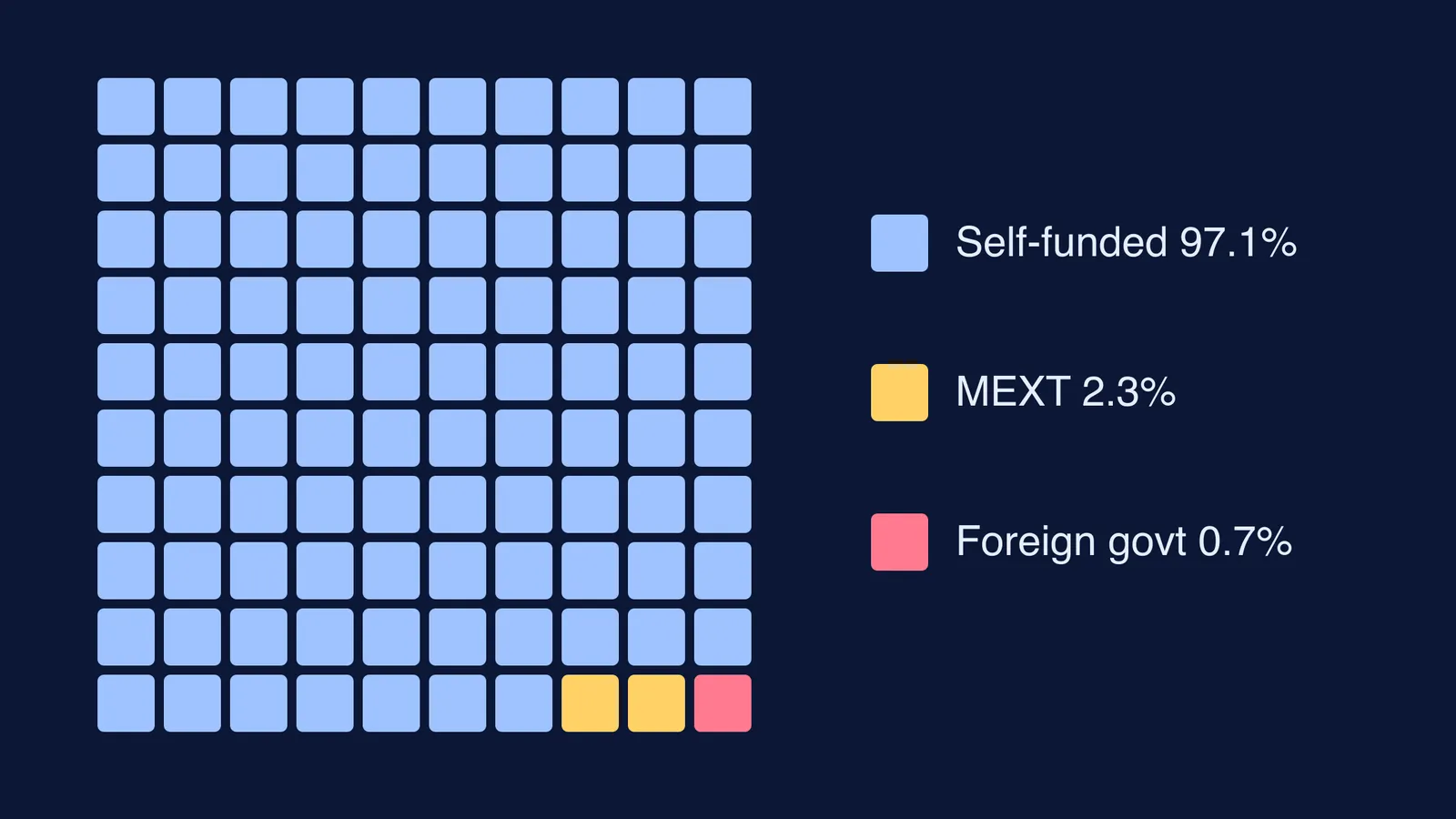
Be realistic about the odds. The JASSO 2025 survey found that 396,058 of 408,069 international students, about 97%, were privately financed, and only 9,221 held Japanese government scholarships.
How much does it cost to study in Japan?
JASSO's Student Guide to Japan fee table (2019-2020 edition) lists a first-year bill of 817,800 yen at a national university: a one-time admission fee of 282,000 yen plus 535,800 yen of annual tuition. It notes this does not apply at some national universities, and the figures are several years old, so check current fees with each university.
The four-year sum for a national university, from that table:
Admission fee, paid once: 282,000 yen
Tuition, 4 years x 535,800 yen: 2,143,200 yen
Total fees to graduation: 2,425,200 yen, against 5,169,374 yen for private science and engineering
A year of the JASSO honours award (12 x 48,000 = 576,000 yen) roughly matches one year of national-university tuition, but rent, food and flights come on top. With immigration permission, students may work up to 28 hours a week, says the Study in Japan part-time jobs page. Treat that as pocket money, not your fee plan.
What should you do in Class 11 and 12?
Class 11, first term: build a shortlist and choose April or September entry.
Class 11, second term: take a practice IELTS or TOEFL, then the real test once you are near the band.
Summer before Class 12: attempt one MEXT maths and one science past paper to see where you stand.
Class 12: sit the June or November EJU if your programmes need it, and send applications.
After an offer: ask about the JASSO reservation and fee reductions, then follow the university's visa instructions.
If practice papers expose Class 11 physics or chemistry gaps, the Fermi Concept Library covers every concept in physics, chemistry, biology, mathematics and computing, each with its own lesson.
Start this week with the portal search and that four-question email to two universities.