On this page
If your college has announced student council elections, you probably have two questions: is it worth it, and will it wreck your semester? In India, most of the ground rules come from the Lyngdoh Committee. In an order dated 22 September 2006, the Supreme Court directed that its recommendations be followed in all college and university elections (UGC copy of the recommendations).
What does a student council actually do?
A student council, often called the students' union, is the elected body that speaks for students to the college administration. Under the Lyngdoh recommendations, only regular students can sit on it; no faculty member or administrator may hold a post.
Roles usually come in three layers:
Class representative: elected by your class. In two of the election models the committee describes, class representatives then elect the office bearers.
Executive member: sits on the council and takes on specific work, such as an event or a hostel issue.
Office bearers: the report names posts such as President, Vice President, Secretary and Joint Secretary. They usually run meetings and represent students to the principal or dean.
Day to day, the work is less speeches and more follow-up: collecting complaints, attending meetings and checking that promises were kept.
Who can contest student council elections in India?
The Lyngdoh rules set these conditions (UGC copy):
Undergraduates aged 17 to 22 may contest; this may be relaxed for professional courses of 4 to 5 years.
The maximum age is 24 to 25 for postgraduates and 28 for research students.
You should have no academic arrears in the year you contest.
You need 75% attendance or your university's minimum, whichever is higher.
You get one chance to contest an office-bearer post and two for an executive-member post.
You must be a regular, full-time student with no criminal record or university disciplinary action.
Your college's election notice may add conditions, so read it before you file a nomination.
How much time does a student council role take?
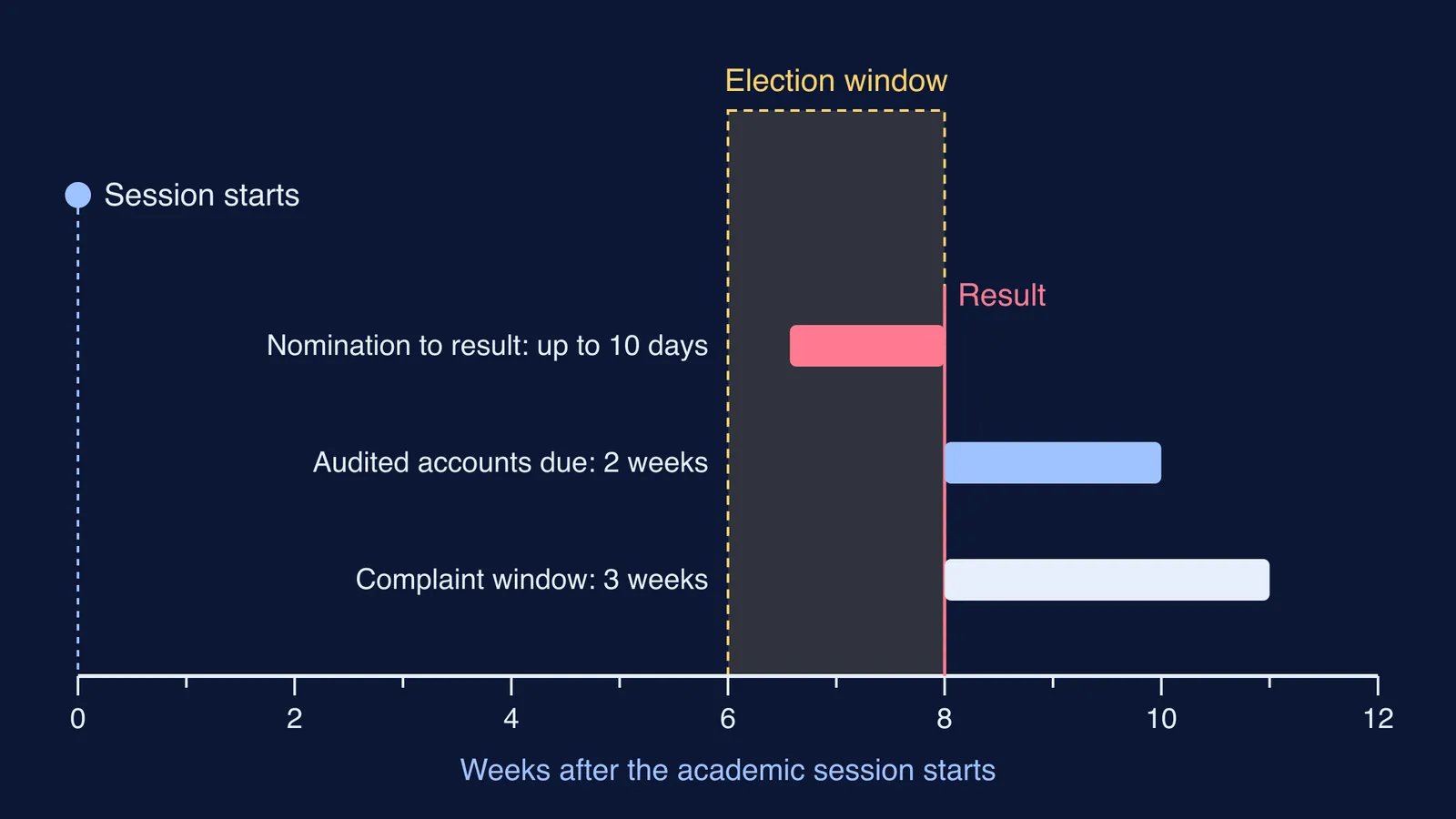
The campaign is short by design. The Lyngdoh recommendations say the whole process, from nominations to results, should not exceed 10 days, with elections held yearly, 6 to 8 weeks after the session begins. Spending is capped at Rs 5,000 per candidate, only hand-made posters are allowed, and audited accounts are due within two weeks of the result.
The term is the real commitment: a full academic year. Hours depend on your post and campus, so budget them before you file. Here is a sample week for a class representative; swap in your own estimates:
Council or committee meeting: 1 hour
Collecting and writing up classmates' issues: 1 hour
Follow-up with staff or the dean's office: 1 hour
Fest or orientation weeks: several extra hours
Then run a one-week study time audit and find where those hours would come from. If the only answer is sleep or self-study, choose a smaller role.
What skills does student council build?
A longitudinal study of 875 college students found that those who took part in leadership education and training programmes grew in civic responsibility, leadership skills, multicultural awareness and personal and societal values (Cress and colleagues, 2001). A survey of senior students in Iowa State University's College of Agriculture and Life Sciences found that those who had served as officers of a club or organisation scored significantly higher on a socially responsible leadership scale (Foreman and Retallick, 2012). Neither study proves the role caused the growth, since students who choose leadership may differ to begin with.
In practice, the skills are concrete:
Speaking to a hall, and to one sceptical official.
Negotiating for what students need within the college's limits.
Keeping honest accounts under a spending cap.
Running a meeting and writing minutes people can act on.
Practising group discussions builds the same speak, listen and respond habit before a campaign.
Should you contest student council elections in college?
Answer these five questions honestly:
Do I meet every eligibility rule, including attendance and no arrears?
Can I name one specific problem I want fixed, and who in college decides it?
Have I found the weekly hours without cutting sleep or self-study?
Can I campaign within the code of conduct, with no outsiders and no printed posters?
Would class representative or executive member teach me the same things first?
If you answered no to two or more, try a lower-stakes route this year, such as a club or NCC or NSS in college.
If you answered yes, your pitch to classmates can be this simple: "I'm standing for class representative. I'll collect our issues every Friday, take them to the department, and post an update within a week. If I can't fix something, I'll tell you why."
If a busy council week costs you a lecture, Fermi's AI tutor can work out what you already know and build a plan for the session, so you come back to a missed STEM topic with a clear next step.
Read your college's election notice this week, then answer the five questions.