

On this page
If your notebook holds four versions of this week's timetable, colour-coded, and the physics chapter is still untouched, you are not lazy. Planning gives you a real feeling of relief. The trouble is that the relief comes before any studying does.
Why does making a timetable feel so productive?
Unfinished work nags at you. In a 2011 set of experiments, psychologists E. J. Masicampo and Roy Baumeister found that unfinished goals caused intrusive thoughts and hurt performance on an unrelated task, and that making a specific plan for the goal removed those effects. They concluded that committing to a plan "may also free cognitive resources for other pursuits."
That is useful when the plan is short and you follow it. But it also explains the timetable trap. Writing out "Monday: Rotational motion, 6-8 pm" quiets the worry about rotational motion, even though you have not opened the chapter. Make a fresh timetable and you get that relief again, still without solving a single problem. (The nagging feeling has a history of its own: read about Bluma Zeigarnik's research on unfinished tasks.)
There is a second trap. Detailed plans are usually too optimistic. In a classic study of the planning fallacy, psychology students predicted they would finish their honours theses in 33.9 days on average, but took 55.5 days, and only 29.7% finished by their own best estimate. Even when asked to predict for "if everything went as poorly as it possibly could," they forecast 48.6 days on average, still short of the real time. So a timetable you spent an hour perfecting is likely to slip anyway. Then you replan, and the loop starts again.
Does planning help at all, then?
Yes, if the plan is small and specific. A review of 94 independent tests found that "if-then" plans, which say when, where and how you will act, had a medium-to-large effect on reaching goals (d = 0.65). Among other things, the review found these plans helped people get started. A useful plan looks like "At 6 pm, at my desk, I open NCERT Chapter 7 and do the first five exercise questions." It does not need colours or a full term mapped out.
So the goal is not to stop planning. It is to plan for a few minutes and then start.
How do I stop overplanning and start studying?
Use two rules together: a 10-minute cap and a start-now rule.
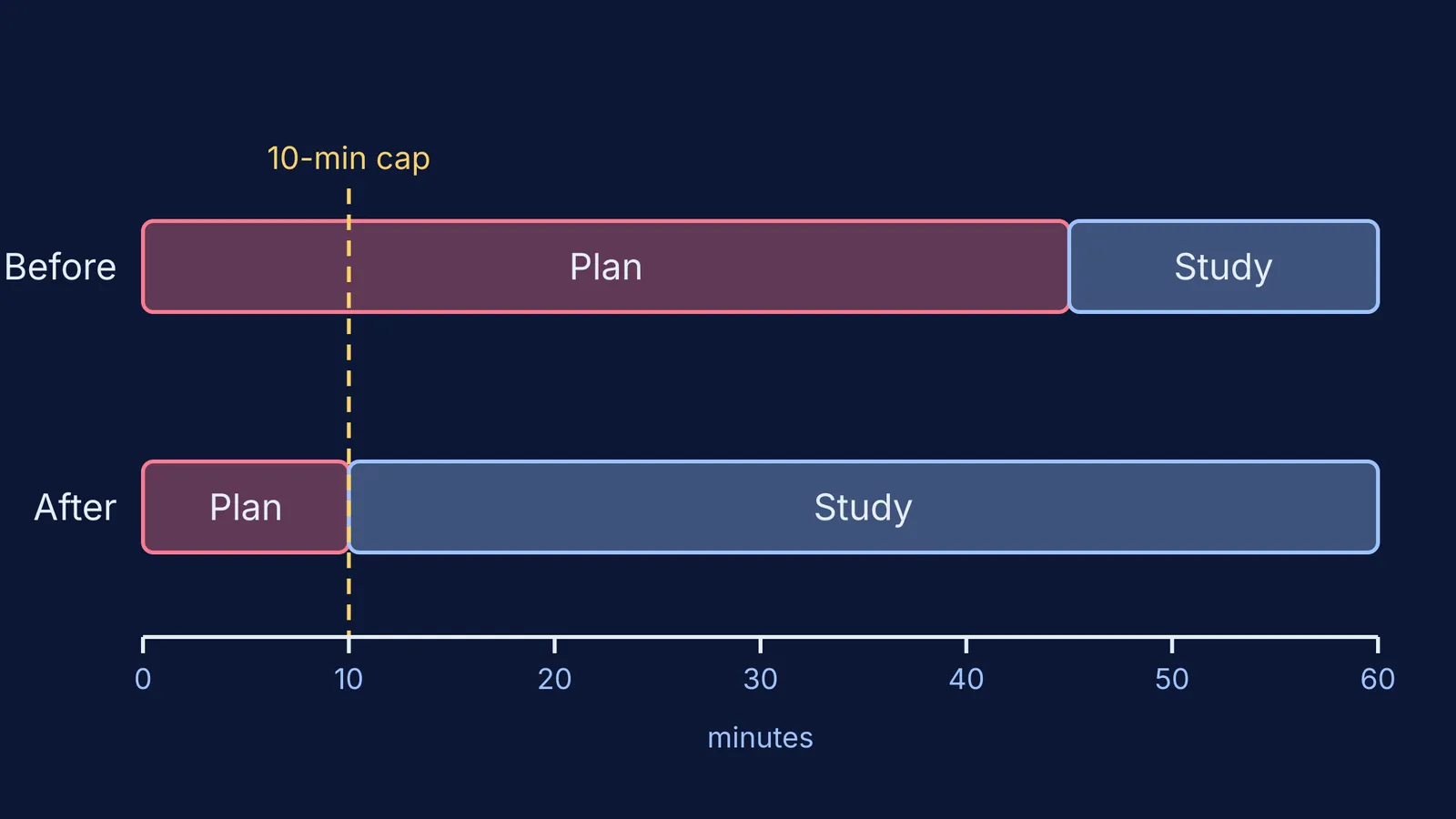
Set a 10-minute timer before you open your planner. When it rings, the plan is done, finished or not.
Write only three things: today's one main task, two smaller tasks, and the time you start each.
Make the first task tiny and concrete. "Do questions 1-5 of Exercise 7.1" works. "Revise maths" does not.
Start-now rule: the last line of every plan is a task you begin within two minutes of the timer ringing. No snack break, no phone in between.
Leave gaps. Given the planning fallacy, assume each task will take longer than you think. Our guide to adding buffer time to a study plan shows how much room to leave.
Replan only once a week, for at most 20 minutes, using what you actually finished, not what you hoped to finish.
A worked example
Picture a Class 12 student, call her Riya, sitting down at 6:00 pm. Old habit: she redraws her monthly timetable until 6:45, feels organised, then has 15 tired minutes left for chemistry.
New version: 6:00 to 6:10, she writes "Main: Electrochemistry, NCERT in-text questions 2.1-2.6. Small: 10 organic reactions flashcards; mark one doubt for school." At 6:10 she opens the textbook to question 2.1. By 7:00 she has 50 minutes of real work done, and tomorrow's plan takes five minutes because she can see where she stopped.
If even the main task feels too big to begin, breaking a chapter into small tasks gives you a first step that takes minutes, not hours. If the real problem is not knowing what to study first, Fermi's AI tutor works out what you already know and builds a plan for the session, so you sit down to a clear next step and spend your energy on the work.
What should parents say when a child keeps making timetables?
Skip "You're wasting time." Try: "That plan looks good. What's the first question you're doing, and can I see it done at 6:30?" This values the plan, keeps it short, and moves attention to starting. Agree to look at one finished task, not the timetable.
If endless planning seems to be a way of avoiding panic about studying, or the worry is affecting sleep or mood, that needs more than a timer. Tele MANAS, the government's free mental-health helpline, takes calls 24x7 on 14416, as listed on IIT Kanpur's counselling page for Tele MANAS.
Tonight, set the 10-minute timer, write one task, and start it within two minutes of the ring.


