

On this page
If you have ever had a catchy song stuck in your head because you only heard the first half of it, you have experienced the Zeigarnik effect.
The story of its discovery begins in a bustling Berlin restaurant in the 1920s. Gestalt psychologist Kurt Lewin noticed that a waiter could remember complex, unpaid orders with perfect accuracy. However, the moment the bill was settled and the task was finished, the waiter could barely remember any details of what the table had ordered. The simple act of completing the transaction seemed to erase the memory completely.
Intrigued by this everyday occurrence, Lithuanian-Soviet psychologist Bluma Zeigarnik designed a series of formal experiments to test the phenomenon. Her findings, published in 1927 in the journal *Psychologische Forschung*, showed a clear and powerful pattern: people remember unfinished or interrupted tasks better than completed tasks.
What is the Zeigarnik effect?
The Zeigarnik effect is the psychological tendency to remember uncompleted or interrupted actions more vividly and easily than tasks that have been finished.
While it often appears as a distracting urge to finish what you started—like an important email you left halfway written—it is also a fundamental cognitive mechanism. In Gestalt psychology, the effect demonstrates that human cognition actively holds onto unresolved patterns, refusing to let them fade into the background until closure is achieved. Television writers rely on this phenomenon constantly. When an episode ends on a cliffhanger, the unresolved storyline creates a cognitive itch that makes you eager for the next episode.
How does the Zeigarnik effect improve memory?
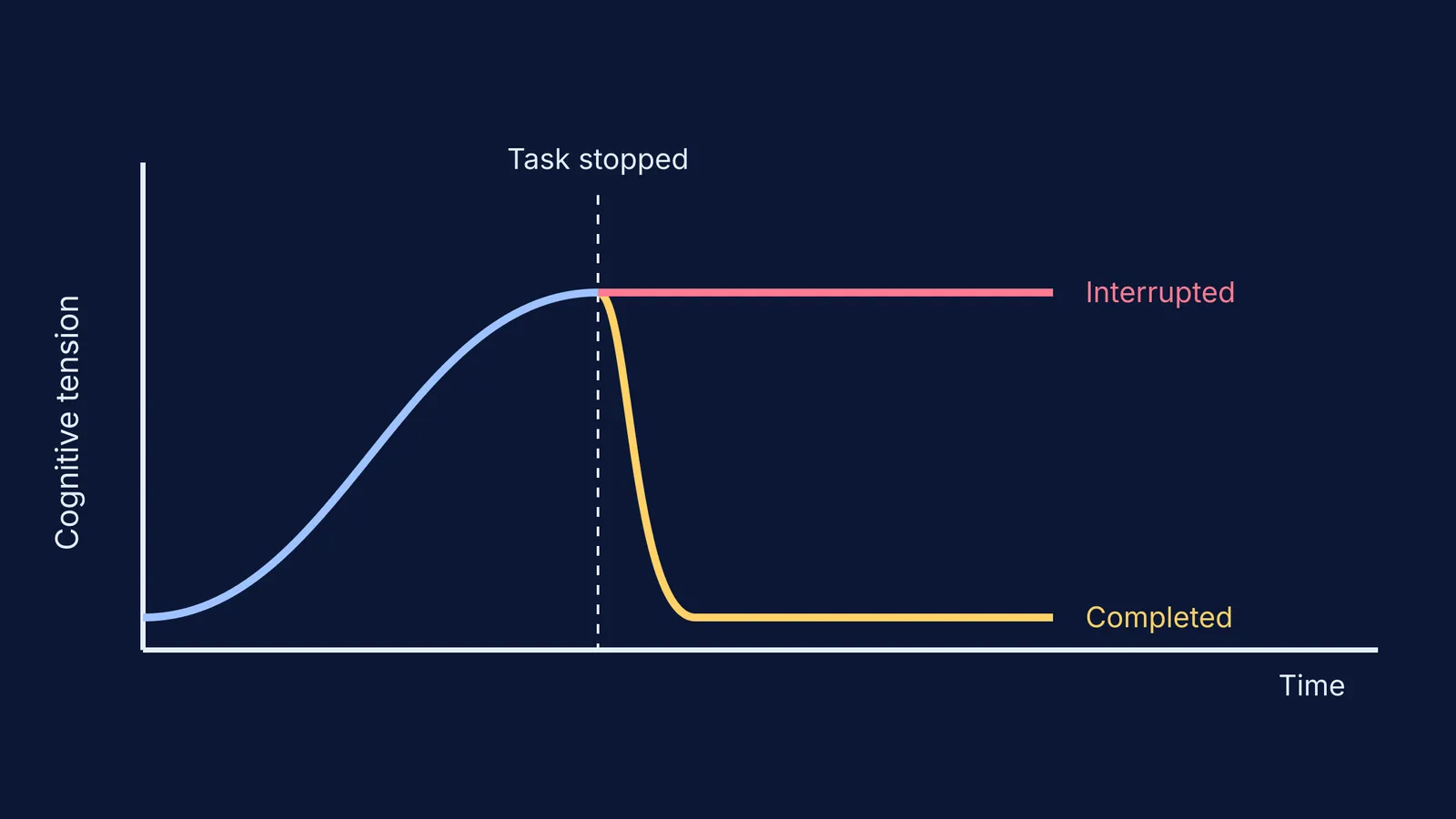
The reason interrupted tasks stick in your mind comes down to cognitive tension. Kurt Lewin proposed a framework called field theory to explain human behavior. Within this framework, every task you intend to do creates a temporary psychological "field" or tension system.
This tension improves the cognitive accessibility of the relevant information. Your brain keeps the data active and ready in your working memory because it expects you to need it again soon to reach a resolution. Once the task is completed, that tension is instantly relieved, and your brain clears the temporary storage to make room for new information. But if the task is interrupted or abandoned midway, the continuous tension keeps the content easily accessible. Because your mind continues to chew on the unresolved problem, the information is much more likely to be transferred to your long-term memory.
This dynamic explains why you understand physics theory but still fail numericals when you just read the textbook passively. Without the tension of an unsolved problem, your brain finds no urgent reason to hold onto the facts.
How can you use the Zeigarnik effect for studying?
Early research suggested that suspending your study to perform unrelated activities—such as switching to a completely different subject or playing a game—can improve memory compared to completing the session without a break. While modern reviews show the memory effect can vary, the psychological urge to resume an unfinished task remains strong. Here is how you can intentionally engineer that tension in your daily exam preparation:
1. Stop at a cliffhanger When you take a study break, do not wait until you finish a chapter. Stop in the middle of a section, or write out a complex math problem and step away before you calculate the final answer. Leaving the task deliberately unfinished keeps the cognitive tension active while you rest, so your brain continues to process the ideas in the background.
2. Switch subjects when stuck If you are struggling with a difficult chemistry mechanism, do not force yourself to stare at the page until you solve it. Switch to a completely different subject, like biology. The Zeigarnik effect ensures you will not forget the chemistry problem; in fact, the interruption may help your mind synthesize the information better than if you had forced a completion. This is closely related to how spacing out your learning works in Robert Bjork's new theory of disuse.
3. Break large goals into interruptible chunks A massive goal like "study optics" does not create the right kind of tension—it just creates anxiety. Instead, start a very specific sub-task, like deriving the lens formula, and leave it halfway done before dinner. The specificity of the task focuses the tension on the exact mathematical steps you need to remember.
4. Use AI to guide, not solve When you return to an interrupted problem after a break, the worst thing you can do is look up the final answer immediately. Instantly reading the solution destroys the cognitive tension before you can benefit from it. To truly learn, you must close the loop yourself.
This is why Fermi's AI tutor teaches rather than answers. It holds a line of reasoning across a whole session, notices exactly where you are stuck, and decides whether to ask, explain, or show. By guiding you step-by-step rather than handing you the solution, the tutor keeps the task-specific tension alive until you reach the "aha!" moment on your own.


