On this page
If you can write shorthand and type cleanly, one Staff Selection Commission (SSC) exam leads straight from Class 12 to a central government desk job. Here is what the job involves, how the shorthand test is marked, and a plan for building speed.
What does an SSC stenographer do, and where do they work?
According to the SSC Stenographer Grade C and D Examination 2026 notice, Grade C is a Group B (non-gazetted) post and Grade D is a Group C post, in ministries, departments and their attached and subordinate offices across India. The notice also says only candidates who have stenography skills are eligible to apply.
Day to day, a stenographer typically takes an officer's dictation in shorthand and turns it into typed letters and notes. The SSC's 2025 allocation write-up shows where new stenographers were placed:
Grade C: 10 offices, including the Ministry of External Affairs, the Intelligence Bureau, the Election Commission of India, Armed Forces Headquarters and the Central Vigilance Commission.
Grade D: more than 40 offices, including the CBI, EPFO, the Railway Board, NITI Aayog, the Border Roads Organisation and the Income Tax directorate.
In the first round of the 2025 cycle, the same write-up shows 228 candidates recommended for Grade C and 1,483 for Grade D. For 2026, the notice lists about 731 vacancies as a tentative figure, and SSC says it will update this number on its website.
Who can apply for SSC Stenographer after 12th?
The 2026 notice sets these rules:
Education: Class 12 or equivalent passed from a recognised board by 1 August 2026.
Age for Grade C: 18 to 30 years on 1 August 2026.
Age for Grade D: 18 to 27 years on 1 August 2026.
Age relaxation: 5 extra years for SC/ST candidates and 3 for OBC candidates, with further relaxation for candidates with benchmark disabilities.
The notice does not ask for a particular stream. Dates and cut-offs change each year, so check the current notice before applying.
How does the SSC stenographer skill test work?
There are two stages. First comes a computer-based test with 50 questions on General Intelligence and Reasoning, 50 on General Awareness and 100 on English Language and Comprehension, in 2 hours, with 0.25 marks deducted for each wrong answer (2026 notice). The reasoning section includes arithmetical reasoning and number series. If those steps trip you up, the Fermi Problem Library has worked problems with a step-by-step solver that explains the reasoning rather than just printing the answer.
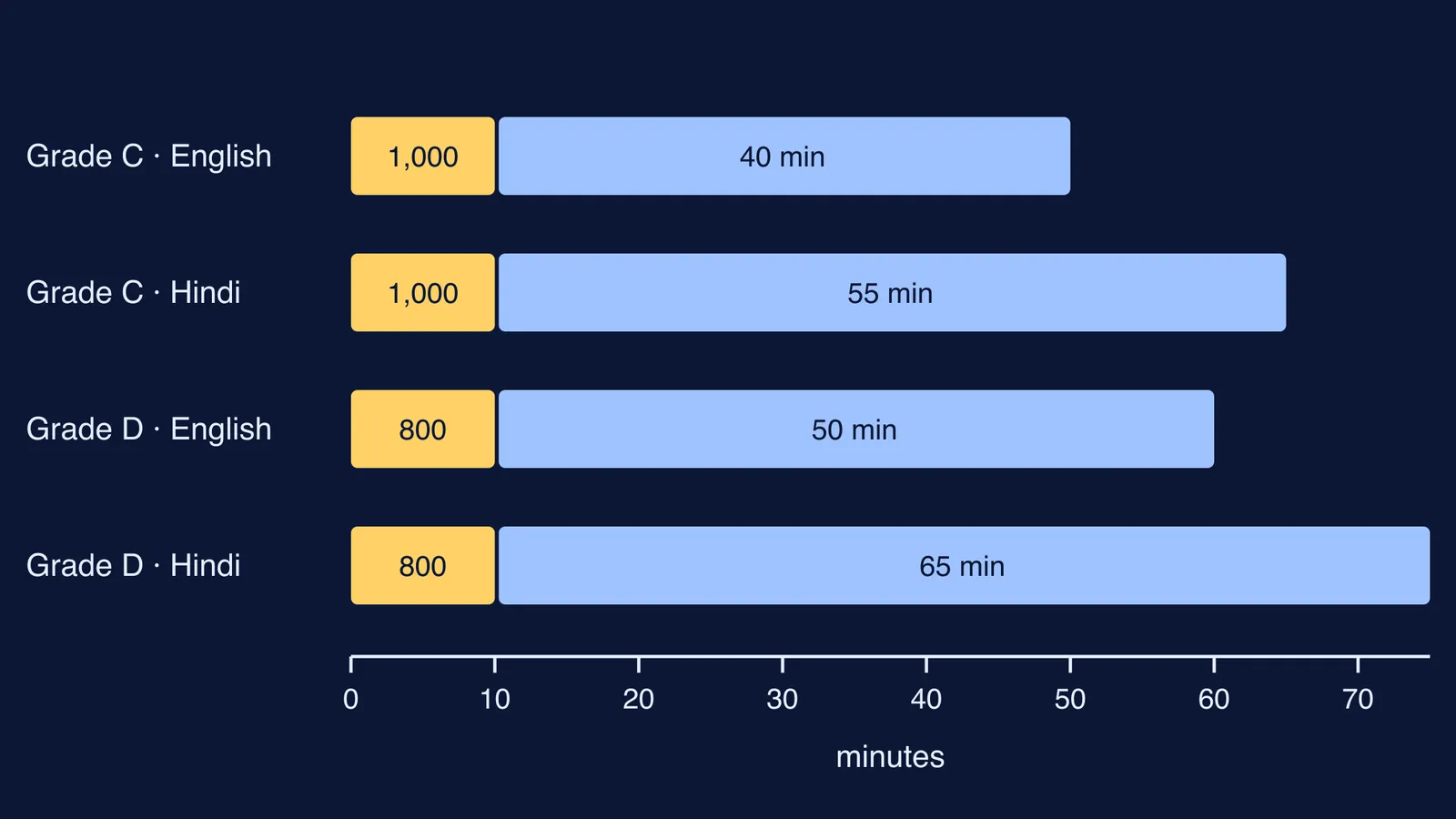
Candidates shortlisted from that test sit the skill test. The same notice says you get one 10-minute dictation in English or Hindi, at 100 words per minute for Grade C or 80 words per minute for Grade D, and then transcribe it on a computer. You get 40 minutes to transcribe for Grade C English, 55 for Grade C Hindi, 50 for Grade D English and 65 for Grade D Hindi.
For 2025, SSC's allocation write-up set the allowed mistakes at up to 5% (unreserved) or 7% (reserved categories) for Grade C, and up to 7% or 10% for Grade D.
A worked example: a Grade C dictation is 100 x 10 = 1,000 words, so the 2025 unreserved limit of 5% means roughly 50 mistakes at most. Typing 1,000 words in 40 minutes is only 25 words a minute, so for most candidates the harder part is reading their own outlines correctly, not raw typing speed. Grade D is 800 words, so the unreserved 7% allows about 56 mistakes.
How do you build shorthand speed for the SSC exam?
Speed comes from measured practice that copies the exam format:
Learn the theory first. Write each outline correctly at a slow pace until it is automatic.
Find your clean speed: the fastest 10-minute dictation you can transcribe with errors under 5%.
Practise one 10-minute dictation a day, 10 words per minute above your clean speed.
Transcribe on a computer under the exam clock set in the 2026 notice, such as 40 minutes for Grade C English.
Count mistakes as a percentage, and list the outlines you misread to drill the next day.
Raise the speed by 10 words per minute only after two passages in a row come in under your target.
Vary your dictation sources so you are not memorising one voice.
If typing is your weak point, add our three-week typing speed plan for students.
How does it compare with other jobs after 12th?
Like clerk posts that add a typing test, this exam pairs a written test with a skill. Compare it with the SSC CHSL posts, exam tiers and six-month plan and the four RRB clerk posts open after 12th. For your next step, download the current notice from ssc.gov.in and take your first timed 10-minute dictation this week.