

On this page
You chose science because you like things that follow rules. Social science can feel like the opposite: long chapters, dates, and answers that seem to need a page of prose. If you also go to foundation coaching, it is often the subject that gets squeezed. The good news: the CBSE paper is predictable, and a predictable paper rewards a small, steady plan over late-night rereading.
How is the CBSE Class 10 social science paper marked?
According to CBSE's 2026-27 sample question paper, the board paper is 3 hours long, carries 80 marks and has 38 compulsory questions. It has four sections of 20 marks each: history, geography, political science and economics.
Answer length is capped in the same document: 40 words for a 2-mark answer, 60 words for 3 marks, 120 words for 5 marks and 100 words for a 4-mark case-based question.
Map work is worth 5 marks: 2 marks in history and 3 marks in geography, according to the sample paper.
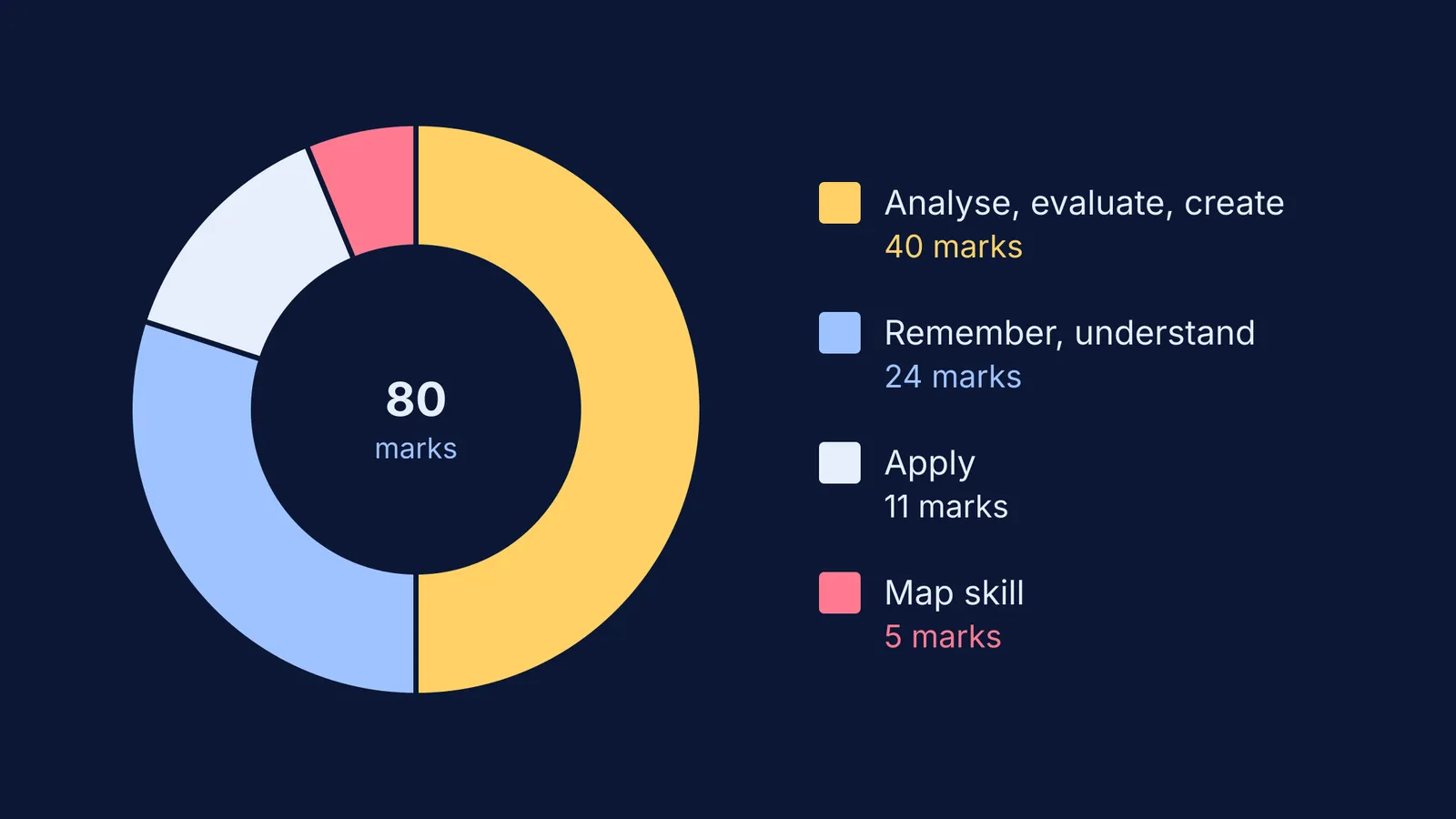
The 2026-27 curriculum document splits the 80 marks by skill: 24 for remembering and understanding, 11 for applying, 40 for analysing, evaluating and creating, and 5 for map skill. So half the paper asks you to explain causes and weigh evidence. You already do that kind of thinking in science; what is usually missing is the facts to think with.
How to study social science for Class 10 boards quickly?
Stop rereading. A 2013 review of ten study techniques by Dunlosky and colleagues rated practice testing and distributed (spaced) practice as high utility, and rereading and highlighting as low utility. In a classic experiment, Roediger and Karpicke (2006) found that students who took recall tests on prose passages remembered more a week later than students who restudied them, even though restudying made students more confident.
So each tool below is a way to test yourself on a little, often.
Maps. Print one blank outline map of India. The curriculum lists the map items for the year: for history, the Congress sessions at Calcutta and Nagpur (1920) and Madras (1927), the satyagrahas at Kheda, Champaran and Ahmedabad, Jallianwala Bagh and the Dandi March; for geography, soil types, dams, crop areas, mines, power plants, industries, sea ports and international airports. Mark a few from memory daily, then check.
Timelines. Draw one line per history chapter with five to eight events. Question 4 in the sample paper asks you to put four print-culture events in order, so the sequence matters as much as the dates.
Keyword answers. For each likely question, write its three to five points as chains of keywords on a card. Say the full answer aloud from the keywords, then flip the card and check.
Past papers. CBSE publishes previous question papers, including the 2026 Class X social science paper, and marking schemes. Do one section at a time, then mark it strictly against the scheme.
Case-based questions need their own method: our guide to answering source-based questions in history shows how to read the passage for marks.
What does a keyword answer look like?
Take question 6A from the sample paper: 'The female figures become an allegory of the nation during the 19th century in Europe.' Elaborate on the statement with examples (3 marks). The official marking scheme gives three points. As a keyword card:
Artists personify the nation → female figure → abstract idea given concrete form
France → Marianne → red cap, tricolour, cockade
Germany → Germania → crown of oak leaves = heroism
Three chains, three marks. Each chain becomes one or two sentences, well inside the 60-word limit. To lay those sentences out so the examiner sees every point, read how to improve answer writing for boards.
How can a science student fit this into a busy week?
Here is a time-light plan: about 30 minutes a day, six days a week, starting roughly eight weeks before your pre-boards. It rests on the two techniques the Dunlosky review rated highest, self-testing and spacing.
Monday, history: redraw one chapter's timeline from memory, then two keyword cards
Tuesday, geography: ten map items on a blank map, then one card
Wednesday, political science: three keyword cards
Thursday, economics: three cards plus key definitions
Friday, past paper: one 20-mark section from a CBSE paper, marked against the scheme
Saturday, repair: redo only what went wrong this week, then shuffle in older cards
A 20-mark section is a quarter of the 3-hour board paper, so give it about 45 minutes.
Parents can help without nagging: at dinner, read out one card's question and let your child say the keywords. If coaching is crowding out board subjects altogether, our piece on Class 10 boards with foundation coaching covers when to slow down.
The half hour holds only if science study does not spill over. On science days, Fermi's AI tutor can work out what you already know and build a plan for the session, so you sit down to a physics or maths block with a clear next step.
Start tonight: one blank map, ten places, five minutes.


