

On this page
Topper notes are everywhere before JEE Main and NEET-UG: scanned PDFs in group chats, printed sets, colour-coded pages on Instagram. Research on studying from someone else's notes gives a fairly clear answer on whether they are worth it.
What can topper notes actually do for you?
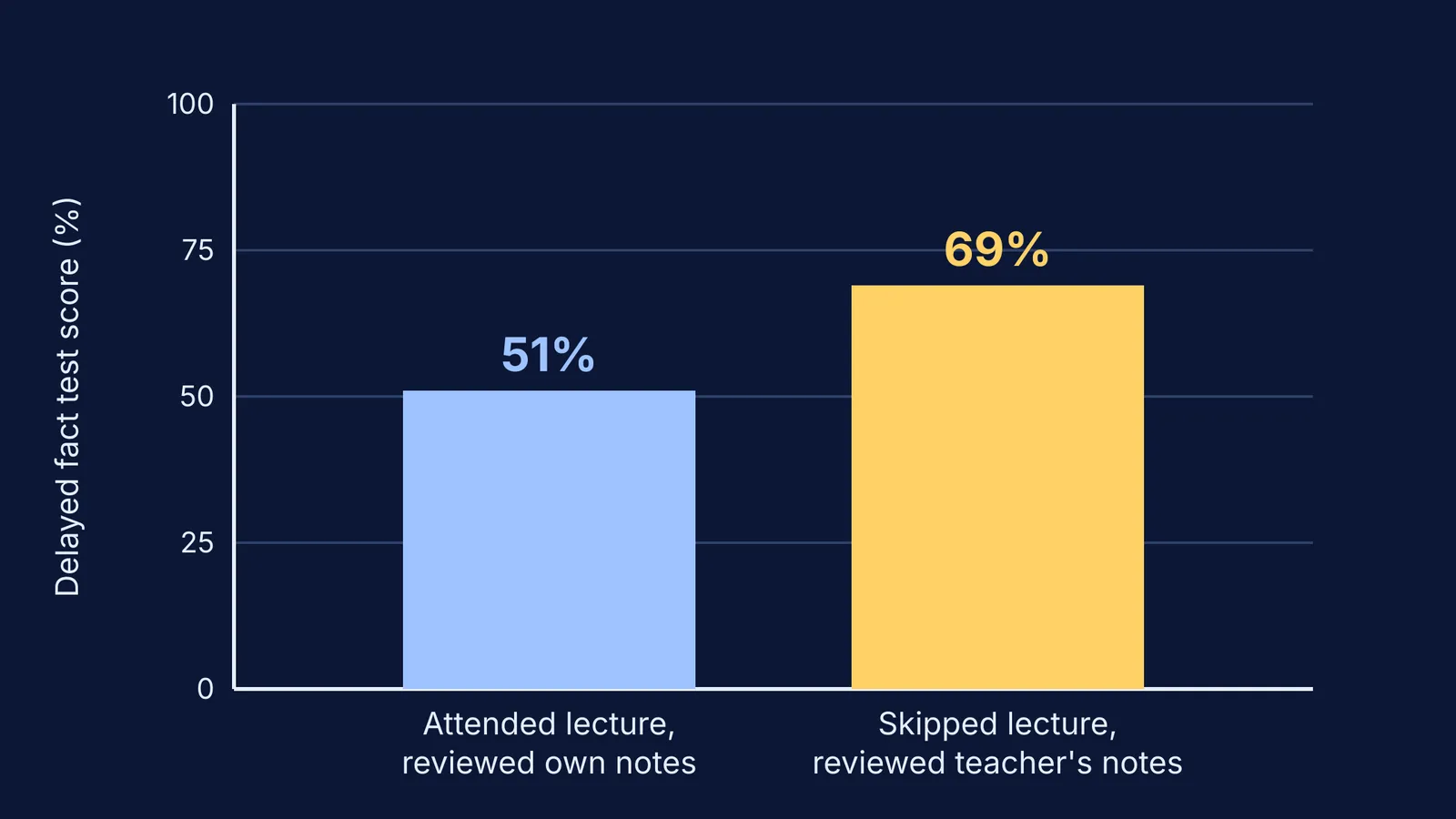
They can fill gaps. In a 1985 review of note-taking studies, educational psychologist Kenneth Kiewra reported that students' own lecture notes captured anywhere from 11% to 70% of the critical ideas in a lecture (Kiewra, Educational Psychologist, 1985). In one study he described, students who skipped the lecture but reviewed the instructor's full notes scored 69% on a delayed factual test. Students who attended, took notes and reviewed their own scored 51%.
The same review found that students who reviewed both their own notes and the instructor's full set usually did best of all.
There is a catch. Those notes were written by the instructor who gave the lecture, to match it. A topper's notes were written by a student, for their own gaps, sometimes years ago. They can carry errors, skip steps the topper found obvious and miss syllabus changes. Before you trust any set, compare its chapter list with the current syllabus on the official JEE Main website or NEET-UG website.
What can't topper notes do for you?
They won't make you better at solving problems. In Kiewra's own studies, reviewing the instructor's notes improved scores on factual tests, but in no case did it make a difference to higher-order learning such as application, analysis or problem solving (Kiewra, 1985). Many JEE and NEET questions ask you to apply ideas to problems you have not seen before, which is that second kind of learning.
They also tempt you into the weakest kind of study. A major review of 10 learning techniques rated rereading and highlighting as low utility. It rated practice testing and spacing your study out over time as high utility (Dunlosky and colleagues, Psychological Science in the Public Interest, 2013). Neat notes invite rereading.
Rereading also feels more useful than it is. In one experiment, students who restudied a passage did better on a test 5 minutes later. But students who had practised recalling it remembered substantially more after 2 days and after 1 week. Restudying also made students more confident that they would remember (Roediger and Karpicke, Psychological Science, 2006).
When are topper notes worth buying?
Buying or downloading a set makes sense if:
you already have your own notes and want to find what you missed
you missed classes for a chapter and need a complete outline to catch up
the set matches the current syllabus and you can check it against NCERT
you will test yourself from it, not just read it
Skip it, or wait, if:
you are hoping it will save you from making notes of your own
you already own sets you have not opened
it is a blurry scan you cannot check for errors
the money would do more as a test series or a book of practice problems
How do you use topper notes alongside your own?
Treat them as an answer key for your notes, not as a textbook. Here is a five-step plan for one chapter, say rotational motion.
Make your own notes first, from class and NCERT, in your own words. Keep them short.
Close everything and write down all you remember on a blank page, as in the blurting method for revising from a blank page.
Open the topper's notes and mark what you missed: a condition for the parallel axis theorem, a sign convention for torque, a common trap. Add each gap to your notes in your own words, in a different colour.
Turn the topper's worked examples into questions. Cover the solution, attempt it, then compare.
A few days later, blurt the chapter again and solve a fresh set of problems with both sets of notes closed.
If step 3 turns up an idea you don't understand, not just a line you forgot, learn it properly instead of copying it. The Fermi Concept Library covers every concept in physics, chemistry, biology, mathematics and computing, each with its own lesson. If you can follow the topper's solution but can't reproduce it, the Fermi Problem Library has worked problems with a step-by-step solver that explains the reasoning rather than printing an answer.
The same borrow-and-adapt rule applies to everything else toppers share, from CBSE topper answer sheets to a topper's daily timetable.
What should parents ask before paying for notes?
Ask your child to show you one chapter of their own notes and tell you what is missing from it. If they can name the gap, a good set of notes may fill it. If they can't, the money is better spent on practice and the time to do it. One line that works: "Show me where your notes are thin, and tell me how you'll test yourself from the new ones."
Then let them make the call.


