On this page
A drop year means spending the year after Class 12 preparing full-time for JEE Main, JEE Advanced or NEET-UG instead of starting college. It can work. It can also become twelve more months of the same scores. The difference is often whether the numbers were checked before deciding. Sit down with a parent, a notebook and your last eight full-length mock scores.
Can I still take the exam next year?
Check eligibility first; the rules differ by exam and can change yearly.
JEE Main: the JEE (Main) 2027 information bulletin sets no age limit and admits candidates who passed Class 12 in 2025 or 2026, or are appearing in 2027.
JEE Advanced: for 2026, the official JEE Advanced eligibility page allowed a maximum of two attempts in two consecutive years. Recheck it when the 2027 rules are out.
NEET-UG: the NEET (UG) 2026 information bulletin states there is no upper age limit; you must be 17 by 31 December of the exam year.
Parents can find more detail in our guide to NEET eligibility and attempts.
Is my mock trend good enough to drop?
Your trend matters more than your best score. Write your last eight mock scores in date order, then:
Average the first three.
Average the last three.
Divide the difference by the months between them. That is your monthly gain.
Subtract your recent average from your target. That is your gap.
Divide the gap by the monthly gain. That is the months you need at your current pace.
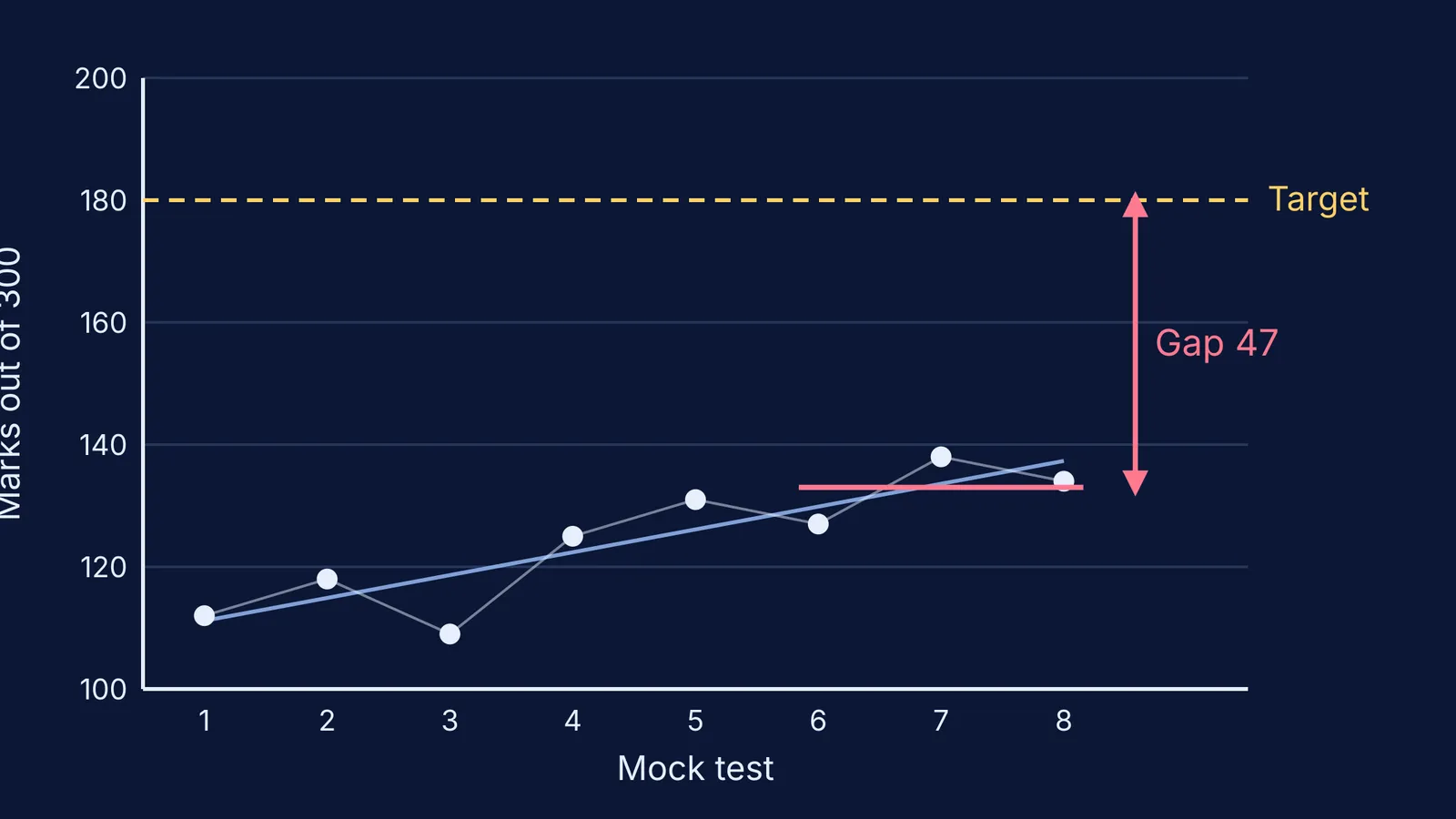
Worked example (made-up numbers). A JEE Main aspirant takes a mock every two weeks and scores 112, 118, 109, 125, 131, 127, 138 and 134 out of 300. The first three average 113 and the last three average 133, about ten weeks apart, so the gain is about 9 marks a month. Against a target of 180, the gap is 47 marks: about five and a half months at that pace. JEE Main 2027 runs 20-28 January and 2-7 April: from a July start, that is about six months to January and nine to April. Tight for January, within reach for April.
If your first and last averages are within a few marks of each other, find the cause before deciding: sort every lost mark in two recent mocks into "didn't know the concept", "knew it but used the wrong method" and "careless error or ran out of time".
If most marks land in the wrong-method bucket, the Fermi Problem Library has worked problems with a step-by-step solver that explains the reasoning, so you can see where your method goes off track.
What does a drop year cost?
With your parents, write down three real figures: coaching or test-series fees, living costs if you would move cities, and the cost of starting college a year later.
Then add how the last year felt. If you were exhausted or low for weeks, say so before deciding. A school counsellor or doctor can help, and Tele MANAS, the government's tele-mental-health service, offers 24x7 support on the toll-free number 14416.
What is my backup if the second attempt goes badly?
Write plan B before the drop year starts, not after the result. The NTA's NEET (UG) 2026 result press release reports that close to 20 lakh candidates appeared and 11.21 lakh qualified. The same release says over 93% of the 138 candidates who scored above 690 out of 720 were taking NEET (UG) for the first time. That describes top scorers, not your own odds.
For plan B, list:
One degree you would honestly be glad to study, and its application dates.
Other entrance exams you could take in the same year.
How long each option stays open to you.
Parents weighing this can read our piece on whether to allow a gap year after Class 12.
How do I decide by a fixed date?
Pick a date now and write it at the top of the worksheet: for example, two weeks after your last result and before the first admission or counselling fee deadline. On that date, decide.
Agree the rule in advance:
Drop if the trend is rising, the gap closes well before your exam date at your current pace, the money is agreed and the backup is written down.
Hold off if the trend is flat: fix the method, then re-test.
Take the backup if you are not eligible next year or the money is not agreed.
A script for the talk at home: "My last three mocks average 133, up about 9 a month. Reaching 180 needs around five and a half months at this pace. The cost is what we wrote down, and my backup is this course. Can we decide on our fixed date using this rule?"
If you do drop, plan the first week before it begins; this hour-by-hour drop year timetable is a practical start. Fermi's AI tutor works out what you already know and builds a plan for the session, so each study day starts with a clear next step.