

On this page
When your teenager asks to take a year off after Class 12, parents often worry about lost academic momentum, social isolation, and college admissions. In India, taking time out after school has historically meant an intensive coaching "drop year" for competitive exams like JEE or NEET. Yet more students now seek time to decompress after testing, explore emerging interests before picking a degree, or build an independent portfolio.
Does taking a gap year after Class 12 help or hurt?
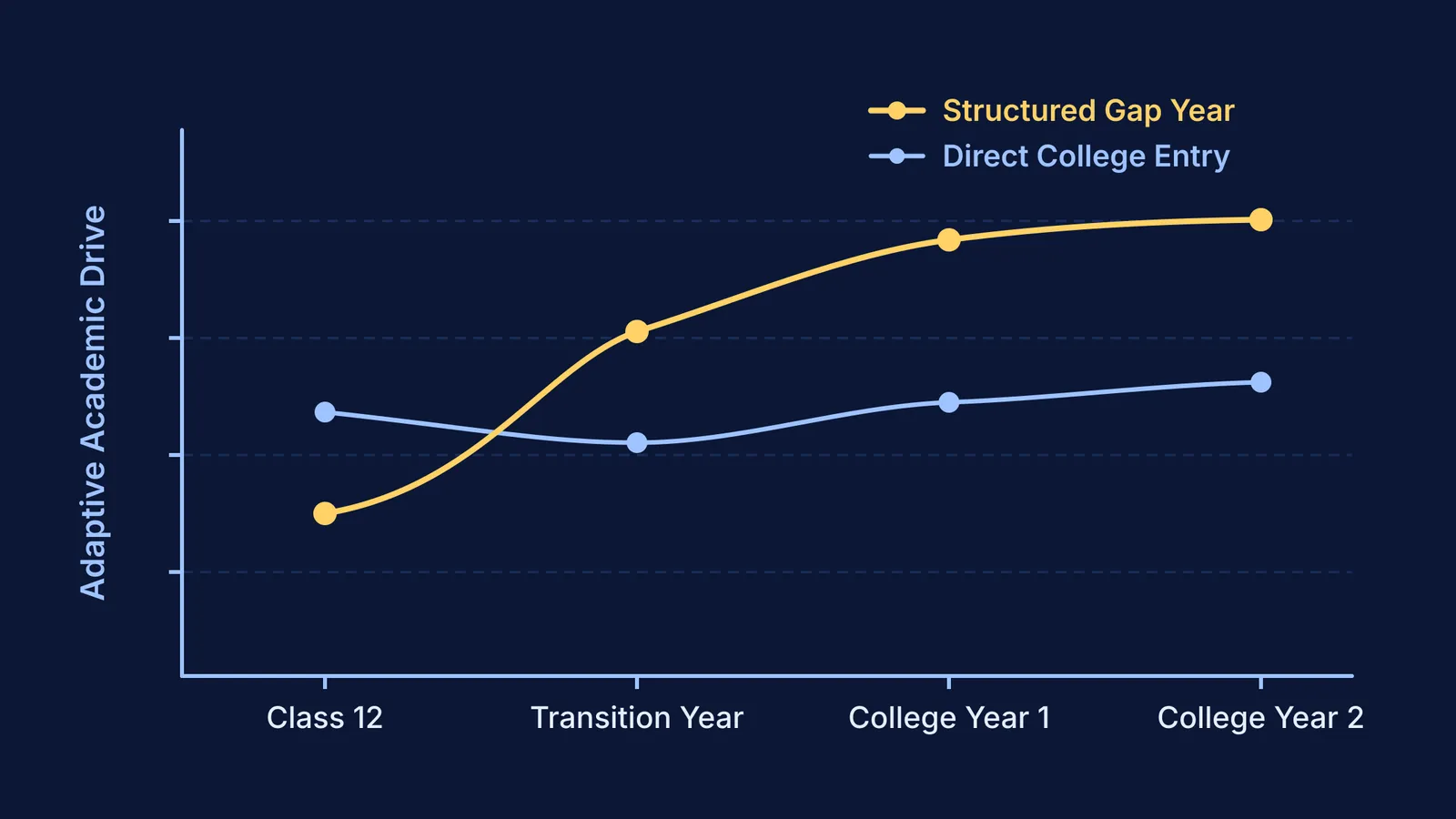
Educational psychology offers reassuring evidence when the break is intentional. In a study published in the Journal of Educational Psychology, researcher Andrew J. Martin tracked 2,502 high school students and 338 university undergraduates to evaluate time out after school. Martin found that while students planning a break often showed lower school motivation, those who took time out reported significantly higher adaptive academic behaviors at university—including better planning, superior task management, and stronger persistence.
However, how students spend that time matters decisively. A longitudinal study of 384 students in Finland and 2,259 in Australia published in Developmental Psychology by Philip D. Parker and colleagues found that gap-year youth experienced significantly lower transition stress than direct university entrants. However, direct entrants maintained higher goal commitment and effort, while gap-year takers in Australia were more likely to drop out of university degrees later. Taking time out eases short-term stress, but without sustained academic habits, it can undermine degree completion.
What questions should parents ask before saying yes?
Instead of an immediate refusal or unconditional approval, sit down for a deliberate conversation. Ask these five diagnostic questions to separate healthy self-direction from avoidance:
"Are you running toward an objective or away from exhaustion?"
Distinguish acute burnout from genuine exploration. If your child is exhausted after board exams, they may need four weeks of rest rather than an entire year off. A viable gap year requires moving toward a clear objective, such as building a portfolio, learning programming, or mastering syllabus gaps.
"What will a normal Tuesday at 11:00 AM look like?"
Without morning school bells and attendance registers, days easily slip into late waking and screen scrolling. Ask your child to map out their target weekday routine before the year begins.
"How will you measure progress every three months?"
Twelve months pass quickly. A structured gap year requires quarterly milestones: completed mock tests, coding projects, internship certificates, or language credentials.
"What are our family financial and domestic rules?"
Agree on expectations early. Who covers test fees, books, or courses? What household responsibilities will your child take on living at home full-time?
"What is the non-negotiable re-entry timeline?"
A gap year needs a firm end date. Mark entrance registrations, university portals, and application deadlines on a shared family calendar before August.
How do you structure a purposeful gap year?
A purposeful gap year mimics professional life rather than an endless holiday. Research on autonomy-supportive parenting shows that teenagers sustain motivation best when parents act as supportive consultants rather than micro-managers.
Divide the twelve months into four operational quarters:
Quarter 1: Rest and Diagnostic Baseline. Allow three weeks of rest to recover from exam fatigue. Then spend two months identifying foundational subject gaps. The Fermi Concept Library covers every concept in physics, chemistry, biology, mathematics and computing, each with its own lesson and its place in the map.
Quarter 2: Deep Immersion and Applied Work. Shift into daily deep-work blocks for apprenticeships, internships, portfolio projects, or exam prep. For competitive exams, this phase aligns with habits in our guide to supporting your child through a JEE drop year. When tackling difficult problem sets without a classroom teacher, students can turn to Fermi's AI tutor, which works out what they already know and builds a plan for the session.
Quarter 3: Applications and Mock Sprints. University portals, entrance registrations, and scholarship applications open between December and March. Finalize essays, compile creative portfolios, and start regular timed mock exams.
Quarter 4: Testing and Transition. Sit for target entrance exams, complete admissions counselling, and re-establish collegiate routines. By June, your teen should hold a confirmed admission offer and renewed momentum.
To maintain accountability, practice teaching your child to plan their time through short weekly check-ins where they review progress and set upcoming priorities.
What are the college admission rules for gap years in India?
A frequent worry among Indian parents is that universities will penalize applicants with a gap year. In reality, higher education institutions across India routinely admit students after a gap year without penalty.
For admissions through central counselling or state universities, colleges standardly require a "Gap Certificate" (or Gap Year Affidavit). This is a simple declaration on non-judicial stamp paper, notarized by a notary public, confirming that the student was not enrolled elsewhere and has no criminal cases pending.
Entrance examinations also accommodate gap years cleanly. For instance, the National Testing Agency allows candidates to sit for JEE Main in three consecutive years from passing Class 12, while NEET-UG has no upper age limit or attempt cap. Preserving Class 10 and 12 mark sheets and certificates ensures a smooth transition back into formal higher education.


