

On this page
You gave the first few papers of your test series, then practicals, a bad score or one busy fortnight got in the way. Now four or five tests have piled up, and each skipped one makes the next harder to open. This plan gets you back this week: rejoin at the current test, cover what you missed in short slots, and fix a test day you can keep.
Should you attempt all the tests you missed first?
No. Start with the test that is due now. Clearing five old papers first means a week of full-length sittings before you are "allowed" back, and that week rarely comes.
Tests are also more than a way to check your marks. In a study published in Psychological Science, Henry Roediger and Jeffrey Karpicke found that students who took recall tests on a prose passage remembered substantially more two days and a week later than students who restudied it the same number of times, even though restudying made students more confident. That is the testing effect: taking a test helps you remember the material, not only measure what you know. So a test you actually sit this Sunday is worth more than a perfect catch-up plan you never start.
Keep the missed papers as question banks for your review. Our month-by-month guide on when to switch from chapter tests to full mocks shows where they fit.
How do you restart a test series after a break?
Sit this week's test as it is. Attempt only what you have studied and leave the rest. Your score will probably drop. Treat it as your starting point, not a verdict on you.
List the missed syllabus. Open the series schedule and write down the chapters the missed tests covered.
Review in short daily slots. Give 30 to 40 minutes a day, one chapter every two or three days. Start each slot by attempting ten questions from that chapter's missed paper before you open notes, then read only what you got wrong.
Fix one test day and time. Same day, same start time, phone in another room. Put it on the family calendar.
If a missed chapter feels new rather than rusty, look it up in the Fermi Concept Library, where each concept has its own lesson and its place in the map. When you keep getting a question wrong by the same method, the Fermi Problem Library has a step-by-step solver that explains the reasoning rather than printing an answer.
What does a restart plan look like week by week?
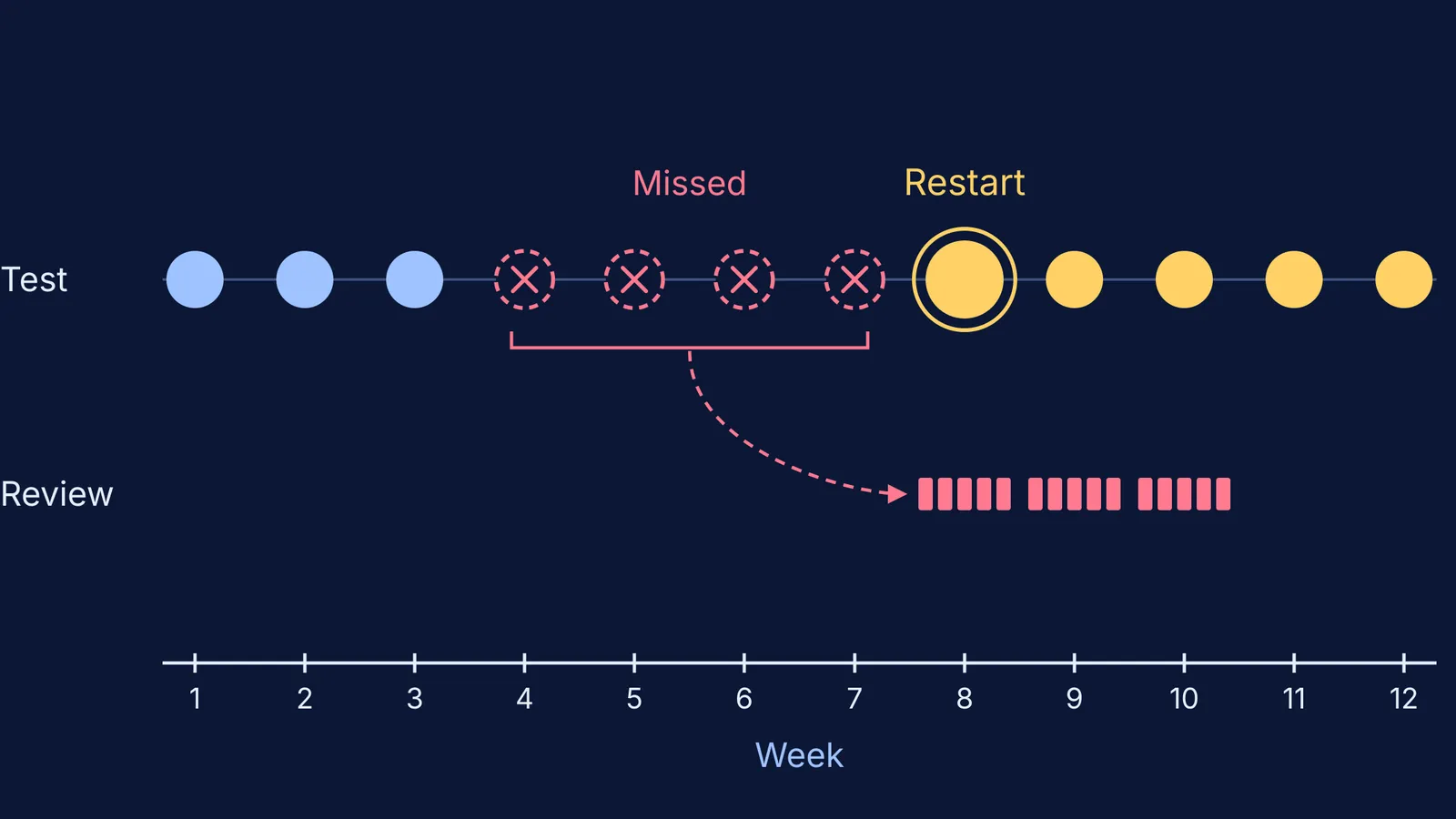
Say your JEE series runs a test every Sunday, and you gave tests 1 to 3 but missed tests 4 to 7. Those four tests covered six chapters: two each from physics, chemistry and maths.
Week 8, Sunday: sit test 8 with everyone else. Note which questions came from the six missed chapters.
Weeks 8 to 10, Monday to Friday: one 35-minute review slot a day, one chapter every two or three days, rotating subjects. Six chapters fit in about three weeks.
Week 11: sit test 11 and check whether questions from the six chapters now go better than in test 8.
If school or coaching takes most of your weekdays, our plan for weekly coaching tests alongside school shows where those slots can go, and our guide to buffer time in a study timetable helps you leave room for the week that goes wrong.
What if you miss a test again?
You will, at some point, and it matters less than it feels. In a study of habit formation by Phillippa Lally and colleagues, 96 volunteers chose a daily behaviour to repeat in the same context for 12 weeks. Missing one opportunity did not materially affect how the habit formed. The same study found the time participants took to get close to their peak automaticity ranged from 18 to 254 days, so don't expect the routine to feel easy within a fortnight.
What helps is deciding in advance what you will do when a test day goes wrong. A meta-analysis by Peter Gollwitzer and Paschal Sheeran pooled 94 independent tests and found that if-then plans, which link a specific situation to a specific action, had a medium-to-large effect on reaching goals (d = 0.65). Your backup slot is that plan: one missed Sunday becomes a Monday evening test, not the start of another five-week gap.
What can parents say to help a child restart?
Skip the post-mortem on why the tests stopped. Try:
"Which test is due this week? What time do you want to sit it?"
"Don't worry about the score this time. Let's see which chapters it shows."
If the break came from something heavier than a busy month, such as constant dread, sleep trouble or not wanting to talk to anyone, talk to a school counsellor or doctor. You can also call Tele MANAS, the government's free mental health helpline, on 14416.
Open your series schedule now, find this week's test and write its day and time where you will see it.


