

On this page
Weekly coaching tests arrive whether or not school has a unit test or project due the same week. The answer is not a Saturday-night cram: it is three short evenings of testing yourself after school work, and one honest review once the marks come back.
Why is testing yourself better than rereading?
Rereading feels productive, but mostly it makes the page look familiar. In a 2006 experiment by Henry Roediger and Jeffrey Karpicke, students who reread a passage did better on a test 5 minutes later, but students who had practised recalling it remembered substantially more when tested 2 days or 1 week later (Psychological Science). The rereaders also felt more confident, which is the trap.
A 2017 meta-analysis by Olusola Adesope and colleagues found that practice tests were more beneficial for learning than restudying and every other comparison condition examined (Review of Educational Research). A 2013 review of ten study techniques rated practice testing and distributed practice, meaning study spread out over time, as the two of high utility; rereading and highlighting rated low (Dunlosky and colleagues, Psychological Science in the Public Interest).
What should a three-day plan before a weekly test look like?
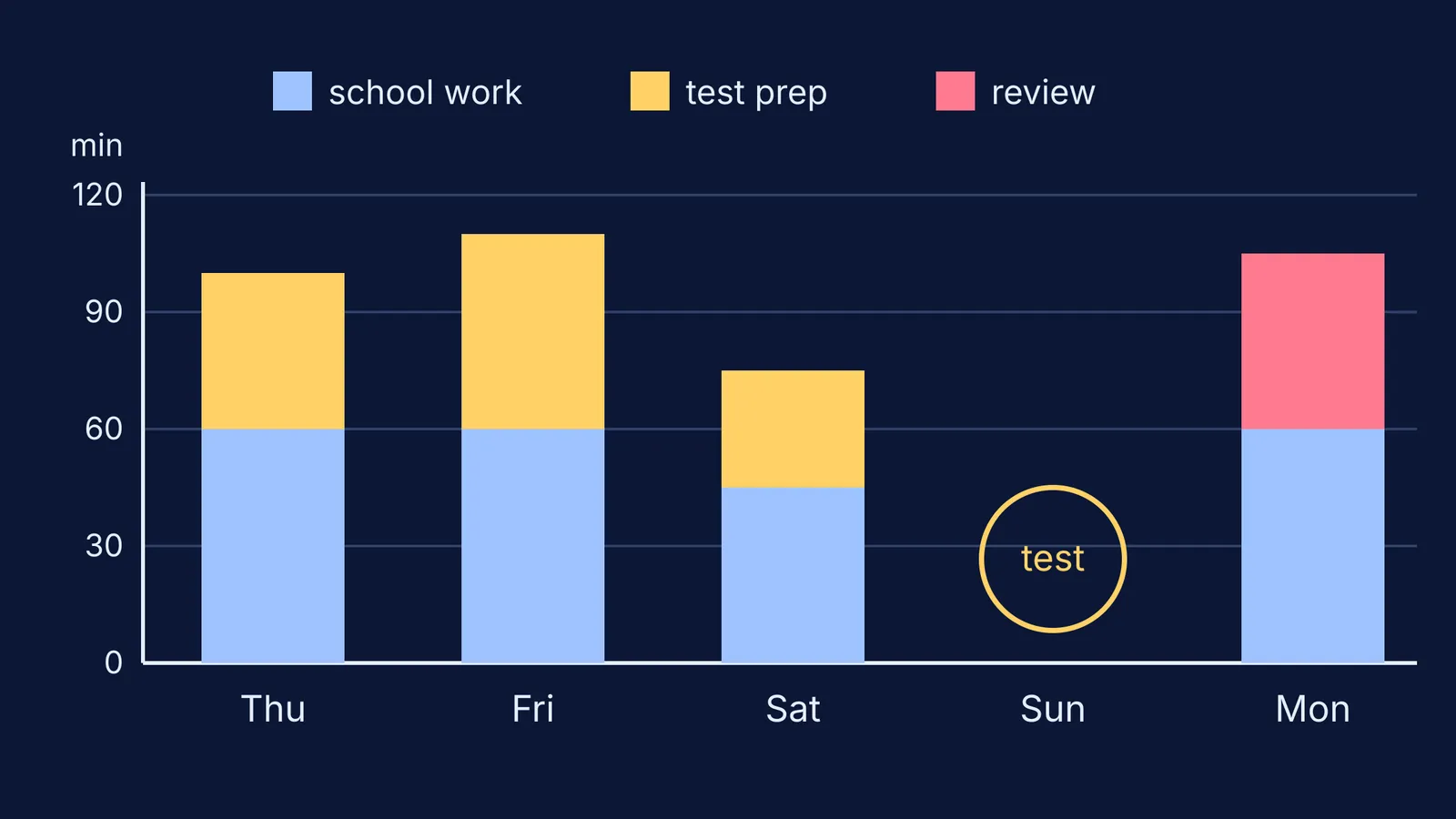
The plan spreads practice across three evenings, following the Dunlosky review on distributed practice. Assume a Sunday test on this week's chapters. Each evening, finish school homework first; it is due sooner.
Thursday, 40 minutes: find the gaps. Check the exact syllabus on your coaching schedule. For each topic, close the book and spend 5 minutes writing what you remember: formulas, reactions, definitions, one diagram. Then mark what you missed in a different colour. That is your revision list.
Friday, 50 minutes: mixed, timed practice. Do 15 to 20 questions from this week's chapters plus 3 to 5 from older chapters. Check them; retry wrong ones before reading solutions.
Saturday, 30 minutes: re-test the gaps only. Write your formula sheet from memory, then re-attempt Thursday's marked items and Friday's wrong questions. No new chapters. Sleep at your usual time.
If school has a test the same week, shrink each block rather than dropping it. For a crowded week, see time blocking for students juggling school and coaching.
What should you revise for a weekly coaching test?
Revise in this order, and stop when time runs out:
Topics where Thursday's recall was blank or wrong.
Question types from your coaching sheets or DPPs that you got wrong in class.
Formulas, units or reactions you tend to mix up.
A few older-chapter questions, so this week does not push out last month.
If an idea itself is shaky, read its lesson in the Fermi Concept Library, which covers each concept in physics, chemistry, biology and mathematics, then test yourself on it again.
How do you review weekly test results?
Janet Metcalfe's 2017 review of research on learning from errors found that making errors and then getting corrective feedback helps learning, and that analysing the reasoning that led to a mistake is crucial (Annual Review of Psychology). The review suggests making and correcting errors in low-stakes situations, and a weekly test can be one.
Within 2 days of getting the paper back, spend about 45 minutes sorting every wrong or skipped question into one of four buckets:
Concept gap: you did not know the idea. Fix: relearn it, then solve three fresh questions on it.
Wrong method: you knew the topic but picked the wrong approach. Fix: write one line on how to recognise this question type next time.
Careless slip: a sign, unit, calculation or misread. Fix: name the slip and add a check step for it.
Time or skipped: you never reached it or avoided it. Fix: solve it untimed, then decide your question order for the next test.
A worked example: you lose marks on six physics questions. Two are concept gaps in torque, three are wrong methods in work and energy, one is a unit slip. Rereading both chapters would eat the week. Instead, relearn torque in one short session, write the line "if the question asks for a speed and not a time, try work-energy before kinematics", and redo all six on Wednesday without the solutions.
For wrong-method mistakes, the Fermi Problem Library has worked problems with a step-by-step solver that explains the reasoning rather than printing an answer, so you can compare its route with yours.
Track the bucket counts week by week; if careless slips stay biggest, your checking needs work. Add fixed questions to a spaced revision schedule, and read using coaching rank lists without losing motivation before opening the leaderboard.
What if weekly tests are making you anxious?
Some nerves are normal. If worry lasts for weeks, affects your sleep or eating, or you feel low most days, talk to a parent, a school counsellor or a doctor. Tele MANAS, the Health Ministry's free 24x7 mental-health helpline, is on 14416 or 1800-891-4416 (details).
Tonight, count back three evenings from your next test and write the blocks into your timetable.


