

On this page
Your coaching teacher starts Laws of Motion on Monday. Should you read the whole chapter on Sunday night? Probably not. A short preview helps. A full read-ahead costs you an evening, and it can leave you feeling you know the chapter before you actually do.
Should you read the chapter before the teacher teaches it?
Read a little, and read it in a particular way. Before class, your goal is not to learn the chapter. It is to build a rough map and a list of questions, so the lecture has somewhere to land.
Educational psychologists call this kind of map an advance organiser. A meta-analysis of 135 published and unpublished studies found that advance organisers had a facilitative effect on both learning and retention (Luiten, Ames and Ackerson, 1980). A preview is a cheap boost, not a replacement for class.
Guessing before you are taught also helps. In five experiments, people who tried to answer questions about a passage before reading it remembered more later than people who simply got extra reading time, even on the questions they first got wrong (Richland, Kornell and Kao, 2009). A 2023 review found that this pretesting effect has been shown with texts, videos and lectures, and that it can help when learners get a chance to study the correct answers afterwards (Pan and Carpenter, 2023).
Why can a full read-ahead backfire?
It feels like learning when it isn't. In a survey of 177 college students, most said they reread their notes or textbook and relatively few tested themselves. The researchers propose that many students experience "illusions of competence" while studying (Karpicke, Butler and Roediger, 2009). A full read before class may do the same: in the lecture everything looks familiar, so you may stop listening closely.
Reading is not always the best preparation. In three classroom studies, college students who analysed contrasting cases before a lecture made more accurate predictions about a week later than students who summarised a relevant text and then heard the lecture (Schwartz and Bransford, 1998). Comparing cases first prepared them better than reading did.
It eats time you need after class. An hour of reading ahead is an hour taken from practising problems on what was taught yesterday.
What should a 10-minute preview include?
Use this four-step preview the night before, or on the way to class:
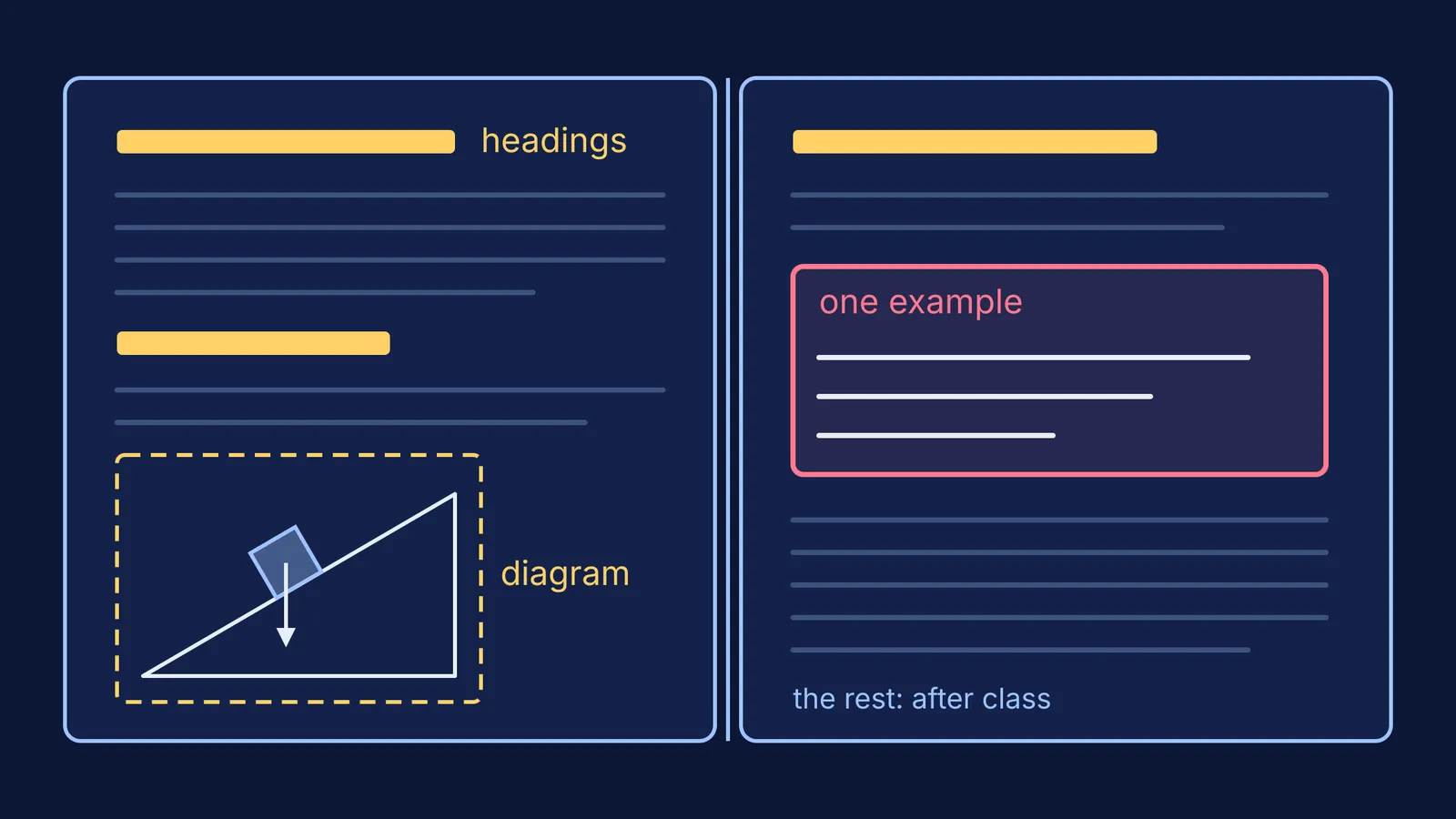
Headings (2 minutes). Read only the section headings and bold terms. Write them as a skeleton on one notebook page, leaving space under each.
Diagrams (3 minutes). Look at each figure and its caption. Ask yourself what is changing in it and what stays fixed.
One example (4 minutes). Pick the first solved example. Cover the solution and try the first step yourself. Getting it wrong is fine. The attempt is what counts.
Questions (1 minute). Write down two questions you could not answer, and take them to class.
Stop there. Don't make notes from the text, highlight or try the exercises yet.
What does a preview look like for a real chapter?
Take friction in Class 11 Laws of Motion. Your skeleton might read: friction, static and kinetic, inclined plane, circular motion on a road. The diagram of a block on a slope raises a question: which way does friction point if the block is not moving? The solved example asks for the angle at which the block just starts to slide. You write the forces along the slope and get stuck on whether to use static or kinetic friction.
That stuck point is your first question for class. When the teacher gets there, you will be listening for one specific answer. A full read-ahead can dull exactly that kind of attention.
If a heading names an idea you have never met, the Fermi Concept Library gives every concept in physics, chemistry, biology, mathematics and computing its own lesson and its place in the map, so you can see what it builds on. When a figure is hard to picture from a still diagram, the Fermi Simulation Lab has interactive simulations for ideas that are easier to see than to read.
What should parents ask instead of "Did you read the chapter?"
Try this: "What were your two questions before class, and did the teacher answer them?" It checks the preview without demanding hours of reading, and gives your child a reason to speak up in class.
After class, the order flips: recall first, then reread only what you missed. Our guide to a five-minute recall before each class and our plan for what to do after coaching classes at night show how to fit both into a week. If you want help writing the step 4 questions, see how to use AI before class to preview a chapter.


