

On this page
You walk through the door at 8 PM after a long day of school and coaching classes. Your bag is heavy, your brain is tired, and the last thing you want to do is open a textbook. The temptation is to drop the bag in a corner and put off the day's topics until the weekend.
But cognitive science suggests that what you do in the two hours after returning home is the most critical study block of your day.
Delaying your revision forces you to relearn the material from scratch, turning exam prep into an uphill battle. A structured evening routine that includes eating, a short break, a focused homework block, and a firm stopping time uses your brain's natural biology to lock in what you learned.
Why does a same-day review matter?
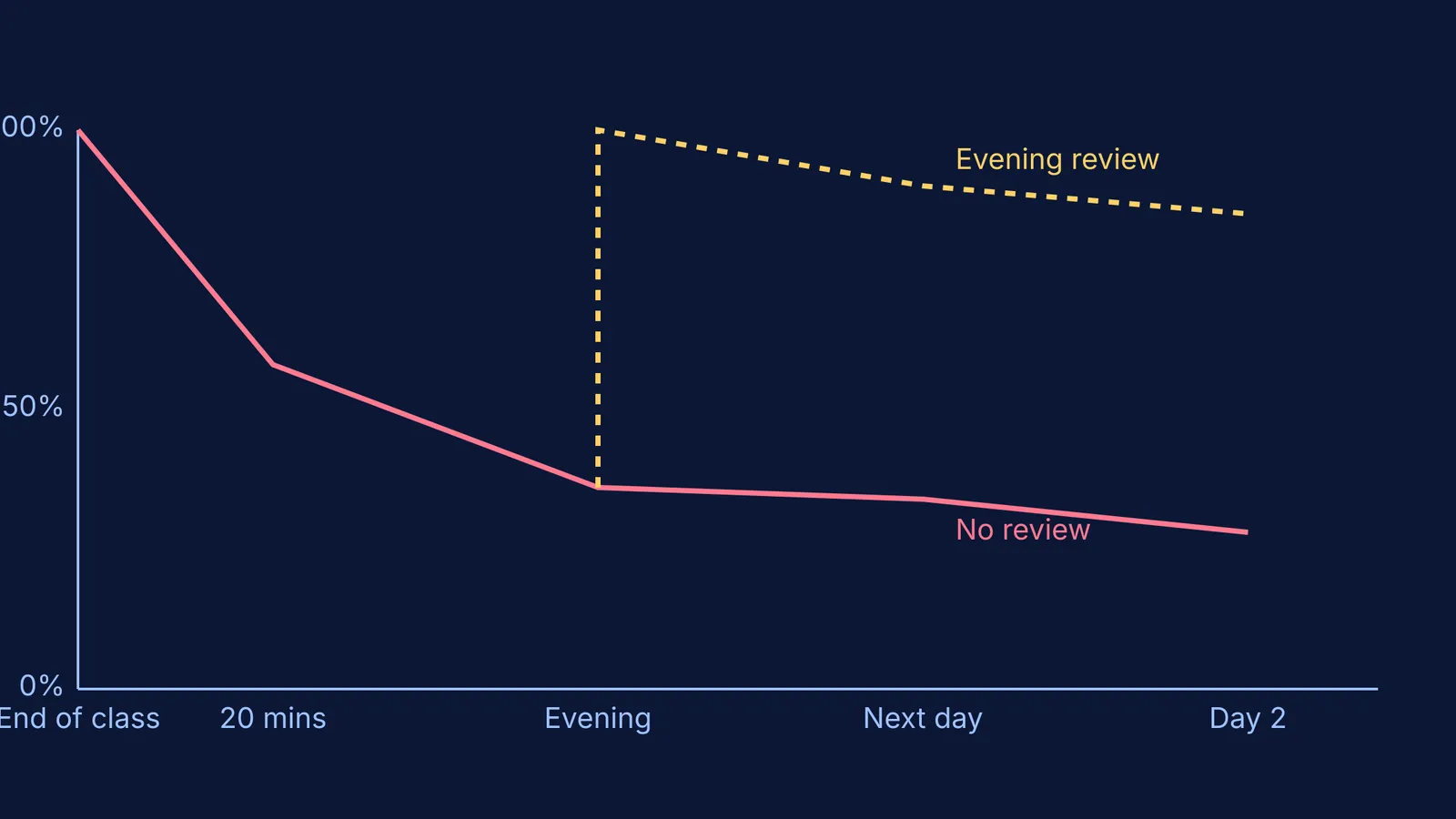
The most critical part of an evening routine is reviewing what you just learned. According to Hermann Ebbinghaus's classical retention curve, 42% of newly learned information is forgotten within 20 minutes, and 66% is lost within 24 hours (Murre & Dros, 2015). That means if you learn the mechanisms of rotational motion at 5 PM and do not look at your notes until Sunday, your brain has essentially discarded the lesson.
A same-day review resets this curve. By revisiting the material before you go to sleep, you signal to your hippocampus that this information is important, preventing it from being pruned as noise. This daily maintenance saves you dozens of hours of cramming before an exam because the knowledge is already securely stored in your long-term memory.
What to do after coaching classes at night?
Here is a practical, step-by-step evening routine to consolidate your learning without burning out.
Take a complete break. Do not start studying the minute you get home. Take 30 to 45 minutes to eat dinner and disconnect. Step away from your desk and avoid looking at screens if possible. This gives your brain time to transition out of the high-stress environment of the classroom.
The 20-minute active recall sprint. Before starting your homework, review today's classes. Do not simply reread your notes; rereading creates an illusion of competence where the text feels familiar but you cannot retrieve the facts on an exam. Instead, close your notebook and write down the core concepts from memory. Open your notes only to check what you missed.
The homework block. Spend the next 60 to 90 minutes applying the concepts to your assignments. This is when you should attempt numericals and problem sets, because active problem solving builds stronger neural pathways than passive reading. If you get stuck on a difficult question, the Fermi Problem Library has worked problems with a step-by-step solver that explains the reasoning rather than printing an answer.
Fill the concept gaps. If your active recall session revealed that you completely misunderstood the day's lecture, fix it immediately. Do not wait for a weekend doubt-clearing session. The Fermi Concept Library contains every concept in physics, chemistry, biology, mathematics and computing, each with its own lesson and its place in the map, so you can catch up the same night.
Why do you need a fixed stopping time?
It is common for JEE and NEET aspirants to pull all-nighters, sacrificing sleep for an extra hour of study. However, having a strict cutoff time—such as 11:30 PM—is one of the most effective study strategies you can adopt.
Memory consolidation is not a passive process. Research established that memory consolidation and reorganization actively happen during sleep (Stickgold & Walker, 2005). Their work shows that sleep stabilizes fragile new memories and integrates them into your existing knowledge network.
Cutting your sleep short to study more actively prevents your brain from saving the work you just did. When you stick to a fixed stopping time, you ensure you get the slow-wave and REM sleep required to turn today's coaching class into long-term knowledge. Rather than studying until exhaustion, decide in advance when the books close.
If you want to make this a daily habit, read our guide on building a study routine that lasts, or learn more about whether a morning or night study schedule works best for your chronotype.


