On this page
Someone had to design, test and print every biscuit wrapper, medicine strip and shampoo bottle in your home. Packaging technology trains those people. In India you can study it as a B.Tech, a diploma, or a postgraduate diploma after a science degree.
What do you study in a packaging technology course?
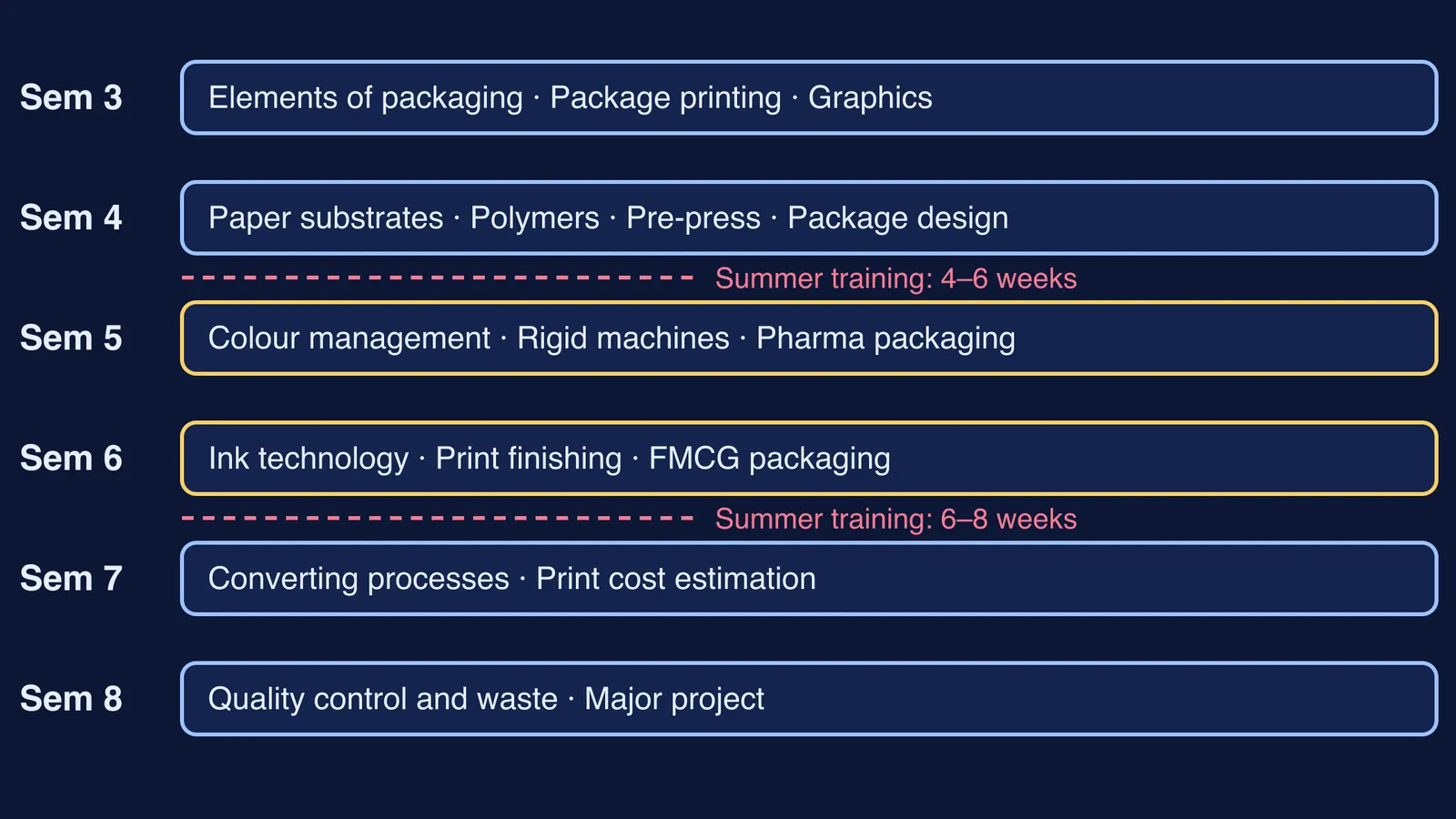
The B.Tech Packaging Technology scheme at Guru Jambheshwar University of Science and Technology, Hisar (batch 2025-29) lists these core subjects from the third semester:
Semester 3: elements of packaging, package printing processes, graphics design for packaging
Semester 4: paper substrates, polymers in packaging, pre-press technology, computer-based package design
Semester 5: colour management, rigid packaging machines, pharmaceutical and cosmetics packaging
Semester 6: ink technology, print finishing, FMCG packaging
Semester 7: packaging converting processes, print cost estimation
Semester 8: quality control and waste management, latest trends in packaging, a major project
Most core subjects come with a lab. The same scheme requires 4 to 6 weeks of industrial or research laboratory training after the fourth semester and 6 to 8 weeks after the sixth. Electives include digital printing, polymer processing and green printing.
How much chemistry and physics is in it?
More than most students expect, because packaging is judged on what it lets through. India's Food Safety and Standards (Packaging) Regulations, 2018 set the rules a packaging technologist works to.
Primary food packaging is packaging material in direct contact with food, according to the FSSAI regulations.
Plastic packaging must pass an overall migration limit of 60 mg/kg or 10 mg/dm² when tested as per IS 9845, the regulations say.
Printing inks used on food packages must conform to IS 15495, and the printed surface must not touch the food.
Newspaper must not be used to store or wrap food.
Migration means substances moving out of a material and into food. Testing it draws on school chemistry: polymers, solutions and concentration. Strength and barrier tests use the physics of stress, heat and gases. If those chapters feel shaky, the Fermi Concept Library gives each concept in physics, chemistry and mathematics its own lesson, so you can rebuild the basics before your first lab.
What is the scope in food, pharma and consumer goods jobs?
The jobs follow the rules. Under the FSSAI regulations linked above, every food business must get a certificate of conformity from a NABL-accredited laboratory for packaging that touches food. That means work in testing labs and in supplier quality teams.
Pharma packaging carries data as well as medicine. Under notification G.S.R. 823(E), the 300 drug brands listed in it must carry a barcode or QR code on batches made on or after 1 August 2023, the CDSCO's FAQ on the QR-code rule says. The code must hold the batch number, manufacturing and expiry dates and licence number, on the primary label or, if space is short, the secondary one. Someone has to design that artwork, choose a print method that scans reliably, and check the batches.
In consumer goods (FMCG), the work is about shelf appeal, cost and speed on the filling line. Typical roles across the three sectors:
Package development: choosing materials and formats
Quality control: testing seals, strength, migration and print
Print production and pre-press: getting colours and codes right
Converting and machine operations: lamination, cutting and filling lines
We found no official salary data, so ask each college's placement cell for the last three years of figures.
Which route after 12th fits you?
B.Tech in packaging or printing technology (four years, after 12th, usually with physics, chemistry and maths): check each university's current prospectus for eligibility and the entrance exam it uses.
Diploma first: a polytechnic diploma in packaging or printing may lead to a B.Tech through lateral entry, where your state allows it.
Science degree, then a PG diploma: the Indian Institute of Packaging, an autonomous body under the Ministry of Commerce and Industry set up in 1966, runs a two-year full-time Post Graduate Diploma in Packaging. Check eligibility in its current prospectus.
If food is what draws you, compare this with BTech dairy technology and the food safety officer route. If you like plants and processes more than products, read what you study in chemical engineering.
A one-weekend plan to test your interest
Saturday morning: collect five packs from home (snack, milk, medicine, detergent, cosmetic). Sort each layer into primary or secondary.
Saturday afternoon: find the FSSAI licence number, batch code and any QR code. Scan any medicine QR code and note what it shows.
Sunday: download one packaging syllabus and mark the subjects you would enjoy and the ones you would dread.
Sunday evening: write three questions for a college: which labs exist, where students did their summer training, and which companies hired from the last batch.
Start with the five packs in your kitchen this weekend.