

On this page
India produced an estimated 247.87 million tonnes of milk in 2024-25, up from 239.30 million tonnes the year before (Press Information Bureau, Basic Animal Husbandry Statistics 2025). A BTech in dairy technology trains you to process, test and package that milk safely, and much of it is applied physics and chemistry.
What is a BTech in dairy technology?
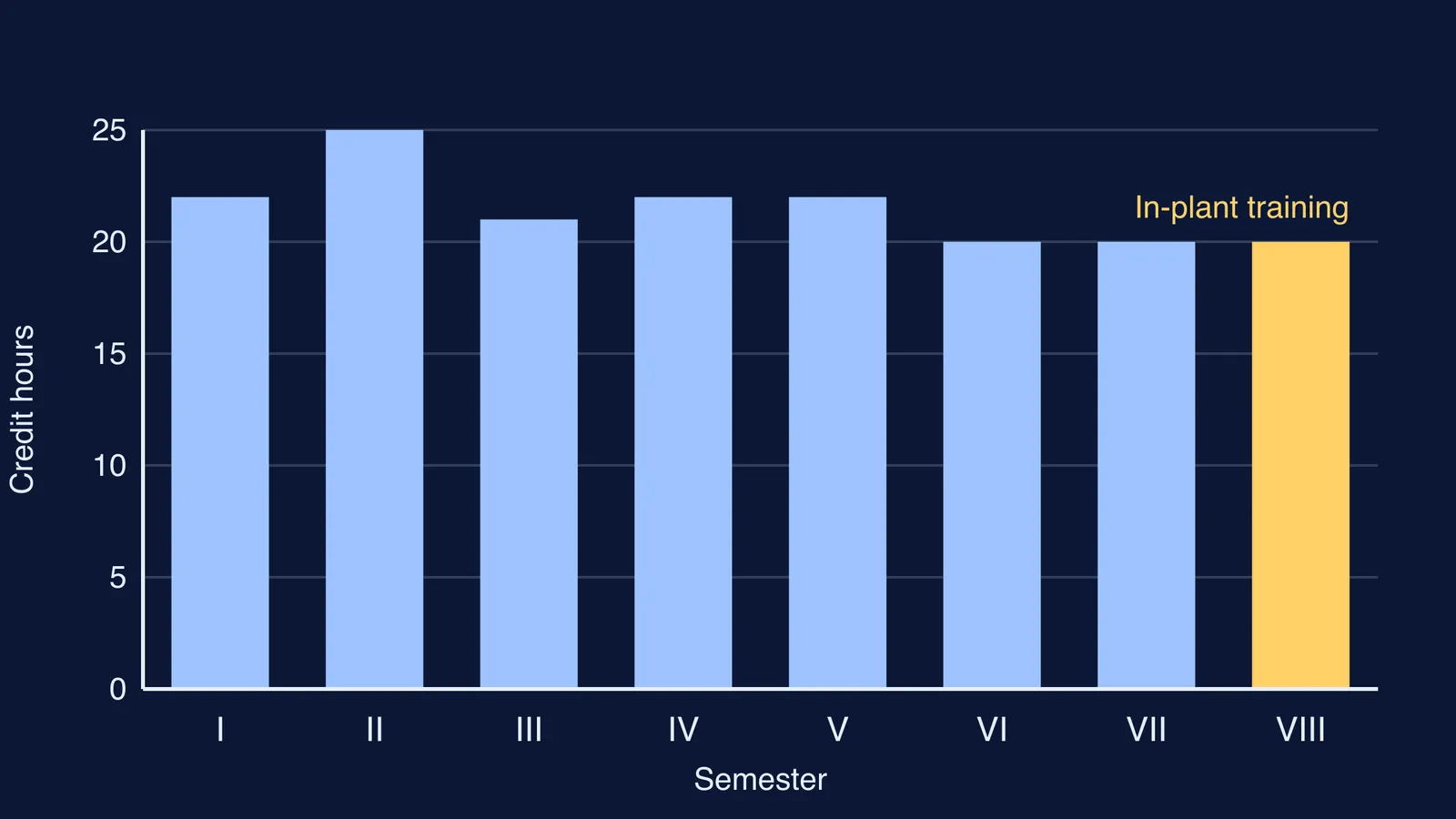
A BTech in dairy technology is a four-year degree in turning raw milk into safe products, built on engineering, chemistry and microbiology. ICAR's Sixth Deans' Committee model syllabus sets it at 172 credit hours plus 8 online credits over eight semesters (ICAR Sixth Deans' Committee report, Dairy Technology chapter). Students may exit with a UG Certificate after year one or a UG Diploma after year two, each after a 10-week internship. Universities adapt this model, so check your college's own course list.
What do dairy technology students study, year by year?
From the ICAR model syllabus:
Year 1, the science of milk: fluid mechanics, physical chemistry of milk, microbiology, market milk, heat and mass transfer.
Year 2, products and machines: thermodynamics, refrigeration, dairy engineering, traditional Indian dairy products, fermented products, cheese and ice cream.
Year 3, quality and scale: condensed and dried milks, quality and safety monitoring, chemical quality assurance, instrumentation and process control, packaging.
Year 4, the plant itself: food engineering, plant design and layout, sensory evaluation, then a whole eighth semester of in-plant training worth 20 credits.
Much of this is Class 11 and 12 physics at work: heat transfer and thermodynamics decide how a pasteuriser heats milk and how a cold store keeps it cold. If those chapters felt shaky, the Fermi Concept Library has a lesson for every concept in physics, chemistry, biology and mathematics, so you can fill a gap before first year.
How do dairy plants standardise milk fat?
Plants blend milk to hit a target fat percentage, often with the Pearson square. Say you have whole milk at 6.0% fat and skimmed milk at 0.5% fat, and you need 1,000 litres at 3.0% fat.
Subtract across the square: whole milk gets 3.0 − 0.5 = 2.5 parts; skimmed milk gets 6.0 − 3.0 = 3.0 parts.
Add the parts: 2.5 + 3.0 = 5.5.
Whole milk = 1,000 × 2.5 ÷ 5.5 ≈ 454.5 litres. Skimmed milk = 1,000 × 3.0 ÷ 5.5 ≈ 545.5 litres.
Check: (454.5 × 6.0 + 545.5 × 0.5) ÷ 1,000 ≈ 3.0% fat.
It is a weighted average, the same algebra as mixing solutions in chemistry. If setting up problems like this trips you up, the Fermi Problem Library has worked problems with a step-by-step solver that explains the reasoning rather than printing an answer.
How do you get admission to BTech dairy technology?
ICAR's Information Bulletin for CUET (ICAR-UG) 2026 lists B.Tech. Dairy Technology among 13 four-year bachelor's programmes filled through the exam, which covers 20% of seats at agricultural universities and 100% of seats at ICAR-NDRI Karnal (CUET (ICAR-UG) 2026 Information Bulletin). The bulletin asks for a Class 12 pass with at least three of physics, chemistry, mathematics, biology and agriculture, and at least 50% aggregate marks (40% for SC, ST, third gender and PwBD candidates).
Many universities add their own subject conditions, so read each university's rules. ICAR-NDRI's 2026 notice for additional paid seats says students admitted with a PCB background must, wherever applicable, complete a bridge course in mathematics (ICAR-NDRI admission notice, August 2026).
Our guide to getting into an agriculture university after Class 12 walks through the process. If you are weighing a broader degree, compare BTech and BSc food technology.
What jobs can you get after BTech dairy technology?
The courses map onto a few job families:
Production: running processing lines, evaporators, dryers and packing in milk plants and product factories.
Quality assurance: testing milk and products for composition and microbes.
Engineering and maintenance: refrigeration, cold storage, instrumentation and plant layout.
Food regulation: under rule 2.1.3 of the Food Safety and Standards Rules, 2011, a bachelor's degree in dairy technology is one of the qualifications for a Food Safety Officer, along with training specified by the Food Authority (FSSAI compendium of the FSS Rules). The same rules list dairy technology for Food Analyst posts, which also need at least three years of experience in food analysis and clearance by a board the Food Authority appoints.
Business and further study: the syllabus includes entrepreneurship development, and an MTech or PhD leads towards research and teaching.
The lab side overlaps with microbiology degree jobs in pharma and food safety.
Is dairy technology a good fit for you?
Ask yourself, ideally with a parent or teacher:
Did you enjoy heat, fluids and thermodynamics in physics?
Are you comfortable with chemistry practicals and growing and counting microbes?
Would you be happy on a factory floor, not only at a desk?
Does making curd, cheese and ice cream interest you more than pure theory?
Will you read each university's eligibility rules yourself?
If most answers are yes, put the syllabus and the CUET (ICAR-UG) bulletin side by side this week and shortlist three colleges.


