

On this page
A Food Safety Officer (FSO) is the government officer who walks into restaurants, dairies and factories, checks that they follow the law, and takes food samples for testing. In India the job is set up under the Food Safety and Standards Act, 2006, and the entry rules are short and specific. If you are in Class 11 or 12 with science, the decision that matters most is which degree you pick, and that comes years before any exam.
What does a food safety officer actually do?
The Food Safety and Standards Rules, 2011 (rule 2.1.3) list the duties. An FSO must:
inspect the licensed food businesses in their area as often as the Designated Officer sets
check that each business is keeping to the conditions of its licence, and report back
take samples of food they suspect breaks the law and send them for analysis, including after a complaint from a buyer
take samples for surveillance, survey and research, which are not used to prosecute anyone
in some situations, seize unsafe, substandard or misbranded food and seal the premises after taking a sample
The same rule says an FSO is a whole-time officer, and that no one with a financial interest in making, importing or selling food can be appointed. So it is a public job, and you cannot run a food business on the side.
Which degrees qualify you to become a food safety officer?
Under rule 2.1.3 of the Food Safety and Standards Rules, 2011, an FSO needs a degree in one of these subjects from a recognised university:
Food Technology
Dairy Technology
Biotechnology
Oil Technology
Agricultural Science
Veterinary Sciences
Biochemistry
Microbiology
Chemistry, but only at master's level
Medicine
The rule also accepts any equivalent qualification the Central Government notifies. On top of the degree, the officer must have completed training set by the Food Authority at an approved institute by the date of appointment.
If food technology appeals to you, our guide to the food technology degree and where it leads covers the course itself. If you prefer biology, read about what a microbiology degree leads to in labs, pharma and food.
How are food safety officers selected?
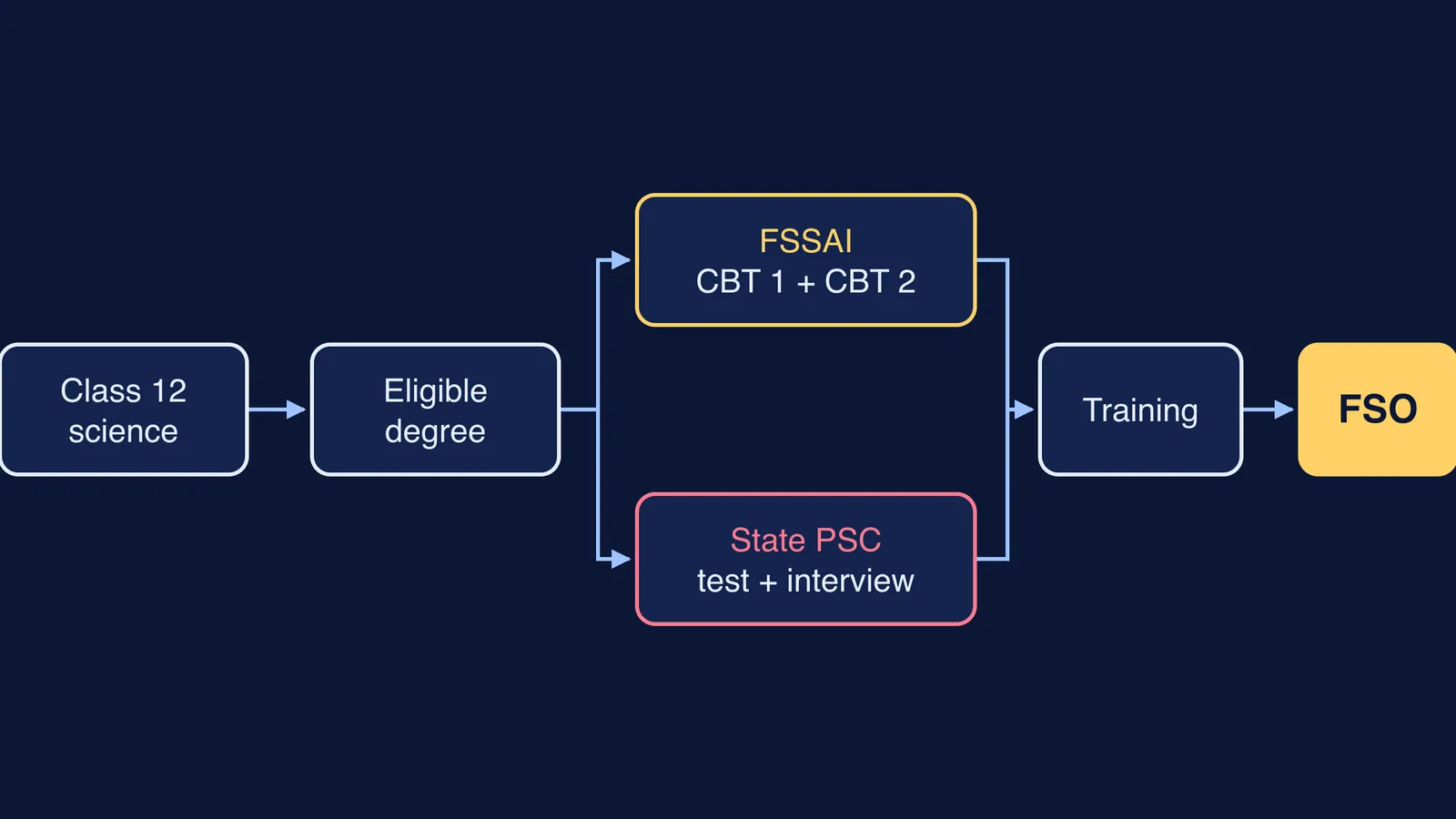
There are two main doors: central posts with FSSAI, and state posts filled by each state's public service commission or health department. Both recruit through advertisements, so the numbers below describe past rounds, not a promise about the next one.
Central (FSSAI). In FSSAI's direct recruitment advertisement DR-04/2021, the Central Food Safety Officer post had 37 vacancies at Pay Level 7, with an age limit of 30 on the closing date. Selection was two computer-based tests, Stage 1 and Stage 2, each worth 50% of the final score. Candidates were to be shortlisted for Stage 2 in a ratio of 1:20, a ratio the advertisement said could change. The required degrees matched the 2011 rules, and the advertisement listed GATE, CSIR NET or ICAR NET as desirable, not required. Reserved categories got age relaxation, for example 5 years for SC and ST candidates.
State (example: Kerala). In its shortlist for Food Safety Officer, Category No. 006/2024, dated 4 June 2025, Kerala PSC listed candidates provisionally eligible to be called for interview, based on an OMR test held on 18 January 2025 and subject to checking their original documents. The pay scale stated was Rs 39,300 to 83,000. Other states set their own process, so read your state's notification line by line.
A plan from Class 11 to your first application
Class 11 and 12: keep chemistry strong whichever group you take. Biology matters for the microbiology, biochemistry, agriculture, veterinary and medicine routes. If a topic like chemical equilibrium or microbes keeps tripping you up, the Fermi Concept Library gives every concept in physics, chemistry, biology and mathematics its own lesson.
Pick a degree that is on the list. Love labs and living things: microbiology or biochemistry. Love chemistry: a BSc followed by an MSc in chemistry (our piece on choosing between an MSc and a job after BSc chemistry helps here). Prefer applied work: food, dairy or oil technology. Already aiming for NEET-UG: veterinary science and medicine also count.
In college: do every food analysis, microbiology and instrumentation practical you can, and read the FSS Act and the 2011 rules once. The whole job, from sampling to seizure, runs on this law.
Final year: consider sitting GATE or a NET exam, since FSSAI has listed them as desirable.
Watch the adverts: check the recruitment notices on fssai.gov.in and your state commission's site, and note the age limit for each round.
Training: complete the training the Food Authority specifies; the 2011 rules require it by the date you are appointed.
When you are revising the science for these tests, the Fermi Problem Library has a step-by-step solver that explains the reasoning behind each answer, which helps with numerical chemistry questions.
For your next step, open rule 2.1.3 yourself and check your planned degree against the list tonight.


