

On this page
A surprise test in school or at coaching checks one thing: what you can pull out of memory today, without warning. You can't cram for it, and you shouldn't have to. A short daily habit, built on two well-researched study techniques, keeps last week's chapters ready.
Why do you blank on a surprise test even after studying?
Mostly because rereading feels like learning when it isn't holding. In a 2006 study by Henry Roediger and Jeffrey Karpicke, students who restudied a passage did better on a test 5 minutes later, but students who had practised recalling it remembered substantially more on tests 2 days and 1 week later. The restudiers also felt more confident they would remember.
That is the surprise-test trap. Notes that look familiar on Sunday are not the same as answers you can produce on Wednesday.
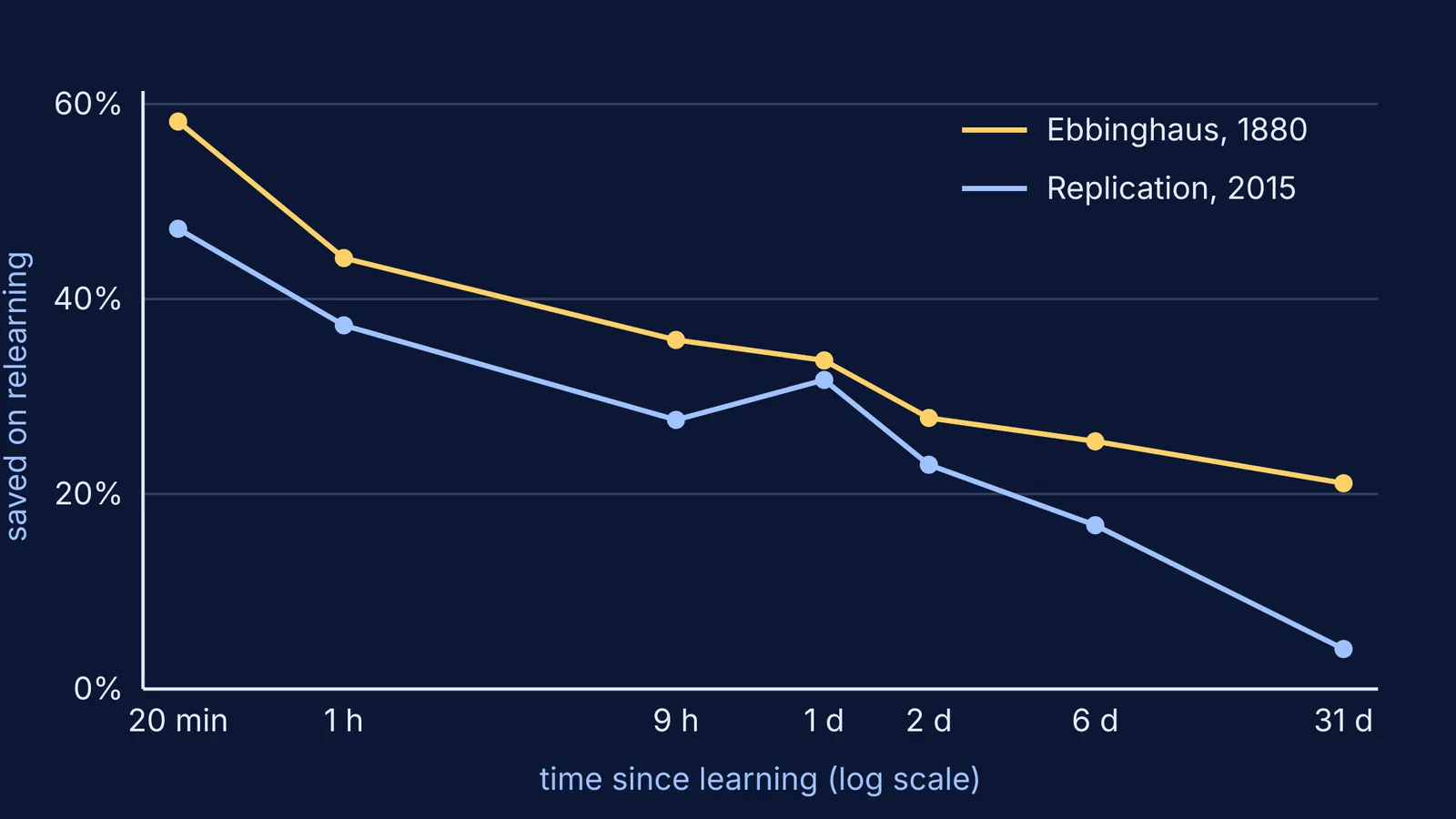
Forgetting is also fastest at the start. In a 2015 replication of Ebbinghaus's forgetting curve, the time saved when relearning a list fell from 47% at 20 minutes to 32% after one day and 4% after 31 days. Those were lists of nonsense syllables, not chapters, so read the shape rather than the exact numbers: a quick review on the same day catches material while the drop is steepest.
What actually keeps you ready for surprise tests?
Testing yourself, spread over days. A 2013 review of ten study techniques by John Dunlosky and colleagues rated practice testing and distributed practice as high utility, and rated rereading, highlighting and summarisation as low utility. A 2017 meta-analysis of practice testing found practice tests more beneficial for learning than restudying and every other comparison condition it examined.
Practice testing here means any low-stakes recall: a blank page, a flashcard, a question answered with your notes shut. Distributed practice means meeting the same idea again on a later day instead of all at once.
What is the 15-minute daily maintenance plan?
It puts both high-utility techniques from the Dunlosky review into one short session. Do it at the same time each day, with notes closed until you check.
Minutes 0-5, blank page. For each class or coaching lecture you had today, write three things from memory: a definition, a formula with when it applies, and one step of a solved example. Then open your notes and mark anything you missed or got wrong in red.
Minutes 5-10, old red marks. Retry yesterday's red marks and last week's from memory.
Minutes 10-15, one problem per subject. Pick one question from this week's topics and solve it with no notes, as if it were the first question on a surprise test.
If you miss a day, do not double up. Just do today's session; a missed day costs less than a habit you start to dread. If you already do a quick recall before each class, the blank page fits naturally at the end of the same day.
What does the plan look like on a school day?
Take a Class 11 student on a Tuesday. Today's school class was the mole concept in chemistry; coaching was kinematics in physics.
Blank page: writes the definition of molar mass, writes v² = u² + 2as and notes that it holds only for constant acceleration, and starts a limiting-reagent problem. Checking the notes, the limiting-reagent step was wrong. Red mark.
Old red marks: Monday's "sign of g when a ball is thrown upward" comes out right, so it needs one more good day. Last Tuesday's "percentage composition" comes out right for the second time and leaves the list.
One problem each: a stoichiometry question and a vertical-throw numerical from the week's coaching sheet, both without notes.
If Wednesday brings a surprise quiz, everything on it has already been recalled at least once, and the shaky parts are on a list instead of waiting to ambush you.
When a red mark keeps coming back, the idea itself may not be clear. The Fermi Concept Library has a lesson for every concept in physics, chemistry, biology and mathematics, so you can rebuild the one that keeps slipping. If the trouble is picking the wrong method, the Fermi Problem Library has worked problems with a step-by-step solver that explains the reasoning rather than printing an answer.
For the bigger, announced tests, pair this habit with a study plan for schools that hold monthly unit tests.
How can parents help without adding pressure?
Ask "What did you remember today?" instead of "How long did you study?"
Offer to be the quizzer for the red-marks step: read one mark aloud and let your child answer.
Protect the slot from errands and screens, and keep it at the same time each day.
If your child puts in the hours but still forgets, read our guide on why a child studies hard but forgets.
If surprise tests bring real dread, lost sleep or panic, talk to the school counsellor or a doctor. Tele MANAS, the free, round-the-clock mental-health helpline launched by the Ministry of Health and Family Welfare, is on 14416.
Start tonight: one blank page, today's classes, notes closed.


