

On this page
Monthly unit tests can feel like a relentless cycle. Just as you recover from one set of exams, the next round appears on the calendar. For many students, this triggers a predictable pattern of late-night cramming, stress, and promptly forgetting everything a week later.
But cognitive science suggests a different approach. Instead of viewing monthly tests as high-stakes judgments, you can use them as spaced checkpoints. Treating them as practice rather than a final verdict not only builds long-term memory but actively cures exam fear.
Why does frequent testing reduce test anxiety?
It seems counterintuitive that taking more tests could make you less anxious. However, educational research shows that frequent, low-stakes assessments help normalise the exam environment. By getting used to the testing format, the perceived threat diminishes, and a single poor performance no longer feels catastrophic.
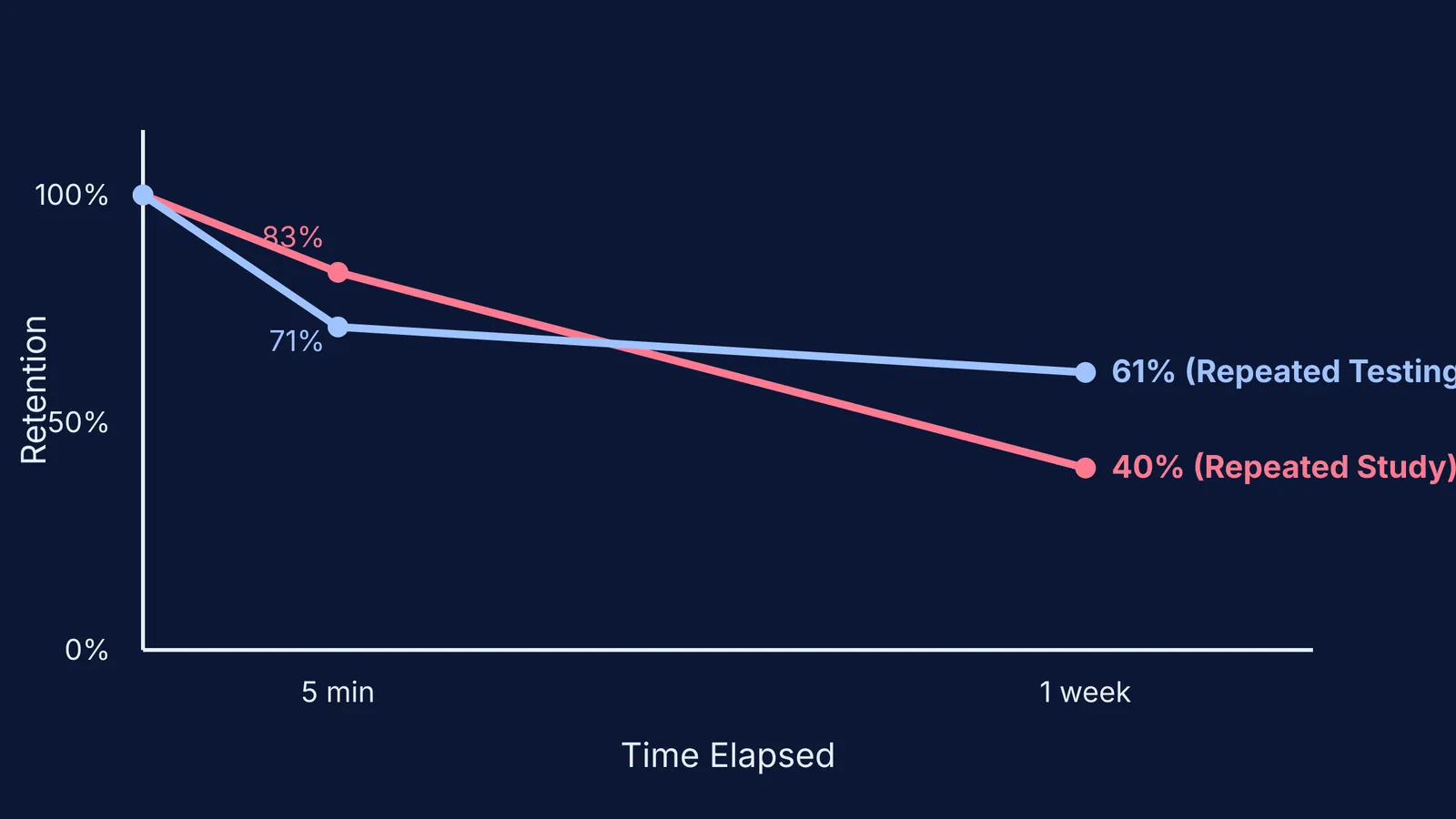
More importantly, taking a test changes how your brain stores information. In a foundational 2006 study published in *Psychological Science*, researchers measured how well students remembered material after one week. Students who simply reread their notes four times retained only 40% of the information. In contrast, students who read the material once and then took three practice tests retained 61% of it (Roediger and Karpicke, 2006).
This phenomenon, known as the "testing effect", proves that actively retrieving information strengthens your neural pathways much more than passively reading a textbook.
What is a 3-day study routine for unit tests?
Because unit tests cover a smaller syllabus, you do not need weeks of preparation. A focused three-day routine built on active recall is highly effective.
Day 1: Condense and triage Spend your first day auditing the chapters. Categorise topics by your comfort level: green for mastered, yellow for familiar, and red for difficult. Spend 80% of your time on the red and yellow topics. If you are missing foundational pieces—such as understanding the rules for naming carbon compounds—use the Fermi Concept Library to find the exact lesson and see how it fits into the broader map.
Day 2: Active retrieval Put your notes away. Use flashcards, solve practice problems, and try to explain concepts out loud from memory. Whether you are memorising ethanol and ethanoic acid reactions or practicing with and without replacement probability, force your brain to retrieve the facts. If you hit a roadblock while practicing, the Fermi Problem Library provides worked problems with a step-by-step solver that explains the reasoning rather than just printing an answer.
Day 3: Mixed practice and sleep Dedicate your final day to a full-length, timed practice exam. Mix different topics together to simulate the real test environment. Finally, get a full night of sleep. Memory consolidation happens while you rest, and a tired brain will struggle to retrieve facts, no matter how many hours you studied.
How do you handle the results for long-term retention?
Once the unit test is over, do not throw the paper in your bag and forget about it. The most valuable part of a monthly test is the feedback it provides.
Create an error log. Write down every question you got wrong, why you made the mistake (was it a calculation error, a forgotten formula, or a misunderstood concept?), and the correct step.
If you find that your mistakes stem from deep conceptual gaps rather than simple careless errors, it helps to walk through them with a teacher. Fermi's AI tutor can work out what you already know and build a plan for the session. It teaches through the gap by writing on a board, drawing the figure, and checking your understanding as it goes, so you sit down to a clear next step instead of a blank page.
By logging your weak topics and fixing them immediately, you ensure they do not snowball into larger problems. When the final exams arrive at the end of the year, you will find that you have already done the hard work.


