

On this page
Physical education can be a high-scoring elective if you treat it as a real subject. Much of the score is earned before the exam.
How is Class 12 physical education marked?
The CBSE Physical Education syllabus for 2026-27 (subject code 048) gives 70 marks to theory and 30 to practicals. Biomechanics and Sports carries 10 marks, the most of the ten theory units, followed by Management of Sporting Events and Training in Sports at 9 each.
The same document splits the 30 practical marks five ways:
Physical fitness test (SAI Khelo India Test, or the Brockport test for children with special needs): 6 marks
Proficiency in one IOA-recognised sport or game: 7 marks
Yogic practices: 7 marks
Record file: 5 marks
Viva voce on health, games and sports, and yoga: 5 marks
What goes in the physical education practical file?
The 2026-27 syllabus names three practicals for the record file:
Practical 1: administering the SAI Khelo India fitness tests.
Practical 2: procedure, benefits and contraindications of any two asanas for each lifestyle disease.
Practical 3: one IOA-recognised sport, with a labelled diagram of the field and equipment, plus its rules, terminology and skills.
Unit 3 lists five lifestyle-disease headings (obesity, diabetes, asthma, hypertension, and back pain and arthritis), so Practical 2 means ten asana write-ups. Give each the same four parts: name, numbered steps, two benefits, two contraindications. Those pages double as revision for the theory paper.
For Practical 3, choose the sport you play in the proficiency test, and the same notes prepare you for the viva. For pacing the work, borrow from our guide to finishing a Class 12 project in three sittings.
How do you draw a knockout fixture with byes?
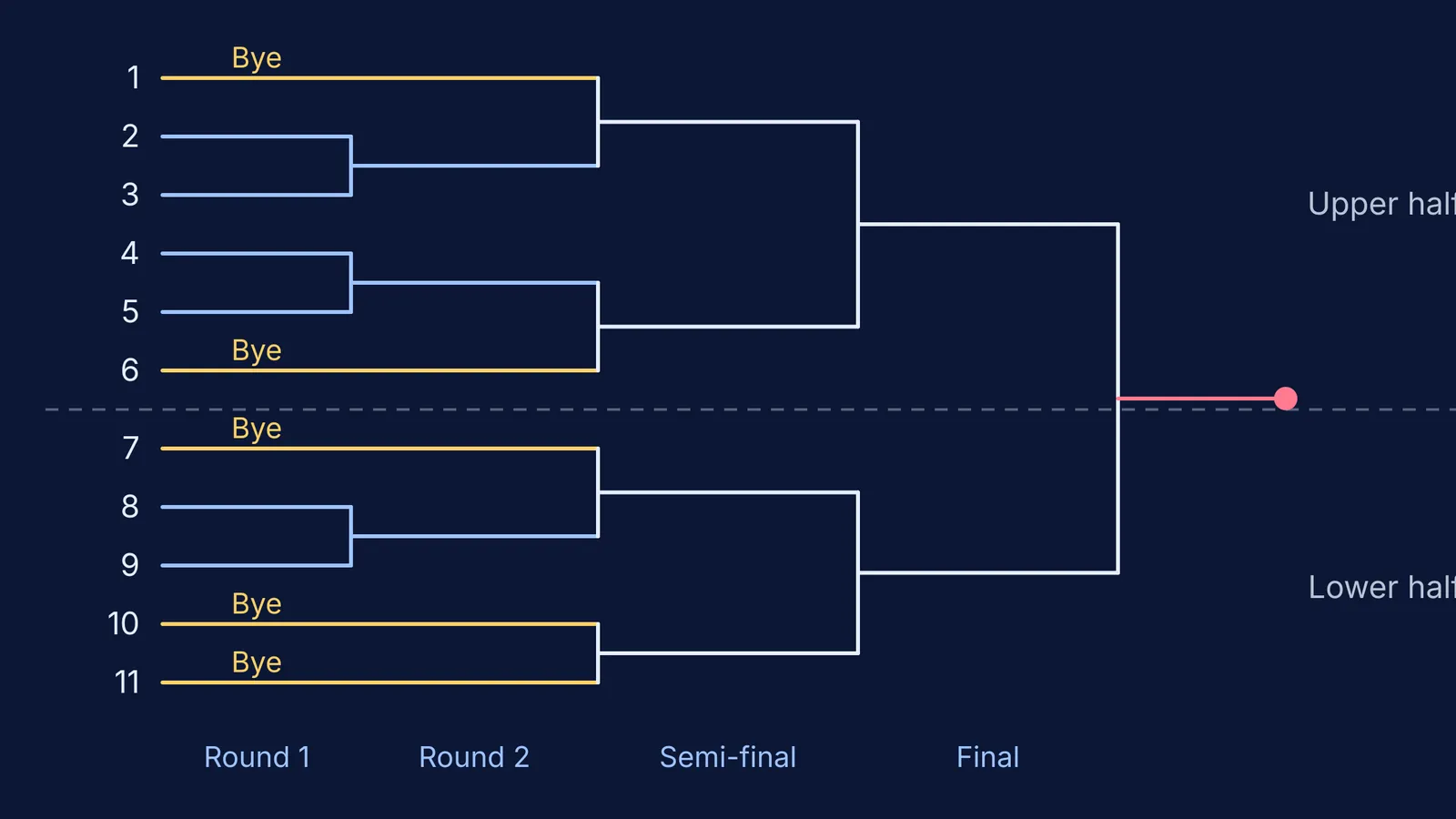
Fixtures sit in Unit 1, Management of Sporting Events, and the 2025-26 CBSE sample question paper built a 4-mark case study around a knockout fixture with byes. These steps follow the 11-team example in the CBSE Class 12 physical education textbook.
Matches: total matches in a knockout = number of teams − 1. For 11 teams, that is 10.
Byes: the next power of 2 minus the number of teams. 16 − 11 = 5 byes.
Halves: with an odd number of teams, the upper half gets (n + 1) ÷ 2 and the lower half (n − 1) ÷ 2, so 6 above and 5 below.
Split the byes: (byes − 1) ÷ 2 = 2 in the upper half and (byes + 1) ÷ 2 = 3 in the lower half.
Place the byes in order: the last team of the lower half (11), the first of the upper half (1), the first of the lower half (7) and the last of the upper half (6), then team 10.
Draw it: 2 v 3, 4 v 5 and 8 v 9 play round one, and the five bye teams join in round two. Count your matches. If you don't get 10, recheck step 5.
For longer fixture answers, see our guide to writing long board exam answers in five parts.
Which chapters need diagrams and calculations?
Sort the syllabus topics by the kind of practice they need:
Draw: fixtures (Unit 1), postural deformities (Unit 2), asanas (Unit 3), fracture types (Unit 7), levers and projectiles (Unit 8).
Calculate: BMR and the Harvard Step Test (Unit 6), plus matches and byes (Unit 1).
Learn as lists: WHO exercise guidelines, nutrients, disability sports bodies, personality types, training methods.
The 2026-27 syllabus gives the Harvard Step Test fitness index as duration in seconds × 100 ÷ (5.5 × pulse count taken 1 to 1.5 minutes after exercise). Step for 300 seconds and count 60 beats, and you score 30,000 ÷ 330, about 90.9.
Unit 8, the heaviest unit, is mostly physics. If levers or projectiles feel abstract, the Fermi Concept Library has a lesson for each physics concept, and the Fermi Simulation Lab has interactive simulations for ideas that are easier to see than to read.
How should you use past papers and sample papers?
The 2025-26 CBSE sample paper has 37 questions in five sections over 3 hours: 18 one-mark multiple-choice questions, 2- and 3-mark answers (you choose 5 of 6 in each section), three 4-mark case studies, and 5-mark answers where you attempt 3 of 4. It sets word limits of 60-90 words for 2 marks, 100-150 for 3 and 200-300 for 5. Check each attempt against the official marking scheme, and look for the 2026-27 paper on CBSE Academic, because formats can change.
A four-week plan:
Week 1: finish the record file and practise the fitness test items.
Week 2: Units 1, 6 and 8, drawing one fixture every day.
Week 3: the other seven units, one summary page each.
Week 4: two timed sample papers, marked against the scheme.
If you train seriously, our board exam plan for students who play sports shows how to fit revision around practice.
Start the record file this week. Those marks are settled before you walk into the exam hall.


