

On this page
For student-athletes, the hardest opponent in a board exam year is not the syllabus, but the clock. Balancing daily practice, travel for tournaments and a demanding academic workload leaves little time for traditional marathon study sessions. However, cognitive science suggests that an athlete's schedule—which forces them to study in short bursts—can actually lead to better long-term memory than cramming.
By combining the science of spaced learning with official exam provisions, students who play sports can build a study routine that does not require them to quit their team to score well.
Why are short daily sessions better than cramming?
Most students try to master a subject by reading a textbook for hours at a time right before an exam, a method psychologists call massed practice. Athletes rarely have this luxury. Between evening practices and weekend matches, their schedules force them into distributed or spaced practice: studying a topic in short intervals over several days or weeks.
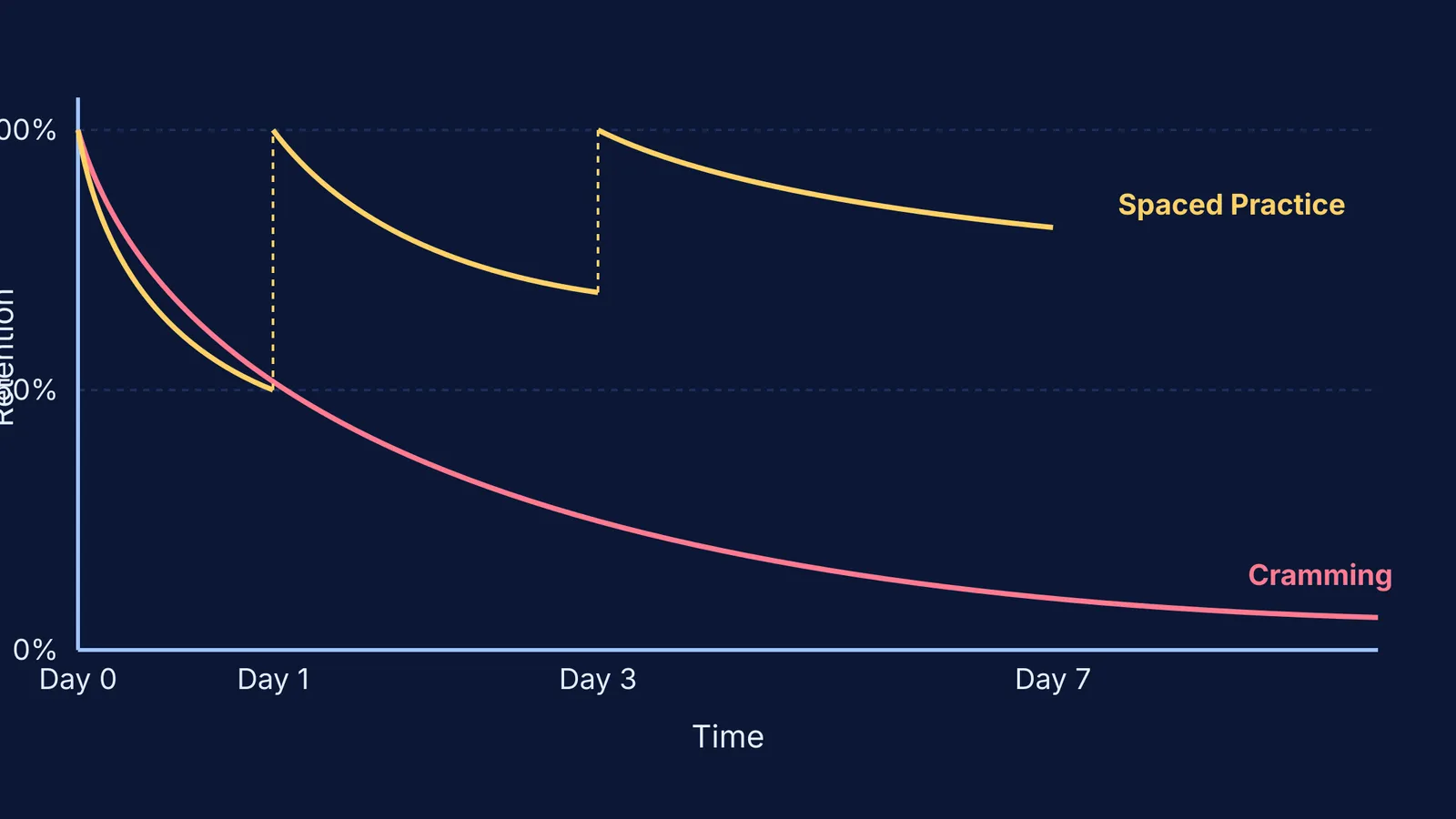
This necessity turns out to be a major advantage. A landmark study on the spacing effect by Shelby McIntyre and J. Michael Munson (2008) in the *Journal of Marketing Education* followed students for nearly three years after a course ended. They found that students who used spaced practice retained 82% of the course material after 150 weeks, while those who crammed retained only 27% (10.1177/0273475308321819).
The reason lies in how the brain consolidates memory. First documented by Hermann Ebbinghaus in 1885, the forgetting curve shows that we rapidly lose new information, often forgetting much of it shortly after learning. However, each time you revisit material after a gap, your brain must work harder to retrieve it. This effort strengthens the neural pathway and flattens the curve. For an athlete, reviewing physics formulas in short sessions after practice each day builds more durable knowledge than a single long Sunday session.
How do you plan study routines around tournaments?
Tournaments and training camps often mean missing school and carrying heavy textbooks on buses or trains. To keep up without feeling overwhelmed, students need a dedicated travel study kit and a clear, actionable plan.
Pre-pack a digital library: A travel kit should rely on lightweight, high-yield materials. Instead of carrying bulky textbooks, pack concise summary notes, a tablet or phone, and downloaded past papers.
Focus on retrieval, not reading: On a bus ride or in a hotel room, simply re-reading a textbook is passive and easily forgotten. Instead, use that time for active recall, such as testing yourself on biology diagrams from memory or balancing chemistry equations on a scratchpad.
Set a clear next step: The hardest part of studying on the road is knowing where to start when you are tired. Fermi's AI tutor can work out what you already know and build a plan for the session, so you sit down to a clear next step rather than a blank page.
Target single concepts: If you are stuck on a specific idea away from your teacher, the Fermi Concept Library holds every concept in physics, chemistry, biology, mathematics and computing, each with its own lesson. This allows you to close a knowledge gap in a short time between matches.
If the stress of balancing these intense schedules builds up, it is important for parents to recognize the signs early and know when to get help for exam stress.
What is the CBSE board exam sports exemption rule?
If a major tournament falls exactly on the dates of the final exams, students no longer have to choose between their sport and their education. The Central Board of Secondary Education (CBSE) provides a special exemption for student-athletes representing their state or country.
Under the current rules for the 2025–26 academic year, if a student's board examination strictly clashes with a recognized sports event or the journey period for that event, the CBSE will conduct a special examination at a later date (cbse.gov.in). For Class 12, these rescheduled exams are typically held within 15 days of the last main board examination. For Class 10 students, exams that clash with the first phase can be taken during the second phase in May.
To qualify for this exemption, three key conditions must be met:
Recognized events only: The sports event must be recognized by the Sports Authority of India (SAI) or the Board of Control for Cricket in India (BCCI).
Theory only: The exemption applies strictly to main theory examinations, not practicals, project work, or internal assessments. Crucially, it does not cover absences for training camps or selection trials.
Application deadline: Students cannot apply directly to the board. They must submit a formal request along with a certificate of participation to their school, which then verifies and forwards the recommendation to the CBSE Regional Office by the deadline set by the board.
By applying early, communicating with teachers, and maintaining a spaced study schedule, student-athletes can plan their year strategically—much like planning for JEE Main's two sessions—ensuring they perform at their absolute best both on the field and in the exam hall.


