On this page
A B.Tech in Paint Technology (often called Surface Coating Technology) is a four-year chemical engineering specialisation. It moves from general science into the specific chemistry of what goes into a can of paint, how it is manufactured, and how it protects surfaces.
What is taught in a paint technology course?
According to the syllabus from the Institute of Chemical Technology, Mumbai, students study the entire lifecycle of a coating. The core subjects include:
Resins and polymers: How to synthesise alkyds, epoxies, polyurethanes and acrylics. These complex molecules form the binding matrix of the paint.
Pigments and additives: The inorganic chemistry of titanium dioxide (TiO₂) for white paint, iron oxides for earth tones, and the organic chemistry of carbon-based dyes. Students also study additives like plasticisers, anti-settling agents and driers.
Formulation engineering: Calculating the Pigment Volume Concentration (PVC) and Volatile Organic Compounds (VOC) to balance the paint's durability with strict environmental rules.
Corrosion science: Understanding the electrochemistry of how metals rust, and designing chemical barriers—such as zinc-rich primers—to stop the oxidation process.
Students spend significant time in the laboratory. They learn how to synthesise alkyd and epoxy resins in pilot-scale reactors, and they use analytical chemistry techniques like gas chromatography and spectroscopy to verify the purity of raw materials. They also test the final paint films for scratch resistance, flexibility, and gloss.
Understanding the complex organic structures of these polymers and how they cross-link can be tough. The Fermi Concept Library has a lesson for every concept in chemistry, making it easier to see how monomers link to form the resins used in paints.
The chemistry of a paint coating system
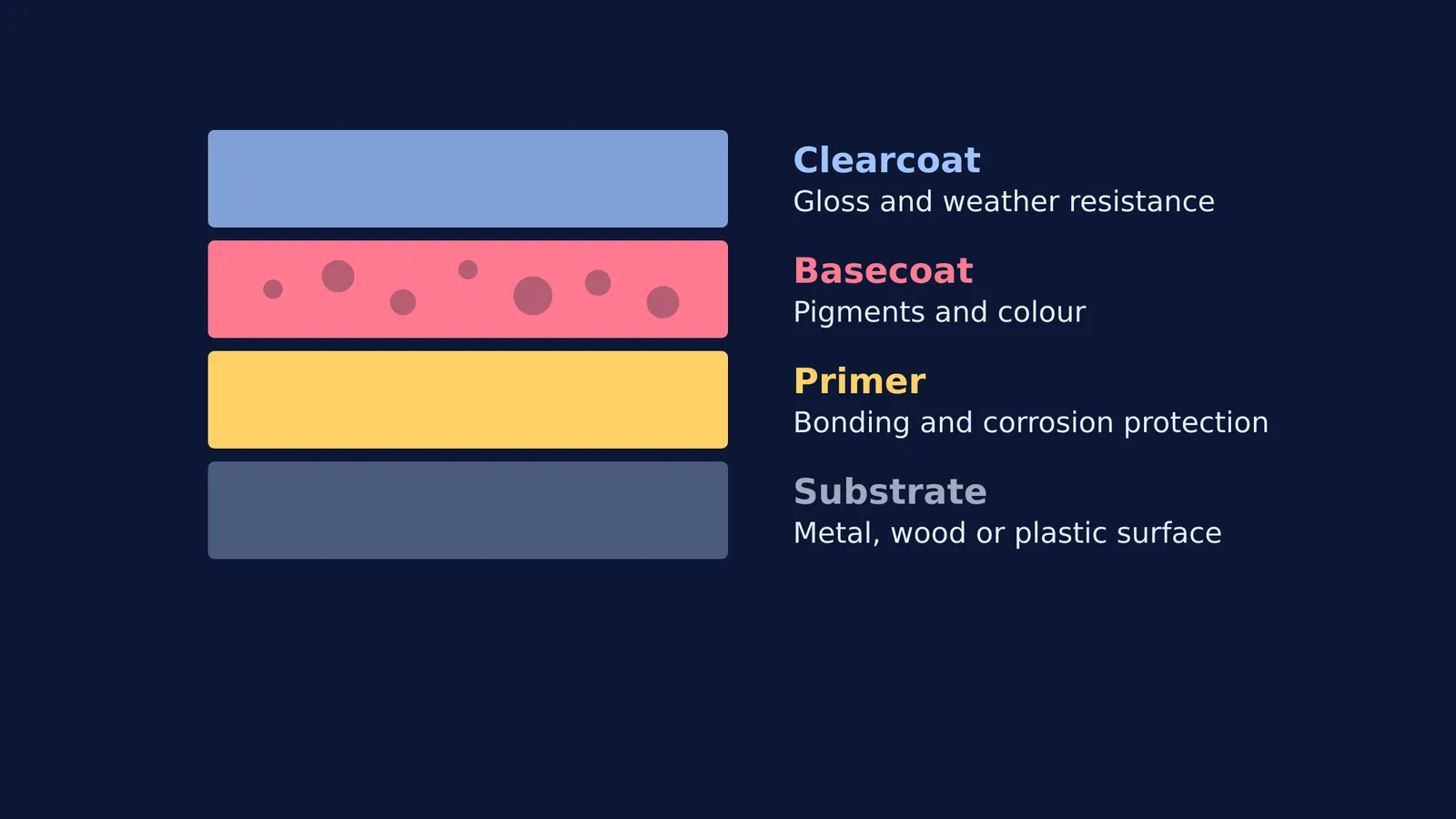
Paint is rarely a single chemical; it is a layered system designed for adhesion, colour and protection. A typical industrial or automotive finish consists of three main layers:
Primer: The first layer applied directly to the substrate (metal, wood or plastic). It is formulated to bond strongly to the bare surface and prevent corrosion.
Basecoat: This layer contains the pigments that provide the colour and visual effects (such as the metallic flakes seen in car paint).
Clearcoat: A transparent, resin-heavy layer applied on top. It provides the final gloss and protects the basecoat below from ultraviolet light and harsh weather.
What is the career scope in the paint industry?
The Indian paint and coatings market is vast and expanding rapidly. Industry estimates place its value around ₹85,000 to ₹93,000 crore in 2024, with expectations to reach ₹1 lakh crore by 2027 or 2028. In the decorative paint segment, up to 80% of demand comes from repainting homes rather than new construction, as the typical repainting cycle has shortened from 7–8 years to 4–5 years. This growth creates a steady demand for chemical technologists in both the decorative and industrial (automotive, aerospace, marine) segments.
Graduates are hired by major domestic companies such as Asian Paints (which is India's largest paints company by market share), Berger Paints, and Kansai Nerolac, as well as global firms like AkzoNobel.
Common job roles include:
R&D Scientist: Developing eco-friendly, water-based paints that lower VOC emissions and designing smart coatings that can heal themselves or change colour with heat.
Formulation Chemist: Adjusting the ratios of solvents, pigments and resins to create finishes for new materials, such as aerospace composites or smartphone cases.
Quality Control Specialist: Testing large production batches for viscosity, drying time, opacity and weather resistance.
Production Manager: Overseeing the massive chemical reactors that cook resins and the heavy milling machines that grind pigments into fine powders.
How to choose between chemical engineering and paint technology?
If you are deciding between a general B.Tech in Chemical Engineering and a specialised degree in Paint Technology, ask yourself these three questions:
Do you prefer broad or specific knowledge? Chemical engineering covers a wide range of industries, from oil refineries to pharmaceuticals and food processing. Paint technology focuses deeply on polymers, resins and surface science.
Where do you want to work? A paint technology degree naturally steers you towards the coatings, automotive, and construction materials sectors. If you are certain this is the industry for you, the specialised degree gives you an edge over general chemical engineers.
Are you interested in sustainability? The coatings industry is currently focused on replacing toxic solvents with water-based alternatives. This offers a clear, high-demand path for research into greener chemistry.
If you are exploring other specialised engineering branches before making a decision, you might also want to read about What is the environmental engineering branch? or the Mechatronics and Robotics Engineering: Career Scope.