On this page
When you think of an eye doctor, you might picture someone asking you to read letters off a chart, or someone in a surgical theatre operating on a cataract. The field of eye care relies on two distinct professionals: optometrists and ophthalmologists. If you are deciding which path to take, the choice comes down to how much you want to study, whether you want to perform surgery, and if you are ready to take the NEET entrance exam.
What does an ophthalmologist do?
An ophthalmologist is a medical doctor who specialises in eye and vision care. They are licensed to diagnose and treat all eye diseases, perform surgeries such as LASIK or cataract removals, and prescribe medications and eyeglasses (American Academy of Ophthalmology).
Because they are physicians, they can also spot systemic health issues like diabetes or high blood pressure through a detailed eye exam. Their day-to-day work often involves treating severe conditions like glaucoma, macular degeneration, and diabetic retinopathy. An ophthalmologist might split their week between consulting with patients in a clinic and performing intricate microsurgeries in an operating theatre.
What does an optometrist do?
An optometrist provides primary vision care. They are healthcare professionals who perform eye exams, prescribe corrective lenses, and detect certain eye abnormalities, but they do not perform surgery (American Academy of Ophthalmology).
Optometrists are often the first stop for a patient whose vision is changing. They use instruments like phoropters and slit lamps to test visual acuity, check for astigmatism, and ensure the outer and inner parts of the eye are healthy. If an optometrist detects a complex medical issue or a condition requiring surgery, they will refer the patient to an ophthalmologist. After surgery, the patient might return to the optometrist for ongoing care and updated glasses.
What is the career difference between an optometrist and an ophthalmologist?
The primary difference is the scope of practice and the required medical training. An ophthalmologist is a surgeon and a medical doctor who handles complex medical eye conditions and has the authority to perform operations. An optometrist focuses on non-surgical management of vision health, prescribing visual aids, and conducting routine, everyday eye care. While they operate in the same field, their daily tasks and legal authority in healthcare are distinct.
Training length and the NEET entrance route
The training routes for these two careers in India are entirely different, both in length and in how you enter them.
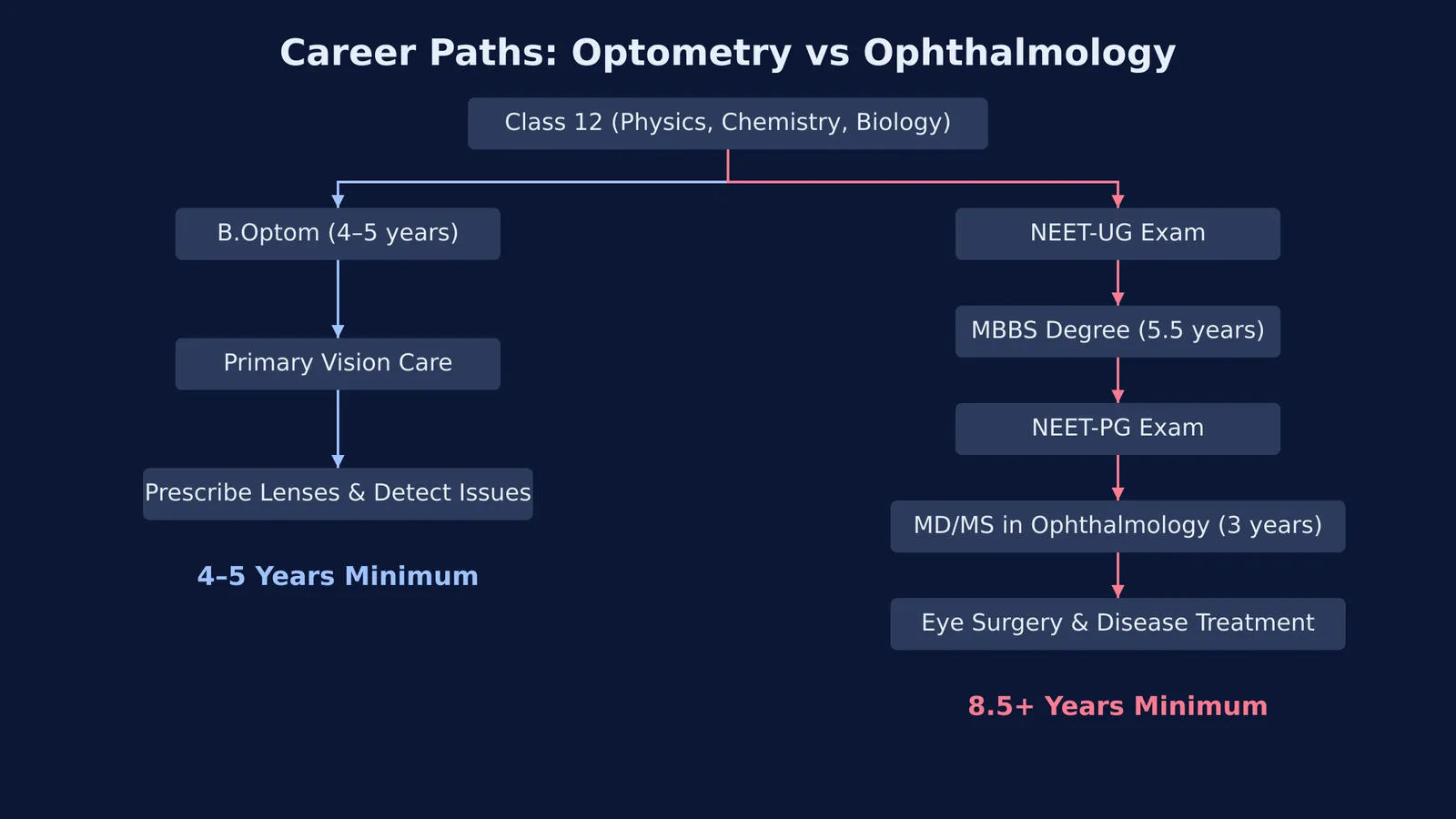
To become an ophthalmologist, you must first become a medical doctor. This starts with clearing the National Eligibility cum Entrance Test (NEET-UG), which is the uniform entrance test for all medical institutions in India (National Testing Agency). You then complete a 5.5-year Bachelor of Medicine, Bachelor of Surgery (MBBS) degree, which includes 4.5 years of academic study and one year of a compulsory rotating medical internship (National Medical Commission).
After completing your MBBS, you must clear the NEET-PG exam and complete a three-year Master of Surgery (MS) or Doctor of Medicine (MD) in Ophthalmology. This means the path to becoming a licensed ophthalmologist takes a minimum of 8.5 years of intense medical education.
To become an optometrist, you do not generally need to take NEET. You pursue a Bachelor of Optometry (B.Optom) degree directly after Class 12. Admission is usually based on your board marks in physics, chemistry, and biology, or through university-specific entrance tests.
Under the National Commission for Allied and Healthcare Professions Act, a healthcare professional degree must consist of at least 3,600 hours of training spread over three to six years (PRS Legislative Research). A standard B.Optom programme typically takes four to five years to complete. This includes foundational science classes, specialised modules in ocular anatomy and visual optics, and a mandatory clinical internship year to gain practical experience with patients.
Whether you aim for the physics-heavy NEET exam or a degree in optometry, mastering the core sciences is essential. You must have a strong grasp of optics—such as understanding The human eye and its defects: myopia, hypermetropia and lenses and mastering concepts like Light in Class 10: reflection, refraction and the lens formula.
If you are struggling to picture how light refracts through a lens or how different eye conditions alter focus, the Fermi Simulation Lab offers interactive simulations for the ideas that are easier to see than to read.