On this page
If you are in Class 12 and want to join the National Defence Academy, your first written exam comes soon after boards: the UPSC programme of examinations for 2027 lists NDA & NA (I), 2027 for 11 April 2027, with the notification due on 2 December 2026. Students still in Class 12 can apply if they later submit proof of passing by UPSC's deadline, says the NDA & NA (II) 2026 notice. Much of the maths paper is already your board syllabus.
How is the NDA written exam set?
These details come from the UPSC NDA & NA (II) 2026 notice and the 2026 booklets (Mathematics, General Ability Test); check each new notice, as details can change.
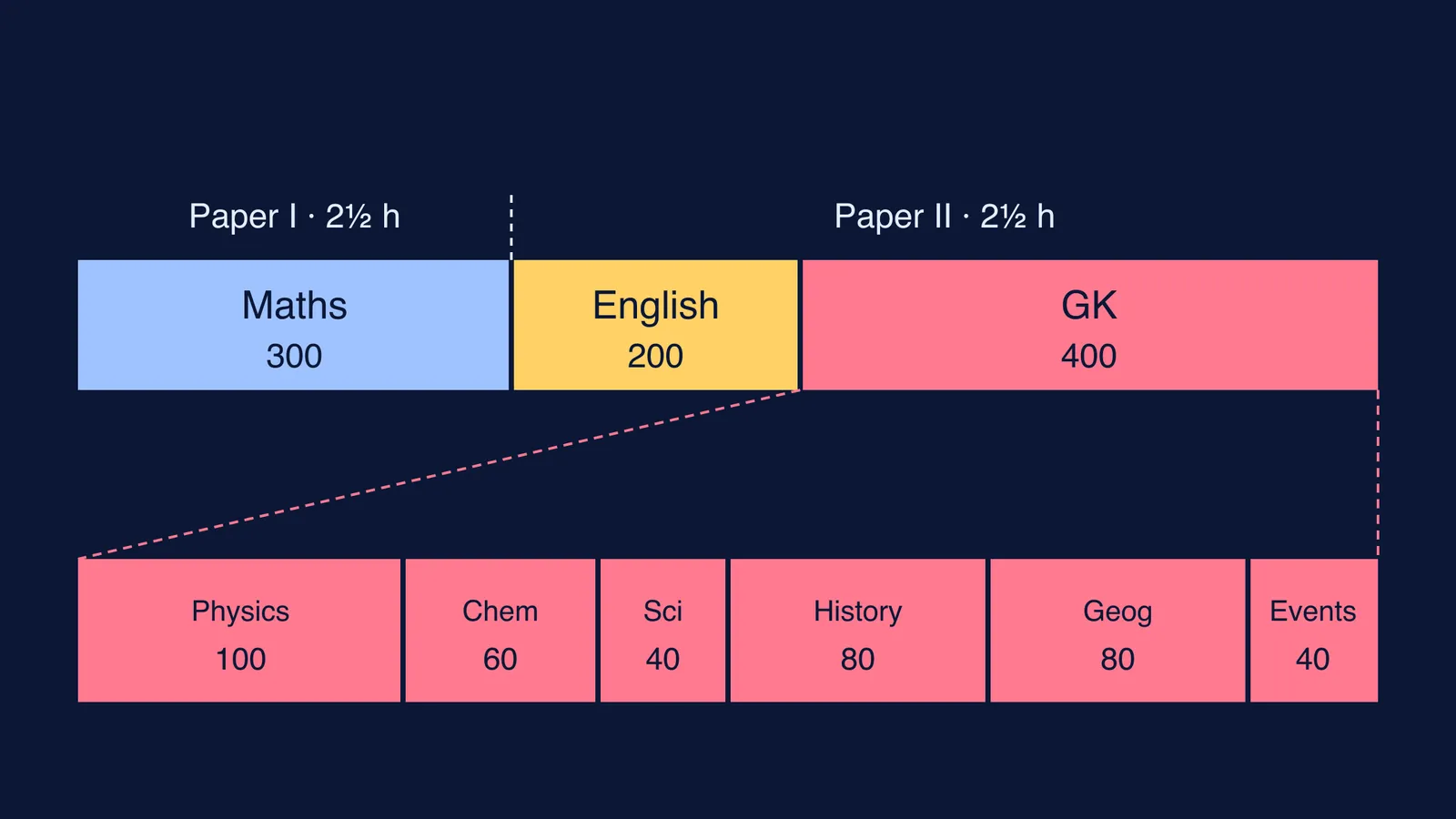
Paper I, Mathematics: 2½ hours, 300 marks, 120 questions of equal marks, so 2.5 marks and about 75 seconds per question.
Paper II, General Ability Test (GAT): 2½ hours, 600 marks, 150 questions of equal marks, so 4 marks and one minute per question.
GAT Part A is English (200 marks): grammar and usage, vocabulary, comprehension and cohesion.
GAT Part B is General Knowledge (400 marks): Physics about 25%, Chemistry 15%, General Science 10%, History and Freedom Movement 20%, Geography 20% and Current Events 10%.
No calculators or log tables are allowed.
A wrong answer costs one third of that question's marks; a blank costs nothing.
Those who qualify then face the SSB interview, which carries another 900 marks.
So Physics alone is worth about 100 GK marks, more than any other GK section.
Which NDA maths topics does Class 12 already cover?
Lay the NDA syllabus beside the CBSE Mathematics syllabus for Classes 11 and 12 (2026-27) and the topics fall into three groups.
Board work that counts twice: relations and functions, inverse trigonometry, matrices and determinants, continuity, derivatives, maxima and minima, integrals and areas, differential equations, vectors, lines in 3D, and conditional probability with Bayes' theorem.
Class 11 topics your boards won't test again: sets, trigonometric identities, complex numbers, quadratics, permutations and combinations, binomial theorem, progressions, straight lines, conics and statistics.
NDA topics not in the CBSE 2026-27 exam syllabus: the binary number system, cube roots of unity, harmonic progressions, Cramer's rule, the equation of a plane and of a sphere, hyperbolic functions in integrals, correlation and regression, and the binomial distribution.
Group 1 needs extra speed, not extra time; Groups 2 and 3 fill your weekly NDA slots. For a Group 3 topic you have never met, the Fermi Concept Library covers every mathematics concept, each with its own lesson, so you can learn the idea before you drill it.
How do you prepare for NDA maths along with Class 12?
Keep your board timetable as the base and add small, fixed NDA slots:
Monday to Friday, 75 minutes: your board maths chapter of the week, then 15 objective questions from the same chapter, timed at 75 seconds each.
Monday, Wednesday, Friday, 30 minutes: one Group 2 or Group 3 topic, rotating so each one comes round every few weeks.
Tuesday and Thursday, 30 minutes: GAT English, one comprehension passage plus 20 grammar or vocabulary questions.
Every day, 15 minutes: read the news and note three events, people or places.
Saturday, 60 minutes: a mixed 40-question maths set from all three groups in 50 minutes, then mark it and sort every error.
Sunday, 60 minutes: one GK block, alternating History and Geography, with the GAT physics list (pendulum, siphon, periscope, pressure cooker) on alternate weeks. Then stop.
Why mix topics on Saturday? In a classroom study of 126 seventh-graders, practice sets that mixed problem types produced higher scores than sets of one type, both on a test the next day and on one 30 days later (Rohrer, Dedrick and Stershic, 2015). The NDA paper mixes everything too, so choosing the method is part of the skill.
Mark each Saturday error as "didn't know it", "wrong method" or "slip". For wrong-method errors, the Fermi Problem Library has a step-by-step solver that explains the reasoning rather than printing an answer, so you can see where your approach went off.
What should change as boards get close?
November to January: run the full template and touch every Group 2 and 3 topic once before pre-boards.
Board exam weeks: boards come first. Drop GK and English to a 15-minute news habit and keep one short mixed maths set on non-exam days. Our six-week board revision calendar shows how to space revision across those weeks.
From your last board paper to 11 April: sit full timed mock papers, one maths and one GAT, in the same 2½-hour slots, and spend the next day on the errors.
If evenings feel crowded, see how to rotate subjects through the week.
If April goes badly, UPSC's 2027 calendar also lists NDA & NA (II), 2027 for 19 September 2027, so April is not your only chance.
PCM students weighing another Army route can compare Army TES eligibility, shortlisting and the SSB.