

On this page
If you are in coaching, you probably have three books open for every chapter: the NCERT textbook, the coaching module, and a reference book that a senior or a teacher swore by. Picking the "right" book matters less than knowing which one comes first. Below is a sequence that works one chapter at a time, plus a simple test for when you can leave the reference book shut.
In what order should you study NCERT and reference books?
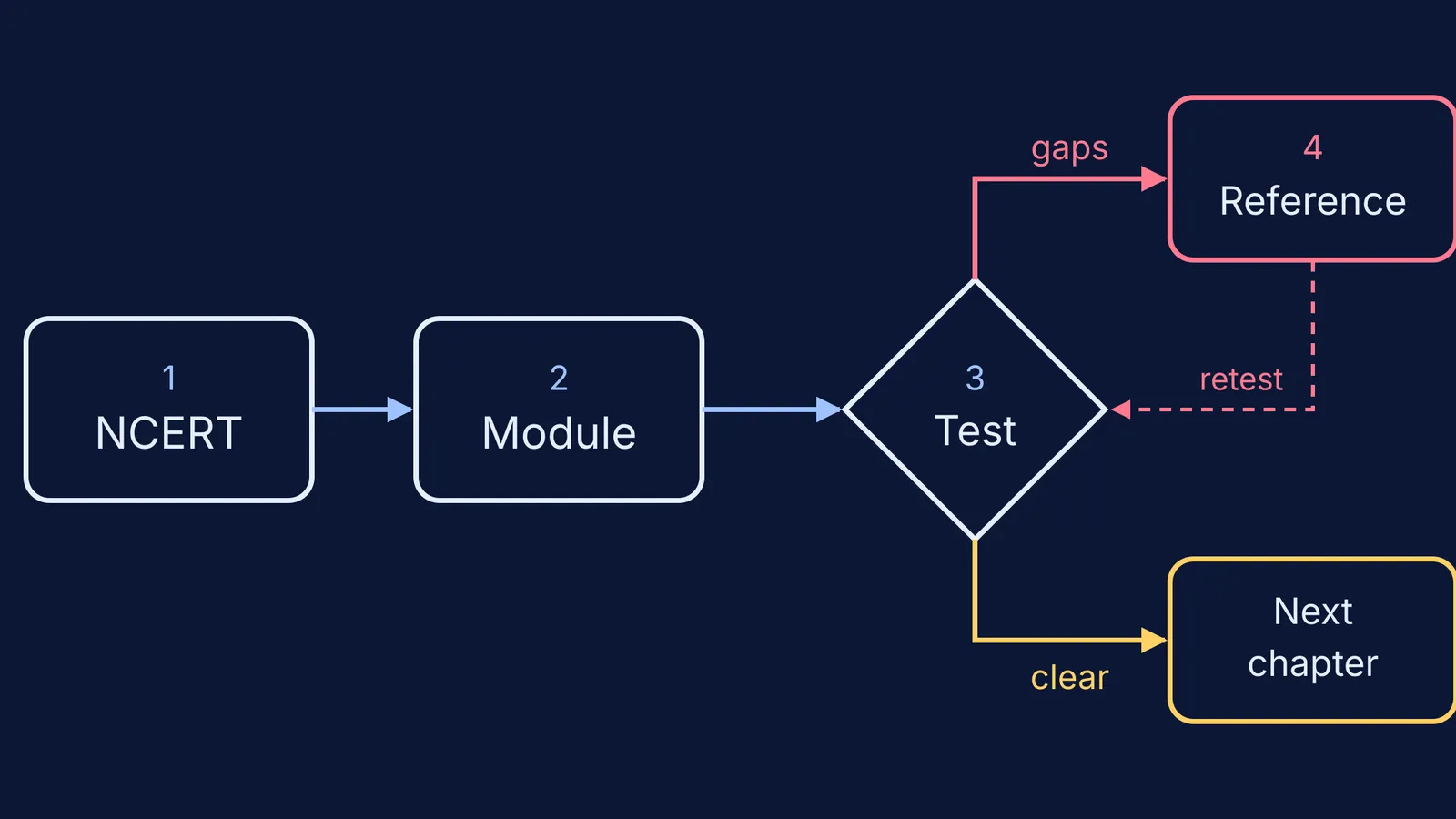
Work through each chapter in four steps.
NCERT text and exercises. Read the chapter, do the in-text questions, then the end-of-chapter exercises. If you are short of time, here is which textbook questions to do first.
Coaching module. Read its theory summary and solve its graded exercises. It usually bridges the gap between school questions and entrance-level ones. Make notes from one source only; this guide on whether to make notes from NCERT or coaching modules helps you choose.
A closed-book self-test. The next day, without notes, attempt 10 mixed questions you have not seen from the module.
A reference book, only for the gaps. Open it for the question types you got wrong, not for the whole chapter.
NCERT comes first because it defines what your board exam can ask. CBSE's 2026-27 Physics curriculum for Classes 11 and 12 lists NCERT's Physics Part I and Part II textbooks, the NCERT physics lab manual and other NCERT books and manuals as its prescribed books. The same document says content that NCERT textbooks mark as excluded for 2026-27 will not be tested by schools. For JEE Main or NEET-UG, check the current official syllabus on the NTA or NMC website. Syllabi change, so don't rely on an old handout.
Why take a test before opening a reference book?
A self-test tells you exactly what is missing, so the reference book becomes a targeted fix rather than a second full reading. A 2013 review by Dunlosky and colleagues looked at 10 common study techniques. It rated practice testing and distributed practice as high utility, and rereading and highlighting as low utility. Reading the same chapter again in a thicker book is mostly rereading. Answering questions and checking them is testing.
There is a second reason. In 2003, Kalyuga, Ayres, Chandler and Sweller described the expertise reversal effect: teaching methods that work well for beginners can lose their value, or even backfire, for learners who already know the material. That suggests that once you understand a chapter, another long explanation of it may help less than new problems do.
When is a reference book not needed?
You can skip it for a chapter if all of these are true:
You scored 8 or more out of 10 on your self-test. That cut-off is our suggestion, not an official one.
The questions you missed were careless slips, not one repeating type.
Your target is the board exam, or the module already has plenty of questions at your exam's level.
If you still have unsolved module questions, finish those before you buy another book. Open a reference book if the same type keeps failing, if the module skips steps you cannot rebuild, or if you have finished the module and want harder problems for JEE Advanced.
What does this look like for one chapter?
Take Chapter 6 of Class 11 physics, System of Particles and Rotational Motion. The CBSE curriculum linked above lists moments of inertia for simple shapes with "no derivation", so for the board exam you need the values and how to use them, not the derivations.
Day 1: read the NCERT chapter and work through its solved examples.
Day 2: do the NCERT exercises and mark every question you could not finish.
Days 3 and 4: module theory, then its first-level and second-level exercises.
Day 5: closed-book self-test of 10 mixed module questions, such as rolling without slipping, angular momentum and torque.
Day 6: sort your mistakes. Say 3 of the 10 were rolling questions where you got the friction direction wrong, and rolling questions also tripped you up in the module. That type has failed twice, so read only the rolling section of your reference book and do 5 of its problems.
Day 7: retest with 5 new rolling questions.
If the mistake is a concept gap (you cannot say why friction acts at the contact point), go back to that NCERT section or look up the concept in the Fermi Concept Library. If you know the idea but used the wrong method, the Fermi Problem Library has a step-by-step solver that explains the reasoning rather than just printing an answer.
Small chapter tests like this one are different from full mocks. Here is when to use chapter tests and when to use full mocks.
Before you start the next chapter, write down your self-test score and the one question type you will watch for next time.


