

On this page
It is tempting to flip straight to the hardest end-of-chapter exercises to test yourself. But cognitive science suggests a different path: you should start with the worked examples and the in-text questions scattered throughout the chapter.
Which questions to do first at end of chapter?
When you learn a new concept, your working memory can easily be overwhelmed by the "extraneous load" of trying to figure out a problem-solving strategy from scratch. A 2023 meta-analysis by Barbieri, Miller-Cotto, Clerjuste and Chawla evaluated 55 studies and found that studying worked examples has a medium positive effect on mathematics performance, improving scores by nearly half a standard deviation (Hedges’ g = 0.48) compared to students who only solved problems. Correct worked examples build a mental framework, or schema, that you can rely on when you move to independent practice.
If you are staring at a new chapter and do not know where to start, this is exactly where Fermi's AI tutor can help. It works out what you already know and builds a plan for the session, deciding whether to explain, ask, or show as you improve.
Why should you solve in-text questions first?
Textbooks place in-text questions (often called adjunct questions) directly after a new concept for a reason. These questions act as speed bumps that force you to engage in retrieval practice—pulling a fact from your short-term memory before it fades.
Answering these questions while you read helps you monitor your own comprehension. If you skip them, you risk the "illusion of competence," where reading a clear explanation makes you feel like you understand the material. If you find gaps in your understanding during these questions, you can review the specific theory in the Fermi Concept Library before you move on to the demanding exercises at the end of the chapter.
How to mix your practice for better recall?
Once you reach the end-of-chapter exercises, you face a new problem. Textbooks usually group exercises by topic—a block of problems on velocity, followed by a block on acceleration. This is called blocked practice.
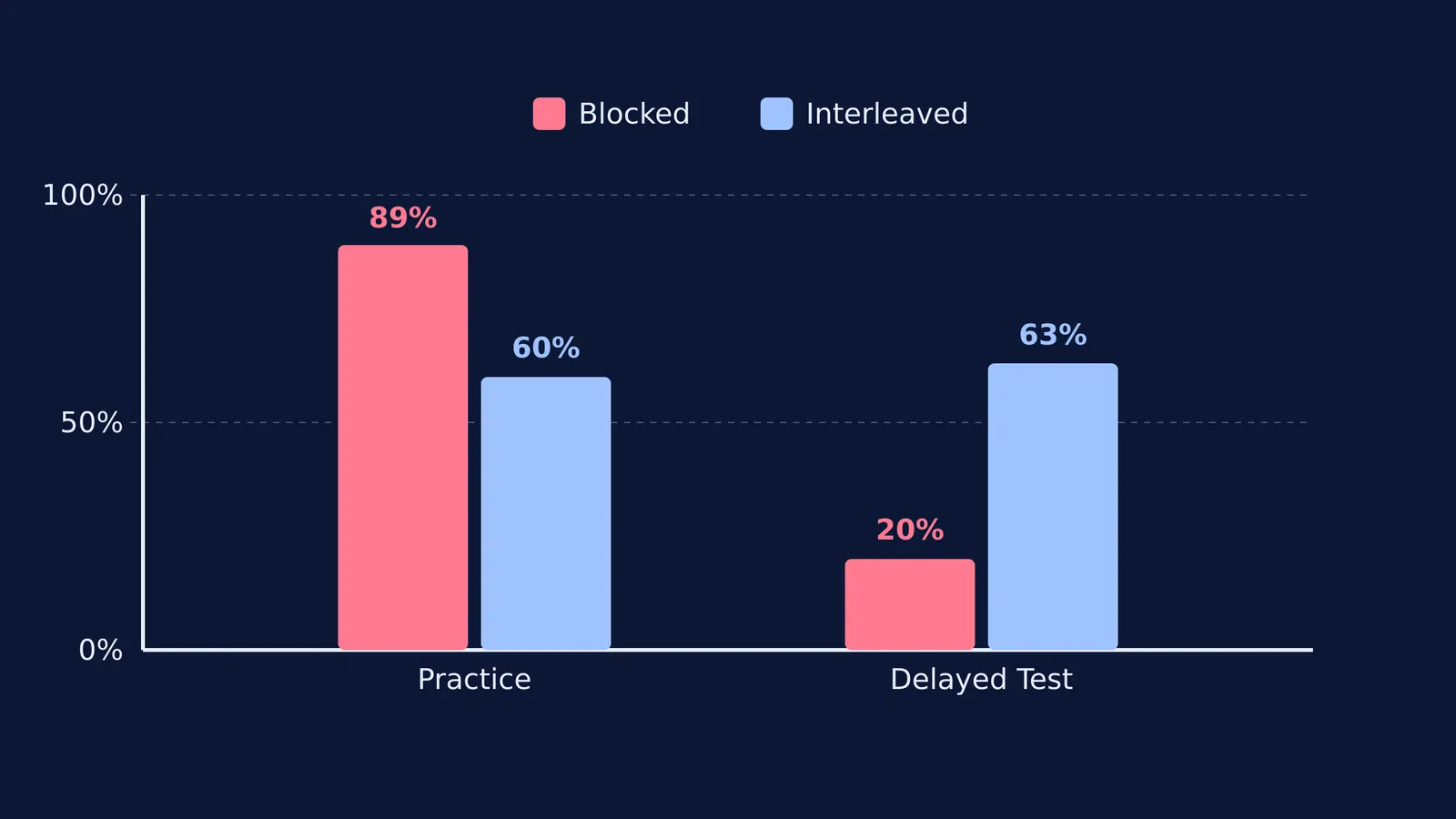
You should avoid doing these in order. A famous 2007 study by Doug Rohrer and Kelli Taylor proved that mixing up different types of mathematics problems—known as interleaved practice—dramatically improves long-term learning. During the practice session in the study, students who did blocked practice scored 89%, while those who did interleaved practice scored only 60%. However, on a delayed test one week later, the results flipped: the interleaved group scored 63%, while the blocked group plummeted to 20%.
Blocked practice is easier because you already know which formula to use before you even read the question. Interleaved practice forces your brain to discriminate between problem types and choose the right strategy. If mixing up questions leads to wrong-method mistakes, you can use the step-by-step solver in the Fermi Problem Library, which explains the reasoning behind the correct approach rather than just printing an answer.
When should you skip ahead to extra questions?
You do not need to solve every question in a textbook to master a subject. Because of the "expertise reversal effect," the scaffolds that help a novice (like worked examples and repetitive easy problems) become redundant and actually hinder learning once you build competence.
Try this approach instead:
Pick a few challenging problems of a specific type.
If you solve them correctly without much hesitation, skip the rest of the similar problems.
Move ahead to the extra questions or past-year papers that combine multiple concepts.
Spending an hour on dozens of easy problems provides very little additional learning compared to struggling through a few difficult, multi-concept questions. Prioritize quality and variety over completing a checklist.
Further reading:


