

On this page
The National Overseas Scholarship (NOS) is a central government scheme run by the Ministry of Social Justice and Empowerment. It pays for a Master's or PhD abroad for low-income students from the groups it covers. The windows are short, so plan a year ahead.
What is the National Overseas Scholarship?
The Ministry's 2026-27 scheme guidelines describe NOS as a scheme to help low-income students from Scheduled Castes, Denotified, Nomadic and Semi-Nomadic Tribes, Landless Agricultural Labourers and Traditional Artisans study abroad for a Master's degree or PhD.
Each selection year has 125 fresh awards, subject to funds: 115 for Scheduled Castes, 6 for denotified and nomadic tribes, and 4 for landless agricultural labourers and traditional artisans. Under the same guidelines, 30% of each year's awards are earmarked for women. Bachelor's courses in any subject are not covered.
Who is eligible for the National Overseas Scholarship?
The 2026-27 guidelines set these broad conditions:
At least 60% marks or an equivalent grade in the qualifying exam: your Bachelor's for a Master's, your Master's for a PhD.
Age not more than 35 on 1 April of the selection year.
Gross annual family income of up to ₹8 lakh in the last completed financial year, on an income certificate from a Revenue Officer not below the rank of Tehsildar.
An unconditional offer of admission. In the first round, only offers from the top 500 universities in the latest QS World University Rankings are considered. In the second round, top-500 offers still come first, then offers from other QS-ranked and other recognised institutions for candidates who have applied under the scheme before.
You must not already be studying or have studied abroad, or already hold the degree level you are applying for.
No more than two children of the same parents can receive the award, and employed applicants need a no-objection certificate from their employer.
Two rules catch people out. For the United States, you need a J-1 visa; anyone who has applied for or holds an F-1 visa is not eligible. And courses on Indian culture, heritage, history or India-based social studies research are not covered.
Our guide to conditions on abroad admission offers explains the common ones.
What does the scholarship pay for?
The financial assistance table in the scheme guidelines lists:
Tuition fees as actually charged.
An annual maintenance allowance of US$15,400, or £9,900 in the UK.
An annual contingency allowance of US$1,500, or £1,100 in the UK, for books, a laptop, conference travel and similar costs.
Visa fees, the medical insurance premium and an economy air ticket.
Support lasts for the sanctioned length of the course, up to 3 years for a Master's and 4 years for a PhD. In return, you sign a bond with two sureties, return to India within 30 days of finishing, and stay in India for at least a year. If you are declared a defaulter, for example by not completing the course or by joining another university or course, you can be asked to refund everything spent on you with 12% annual interest.
When does the NOS application open, and how do you track it?
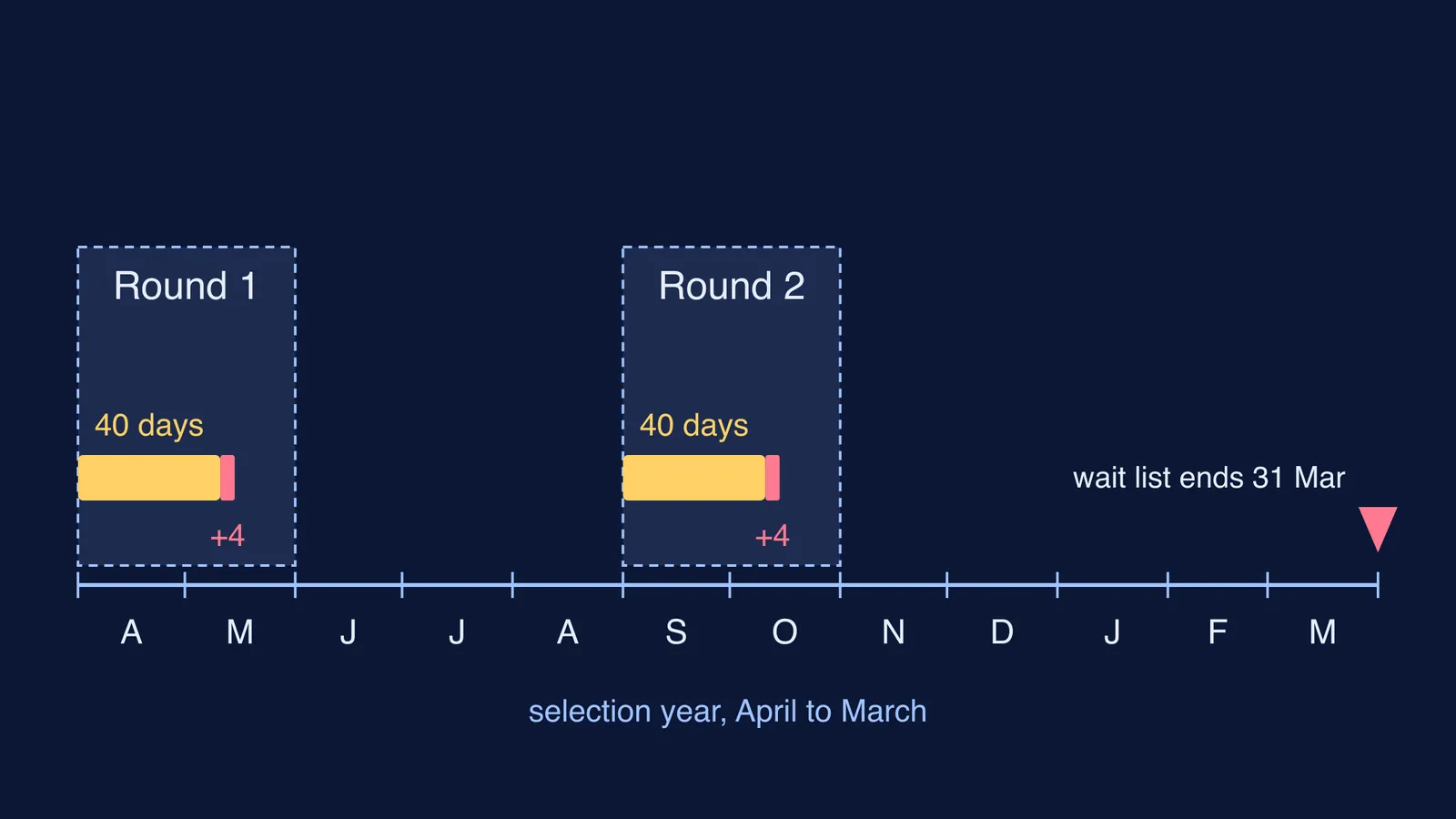
The guidelines say the selection year runs from April to March. The portal opens for the first round in April or May for 40 days, then reopens for 4 days of corrections. If slots remain, a second round opens in September or October on the same pattern. Results go up on the portal, with 30 calendar days to raise a grievance. This timeline is tentative; exact dates come in each year's notice.
A simple tracking plan:
Bookmark the official portal, nosmsje.gov.in, where you apply online to the Ministry.
Each March and August, check the portal, socialjustice.gov.in and newspapers for the new notice.
Put both windows, plus the 4-day correction window, on a scholarship tracking calendar.
Collect documents early, including every semester marksheet and, if your university gives only CGPA, its conversion formula.
A worked example: does this application qualify?
Take a hypothetical applicant, Ananya, 22, who finishes a BTech with 71%. Her family's income for FY 2025-26 is ₹6.4 lakh, and she has a Master's offer from a university in the QS top 500, conditional on her final transcript. Checking her against the guidelines:
Marks: 71% clears the 60% bar.
Income: ₹6.4 lakh is within ₹8 lakh. As it is above ₹3 lakh (new tax regime), she must upload ITR acknowledgements when applying and complete family ITRs before the final award letter.
Age: well under 35.
Offer: still conditional, so it cannot be considered yet. She should aim for the September or October round, if slots remain, once the university confirms.
If a few undergraduate topics feel shaky before a STEM Master's, the Fermi Concept Library has a lesson for each concept in physics, chemistry, biology, mathematics and computing, so you can close gaps before your first semester.
If you would rather study in India, read our explainer on the Top Class Education scheme for SC students next.


