

On this page
If your batch starts at 7:00 and you live in a coaching hostel, your morning is short. Most of the routine happens the night before. The morning itself needs three things: room for the groggy first half hour, a short recall block, and leaving early enough that you never run.
How much sleep do you need before an early batch?
A panel of 13 sleep experts convened by the American Academy of Sleep Medicine recommends that teenagers aged 13 to 18 sleep 8 to 10 hours per 24 hours on a regular basis.
Work backwards from your alarm. If you wake at 5:30, eight hours means being asleep by 9:30 pm. For many hostel students that sounds impossible, because evening classes, dinner and homework all pile up after 7 pm. Treat it as the number to aim for, not a rule you've failed. Moving lights-out a little earlier, step by step, is a reasonable start. If you are sleepy late at night and wide awake at midnight, that has a biological side too, explained in why teenagers feel sleepy late.
What should you do the night before?
A few minutes before bed saves a rushed start in the morning. Do these in the same order every night:
Pack your bag for tomorrow's timetable: modules, notebook, two pens, ID card, water bottle.
Put tomorrow's clothes on the chair.
Write three recall questions on a card or sticky note, from today's classes. For example: "Why is acceleration non-zero in uniform circular motion?", "State the ideal gas equation and the units of R", "What is the order of a reaction?"
Set the alarm and put the phone across the room, so you have to stand up to stop it.
Tell your roommate your wake-up time if you share a room, so neither of you is surprised.
The evening after coaching routine covers how to fit this into the rest of your night.
Why do you feel so slow right after waking?
That fuzzy feeling has a name: sleep inertia. A 2020 review in Frontiers in Physiology says that sleep inertia typically takes 15 to 30 minutes to clear, and some studies have found that performance may not settle fully until about 2 hours after waking.
The same review notes that there is limited evidence that countermeasures such as light, washing your face or caffeine clear it within 15 minutes of waking. So do not plan hard thinking for the first half hour. Use it for jobs that need no brainpower: drink water, wash, brush, dress. Your study block comes after.
What does a 90-minute morning look like?
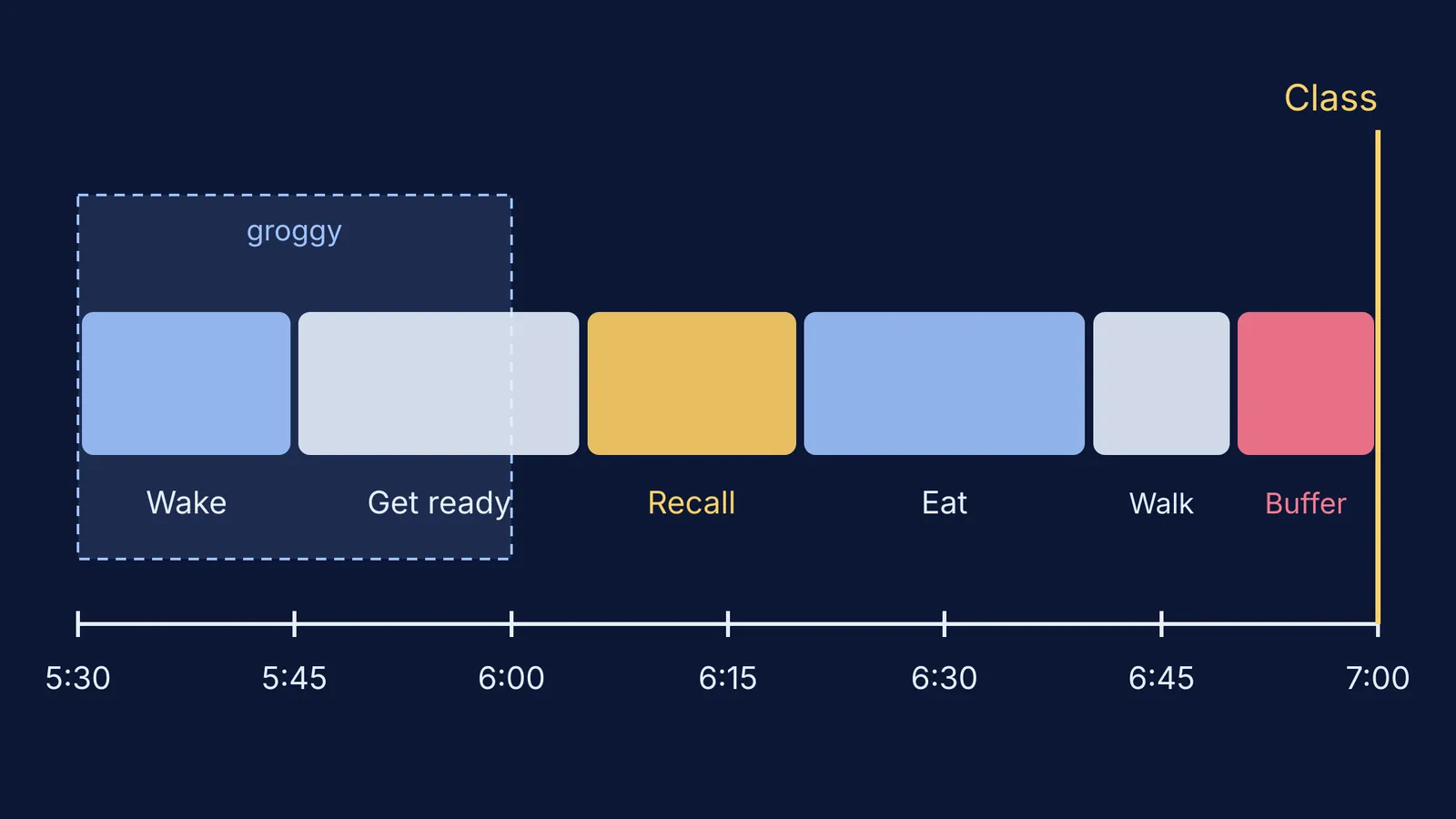
Here is a worked plan for a 7:00 batch, with a ten-minute walk from hostel to centre. Shift every time if your batch starts earlier or later.
5:30: alarm across the room. Stand up, drink a glass of water, open the curtain or switch on the light.
5:45: wash, brush, dress in the clothes you laid out.
6:05: recall block, 15 minutes (see below).
6:20: breakfast at the mess, or your own food if the mess opens late.
6:40: leave. Bag is already packed.
6:50: arrive with ten minutes to spare. Find your seat, open the notebook, read the board.
The buffer matters more than it looks. A late lift, a long mess queue or a missing ID card can eat several minutes. Without a buffer, one small delay means running in and missing the first explanation of the day.
How do you do a 15-minute recall block?
Take out last night's card. Close your notes. For each question, write the answer from memory in your notebook, including any formula or diagram. Then open your notes and check. Mark anything you got wrong or couldn't remember, and put it at the top of tomorrow's card.
Why recall and not reread? In a 2006 study in Psychological Science, students who took recall tests on prose passages remembered more on tests two days and one week later than students who restudied the same material. Restudying did better on a test five minutes later and made students more confident, which is why it feels like it works. For more on this habit, see a short recall before each class.
If one question keeps coming back wrong, the gap is often a concept, not a fact. The Fermi Concept Library covers every concept in physics, chemistry, biology, mathematics and computing, each with its own lesson, so you can read the one you're missing that evening rather than guessing in the morning.
What if mornings feel too hard every day?
Some tiredness is normal in the first weeks of a new batch. If you are dreading every morning, cannot sleep even with the lights off, or feel low most days, tell someone: a parent on your next call, your hostel warden or a counsellor at your centre. You can also call Tele-MANAS, the Indian government's free mental health helpline, on 14416, toll-free and available 24/7.
Tonight, write your first three recall questions and put your phone across the room.


