On this page
Some evenings you sit down after school or coaching and there is nothing left. Forcing a full session or skipping with guilt are both bad options. The third is a minimum study day: a fixed 45-minute list of small tasks you decided in advance, done instead of your normal plan.
What should you study when you have no energy?
Stick to things you have already met. New material takes attention you don't have today. A low day suits three kinds of work: pulling things back from memory, re-solving familiar problem types, and fixing mistakes.
Recall is a good fit for a low day. In Roediger and Karpicke's 2006 experiments, students who took recall tests on a passage remembered substantially more two days and one week later than students who simply restudied it. The study did not test tired students, but recall needs no new material, so it is easy to start.
Does skipping one day break your study habit?
Probably not. In a habit-formation study by Lally and colleagues, 96 volunteers repeated a chosen daily eating, drinking or activity behaviour in the same context for 12 weeks. Missing one opportunity to perform the behaviour did not materially affect the habit formation process. The behaviours were not studying, but the finding suggests one gap is not a reset. Habits also build slowly: reaching 95% of their own peak automaticity took participants anywhere from 18 to 254 days.
The real danger is one missed day turning into a missed week, because restarting from zero feels heavy. A minimum day keeps the same desk, time and open notebook, so tomorrow is a normal day, not a restart.
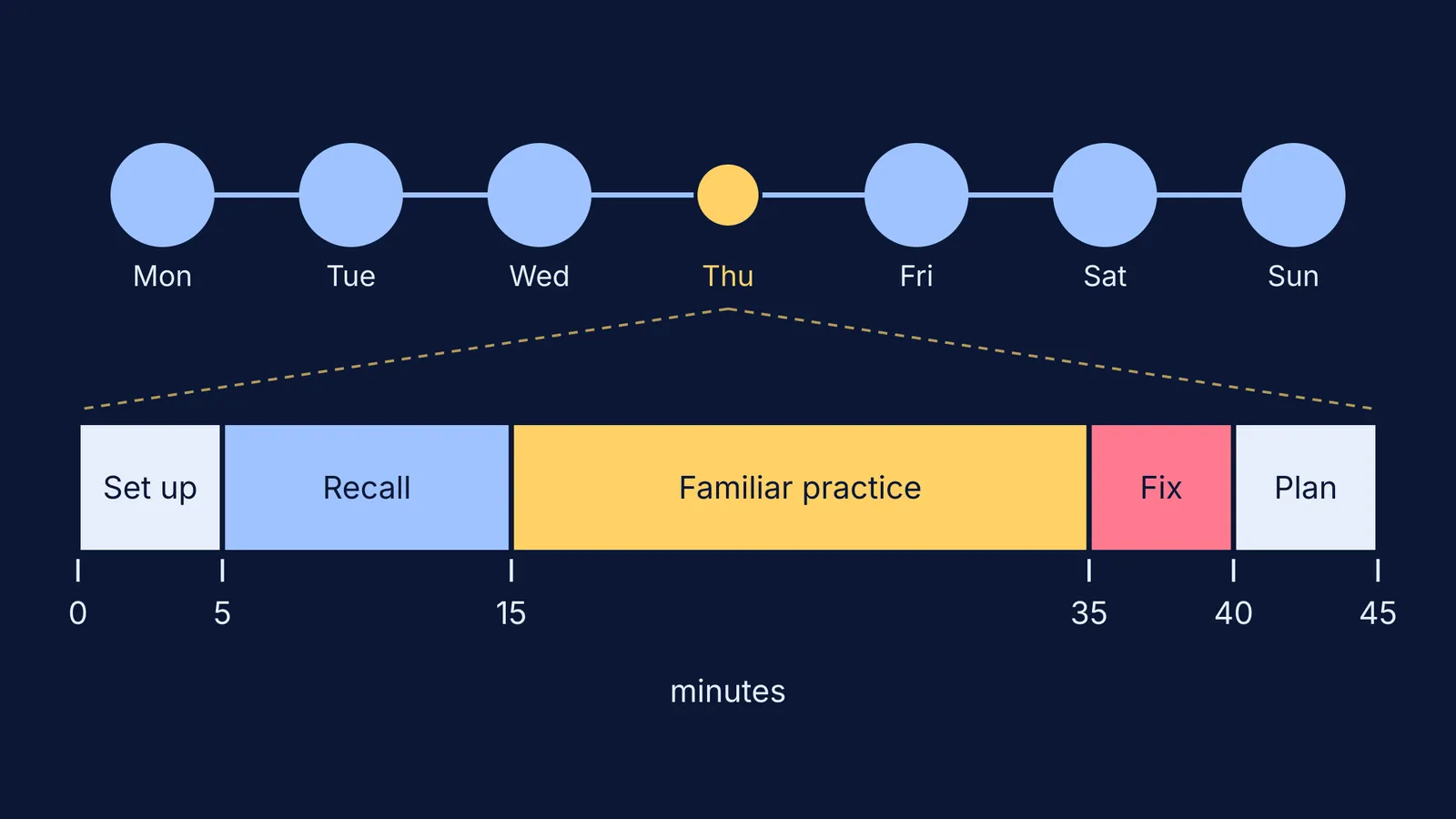
What goes into a 45-minute minimum study day?
Minutes 0-5, set up: clear the desk, put the phone in another room, open the notebook where you stopped yesterday.
Minutes 5-15, recall: pick one topic from this week and write every formula, definition or step you remember on a blank page. Check against your notes and mark the gaps.
Minutes 15-35, familiar practice: solve three to five problems of a type you have solved before.
Minutes 35-40, fix one mistake: redo one question from your error log or your last test, cleanly.
Minutes 40-45, set up tomorrow: write tomorrow's first task in one line, specific enough to start without thinking.
Then stop. If you want to carry on, you may, but the day counts as done at 45 minutes.
Make starting automatic with an if-then plan. Gollwitzer and Sheeran describe implementation intentions as if-then plans that link a situation to a response that helps you reach a goal. Yours could be: "If I sit down at 7 pm and feel I have nothing in me, then I open the minimum list instead of my full plan."
Worked example: a low Tuesday in Class 12
A JEE Main aspirant gets home from coaching at 8 pm, drained after a test. The plan says "Start rotational motion, part 2." Instead:
8:30-8:35: opens the notebook at yesterday's last torque problem.
8:35-8:45: writes moments of inertia of a ring, disc, rod and sphere from memory, checks, circles two wrong ones.
8:45-9:05: solves four torque problems from last week's sheet.
9:05-9:10: redoes one test question lost on a sign convention.
9:10-9:15: writes "Tomorrow, 7 pm: rolling without slipping, questions 1-5."
If a familiar problem still won't come out, the Fermi Problem Library has a step-by-step solver that explains the reasoning rather than printing an answer, so one stuck problem doesn't eat the whole session. To make tomorrow's start even easier, try stopping mid-problem so you can restart fast.
How do you stop feeling guilty about a short study day?
Treat the minimum day as the plan working, not failing. In a study of 134 first-year university students, Wohl, Pychyl and Bennett found that students who forgave themselves for procrastinating on their first set of exams were less likely to procrastinate before the second round, as the British Psychological Society's Research Digest summarised.
Parents can ask "Did you do your minimum?" instead of "How many hours?", and accept yes as a full answer.
If you need several minimum days a week, look for the cause. Sleep is the first suspect: the CDC recommends 8 to 10 hours of sleep a day for teenagers aged 13 to 17, and our plan for feeling sleepy while studying has practical fixes. If a whole day slipped by with no study at all, use this next-day recovery plan after a wasted day. And when you're back to full energy but unsure where to restart, Fermi's AI tutor can work out what you already know and build a plan for the session.
If low days keep coming, or you feel hopeless or unable to enjoy things you used to, that is not a study problem. Talk to a parent, a school counsellor or a doctor. In India, Tele MANAS is a free, 24x7 national mental-health helpline: call 14416 or 1800-891-4416.
Tonight, on a good day, write your own five-line minimum list and put it at the front of your notebook.