

On this page
You sit down, open the book, flip pages, check your phone, reread yesterday's notes and wonder where you were. A lot of energy goes before you write a line. The easier fix happens the night before: stop while a problem is still open, and leave yourself a note on the next step.
Why is it so hard to start studying the next day?
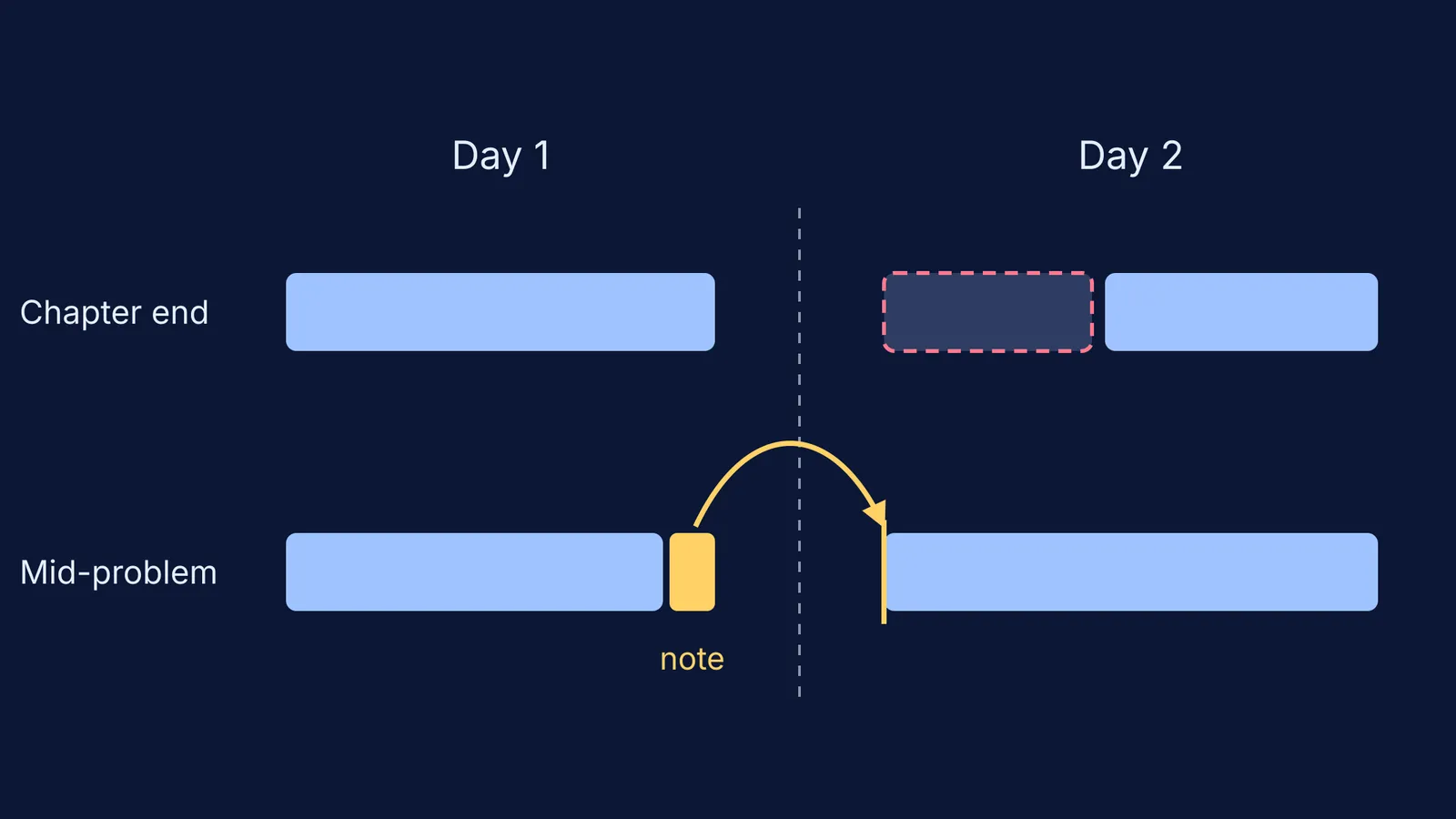
The hard part is often not the work but deciding what the work is. Finish a chapter neatly and close the book, and tomorrow begins with a blank choice: what next, from where, and how?
An unfinished task works differently. The Ovsiankina effect is the tendency to go back to an interrupted task and complete it, and a 2025 meta-analysis by Romain Ghibellini and Beat Meier found it to be a general tendency (Humanities and Social Sciences Communications). The same review found no overall memory advantage for unfinished tasks, so the better-known Zeigarnik effect does not hold up as a general rule. What holds up is the pull to go back and finish.
Does stopping in the middle of a task actually help?
Three lines of research point the same way.
A plan quiets an unfinished task. In experiments by E. J. Masicampo and Roy Baumeister, unfinished goals caused intrusive thoughts during an unrelated reading task and poorer performance on an unrelated anagram task; letting people write a specific plan for the goal removed those effects (Journal of Personality and Social Psychology, 2011).
A ready-to-resume plan frees your attention. Sophie Leroy and Theresa Glomb found that when people expected time pressure on returning to an interrupted task, briefly reflecting on and planning that return reduced "attention residue" and protected performance on the task in between, across four studies (Organization Science, 2018).
Specific "when and how" plans get acted on. A meta-analysis of 94 independent tests by Peter Gollwitzer and Paschal Sheeran found that plans stating when and how you will act had a medium-to-large effect on reaching goals, d = 0.65 (Advances in Experimental Social Psychology, 200638002-1)). For more on these if-then plans, see how to set study goals with WOOP and if-then plans.
These were mostly studies of adults in labs and offices, not Class 11 students at a desk in Pune. But trying it costs you very little.
How do you write a restart note?
Do this at the end of every session.
Stop mid-problem. Set the next question up (read it, draw the diagram, write the givens), then stop before solving it.
Write the very next action in one line, starting with a verb.
Write where it is: book, page, question number.
Write the one thing you are unsure about.
Leave the note on top of the open book.
For a JEE Main physics session on rotation:
Weak note: "Continue rotational motion."
Restart note: "Exercise 7, Q14, page 182. FBD drawn. Next: write torque about the hinge and use torque = I times alpha. Unsure: is I about the hinge or the centre?"
For a NEET-UG biology session:
Weak note: "Revise genetics."
Restart note: "NCERT Class 12, inheritance chapter, dihybrid cross. Next: draw the Punnett square for RrYy x RrYy from memory, then check."
The restart note hands you a first move that needs no decision. Once your pen is moving, it is often easier to keep going.
Can writing tomorrow's plan help you sleep too?
Possibly. In a sleep-lab study of 57 young adults, people who spent five minutes writing a to-do list before bed fell asleep faster than people who listed tasks they had already completed, and more specific lists went with faster sleep (Scullin and colleagues, Journal of Experimental Psychology: General). A restart note is a short, specific to-do list, so it may also help you put the day down.
If worry about studies keeps you awake night after night, a note will not fix that. Talk to a parent, a teacher or your school counsellor, or call the free national Tele MANAS helpline on 14416 (Tele MANAS, Ministry of Health and Family Welfare).
What can parents say instead of "Have you started yet?"
That question often lands as pressure. Try:
At night: "Did you leave yourself a note for tomorrow?"
Next day: "What does your note say you start with?"
If they are stuck: "Just do the first line, then decide."
If a student avoids the desk even with a clear note, the problem is often a feeling, not a plan; see why procrastination is about feelings, not laziness. The note also slots into a study routine that lasts: a fixed start time, and the note's first line as your first focused block.
If you study with Fermi's AI tutor, it works out what you already know and builds a plan for the session, and your progress and notes stay in your library, so the next step is there when you come back.
Tonight, stop one problem early and write the line.


