On this page
Mindfulness means paying attention to what is happening right now (your breath, your body, your thoughts) on purpose and without judging it. Many schools teach it, hoping to protect teenagers' mental health. The evidence is mixed: small benefits in smaller trials, none in the largest.
Does meditation help students?
The fairest answer comes from randomised controlled trials, where one group gets mindfulness and another does not. A 2019 meta-analysis led by Darren Dunning pooled 33 such trials with 3,666 children and adolescents (Journal of Child Psychology and Psychiatry). Across all of them it found small positive effects on attention, executive function, depression, anxiety and stress, and negative behaviour.
The catch is in the comparison group. When the authors kept only the 17 trials in which the control group also did some active programme, benefits remained for just three outcomes: mindfulness itself, depression, and anxiety or stress (Dunning et al., 2019). This suggests that part of what looks like a mindfulness effect may come from taking part in any structured activity.
What did the MYRIAD trial find?
MYRIAD (My Resilience in Adolescence) was designed to settle the question at scale. It randomly assigned UK secondary schools either to teaching as usual (their standard social-emotional lessons) or to a course of 10 lessons of psychoeducation and mindfulness practice; 84 schools and 8,376 students aged 11 to 14 were analysed (Kuyken et al., Evidence-Based Mental Health, 2022).
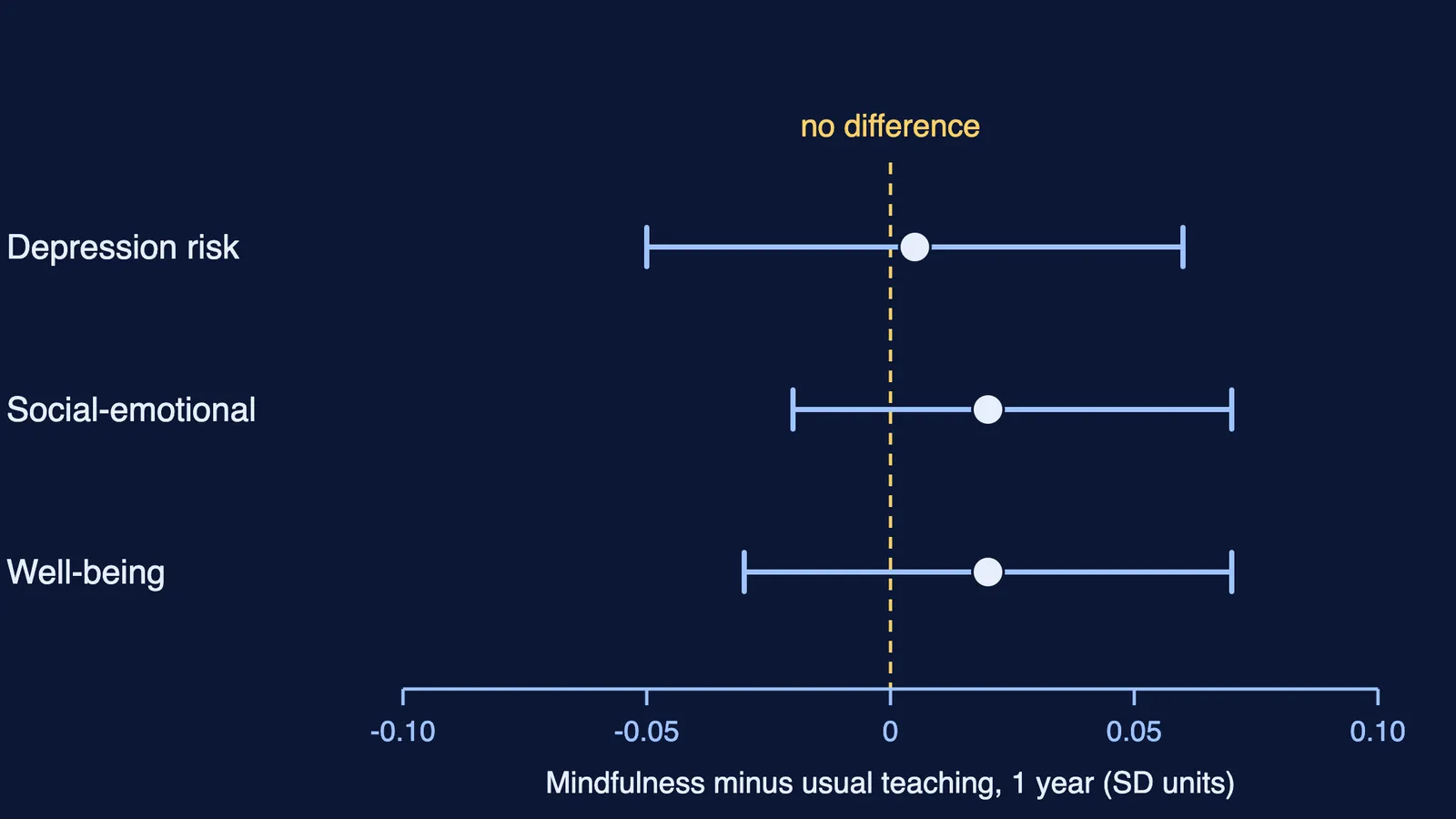
One year later, the MYRIAD trial found no evidence that school mindfulness training was better than usual teaching for depression risk, social-emotional-behavioural functioning or well-being (Kuyken et al., 2022). The differences between the groups were close to zero on all three measures, and no harms linked to the programme were observed.
A companion paper asked who, if anyone, it helped (Montero-Marin et al., 2022). Students already at risk of mental health problems scored slightly worse on depression risk and well-being than similar students who had usual lessons, though the authors judged these differences small and not clinically relevant. Students who gained mindfulness skills did better a year on, but the course did not teach those skills well enough to make a clinically relevant difference. The authors do not recommend this format for whole classes of young adolescents.
Does that mean meditation is useless?
Not quite. MYRIAD tested one thing: a classroom course given to whole classes of young teenagers, whether they wanted it or not. It did not test an older student choosing a short practice for a specific moment, and it was never a treatment for anxiety or depression, which is a job for a trained professional. The honest reading: mindfulness is not a cure-all, and a calming exercise should never replace a study plan, talking to someone, or sleep, which helps you remember what you studied.
How do you try a two-minute practice?
Try this as a personal experiment, not a treatment. Use it at a transition: before you open a chapter, or after a mock test and before you look at the score.
Sit with your feet flat and your phone face down or in another room. Set a two-minute timer.
For the first half-minute, notice three sounds you can hear and two places where your body touches the chair or floor.
For the next minute, follow your breath. Count each out-breath from one to ten, then start again. When your mind drifts to marks or ranks, say "thinking" silently and return to one. Drifting is normal; coming back is the practice.
In the last half-minute, write one line: the single task you will do next, such as "five NCERT questions on electrostatics".
The practice fits neatly at the start of a 25-5 Pomodoro study block. If that next task is a topic you do not understand yet, Fermi's AI tutor can work out what you already know and build a plan for the session, so the two minutes end in a clear next step.
Then test it honestly. For one week, do the practice before half your study sessions and skip it before the rest. Each evening, rate from 1 to 5 how quickly you settled into work. If the practice days are no better, drop it. If it leaves you more anxious or brings up difficult feelings, stop and talk to someone you trust.
What can parents say instead of "just meditate"?
Being told to relax can feel like more pressure. Offer a choice instead: "You seem tense lately. Would you like to try two quiet minutes with me before dinner, or would it help more to talk about what is worrying you?" Then accept either answer. Your own calm matters too; our guide on managing your own anxiety about your child's exams has a plan for that.
Tele MANAS, India's free government mental health helpline, offers counselling and referrals on 14416 or 1800-891-4416 (Tele MANAS). Asking for help early is a sensible decision, not a weakness.