

On this page
The project sheet comes home with two weeks to go. On the second-last night, a parent is cutting chart paper while the student watches. The fix is not "no help at all" but a plan in small steps, done by you, with adults giving hints instead of hands.
Why should you do your school project yourself?
More parent help does not reliably pay off in middle school. A 2008 research synthesis pooled 22 samples from 20 studies and found that parent involvement in homework was linked with lower achievement-related outcomes for middle school students, but better outcomes for primary and high school students (Patall, Cooper and Robinson, Review of Educational Research, 2008). These studies were correlational, so they cannot prove that help causes harm. Parents setting rules, such as a fixed time and place, showed a stronger link than other kinds of involvement.
The kind of help matters. Across two studies of 110 and 121 mothers, controlling help predicted lower engagement and performance, while help that supported the child's independence predicted better performance, mainly for children who were struggling (Ng, Kenney-Benson and Pomerantz, Child Development, 2004). As Eva Pomerantz, a psychology professor, put it in a University of Illinois release: "When mothers respond to their children in a manner that supports autonomy, children doing poorly actually experience increases in their performance during their interactions with their mothers and the next day."
How do you plan a school project in steps?
Split the project into five steps and give each one a day, a time and a place. A plan written as "If it is 5 pm on Tuesday, then I will sit at the dining table and list three sources" is called an implementation intention. A meta-analysis of 94 independent tests found that these if-then plans had a medium-to-large effect (d = 0.65) on reaching goals (Gollwitzer and Sheeran, 2006).
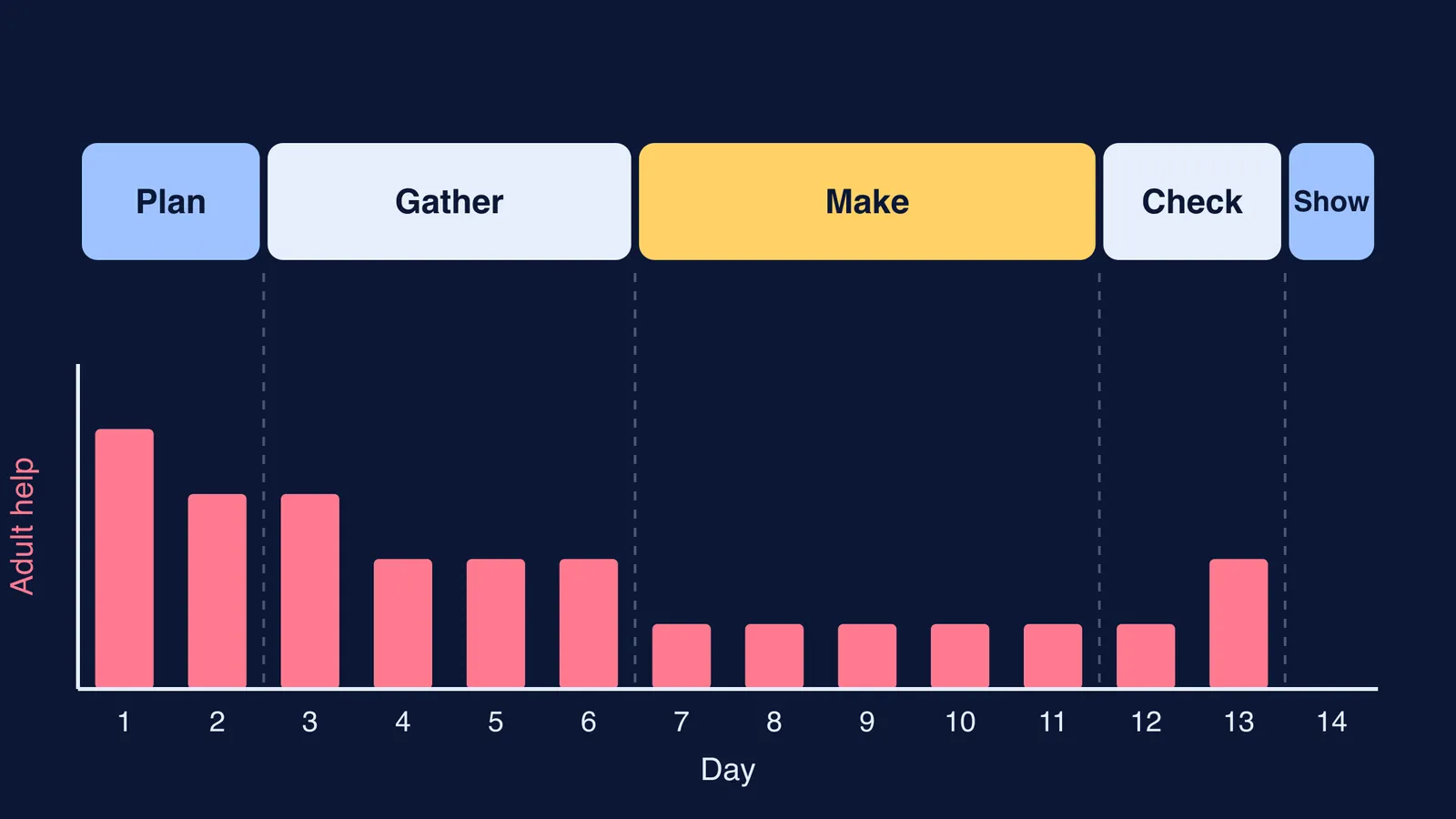
Plan (days 1-2). Read the brief twice. Underline what to hand in, the marks and the deadline.
Gather (days 3-6). Use your textbook, the library and a trusted website. Write the source next to every note.
Make (days 7-11). Write, draw, build or measure, one small task per sitting.
Check (days 12-13). Tick the brief line by line and read your report aloud.
Show (day 14). Hand it in. Because you checked early, a torn chart is a small problem.
To fit these sittings around homework and play, see this daily routine for a Class 7 student.
A worked example: a Class 7 project on water at home
Say the brief is "Study how your family uses water and suggest ways to save it", due in two weeks.
Day 1: List what to submit: a report, a chart and a short talk.
Day 2: Turn the topic into one question: "Where does most of our water go on a normal day?"
Days 3-4: Read the water chapter in your textbook and note key terms.
Days 5-6: Make a tally sheet. Each family member marks every bucket, flush and tap use for one day.
Days 7-9: Count the tallies, draw a bar chart by hand and write what it shows.
Days 10-11: Write three suggestions that fit your home, each with a reason.
Day 12: Check every point in the brief.
Day 13: Practise your talk in front of a sibling or parent.
Day 14: Submit.
The adults filled in a tally sheet and heard a practice talk. Everything else was the student's.
How much should parents help with a school project?
Less as the project goes on. In the 1976 study that gave teaching the word "scaffolding", a tutor gave hands-on help to three-year-olds about twice as often as to four-year-olds and four times as often as to five-year-olds (Wood, Bruner and Ross, 1976; summarised by Structural Learning).
Helpful: setting a time and place, asking questions, buying materials, handling anything unsafe (sharp cutters, hot glue, travel). Not helpful: choosing the topic, writing sentences, redrawing the chart neatly.
A script for parents when your child says "Can you just do this bit?":
"What does the brief say this part needs?"
"What have you tried so far?"
"I will check back at 7. Show me what you have then."
And one for students: "Tell me one thing that is unclear, but please don't fix it."
What if you get stuck halfway?
Name the stuck point in one sentence. If the brief is unclear, ask your teacher rather than guessing. If working alone is new, start with how to study on your own: plan, check, then ask.
If the science itself is the problem, the Fermi Concept Library has a lesson for every concept in physics, chemistry, biology, mathematics and computing. If you do not know where to begin, Fermi's AI tutor works out what you already know and builds a plan for the session, so you start with a clear next step.
Tonight, write your five if-then lines. That is the whole first step.


