

On this page
How much homework should a Class 7 student do?
In Class 7, schoolwork shifts from quick worksheets to independent problem sets and chapter questions. Many families wonder whether an hour of evening study is sufficient or if competitive standards require three or four hours. Research shows that piling on extra study time produces diminishing returns. In a meta-analysis of over 60 studies in the *Review of Educational Research*, Cooper et al. (2006) found that for middle school students, academic achievement gains peak at roughly 60 to 90 minutes of daily homework. Beyond 90 minutes per night, performance plateaus and fatigue erodes motivation.
This evidence supports the "10-minute rule," which allocates 10 minutes of homework per grade level each night, giving roughly 70 minutes for Class 7. Curriculum guidelines from the Central Board of Secondary Education similarly state that middle school homework in Classes 6 to 8 should not exceed 1 hour per day, or about 5 to 6 hours across a school week. When homework extends past this limit, fatigue is usually the culprit. You can explore how much homework helps across different age groups to see how benchmarks change in higher grades.
How much active play and sleep do middle schoolers need?
Outdoor play is not an optional reward; it is essential for learning. The World Health Organization recommends that children and adolescents aged 5 to 17 years engage in at least an average of 60 minutes of moderate-to-vigorous physical activity daily. Active movement increases cerebral blood flow and stimulates neurotrophic factors that support long-term memory. Our review on how physical exercise boosts student learning examines the science behind these movement breaks.
Sleep is equally vital for memory consolidation. A consensus statement from the American Academy of Sleep Medicine recommends that children aged 6 to 12 years regularly sleep 9 to 12 hours per 24 hours. During deep sleep, the brain replays the day's lessons, transferring mathematical concepts and vocabulary into durable neural networks. Sacrificing sleep for an extra worksheet impairs next-day concentration.
Independent reading bridges study and recreation. An influential study by Anderson, Wilson, and Fielding (1988) found that students who read books independently for 20 minutes a day encounter roughly 1.8 million words per year outside school. This volume of reading places students in the 90th percentile of vocabulary growth, outperforming peers who read for fewer than 5 minutes.
What does a balanced weekday timetable look like?
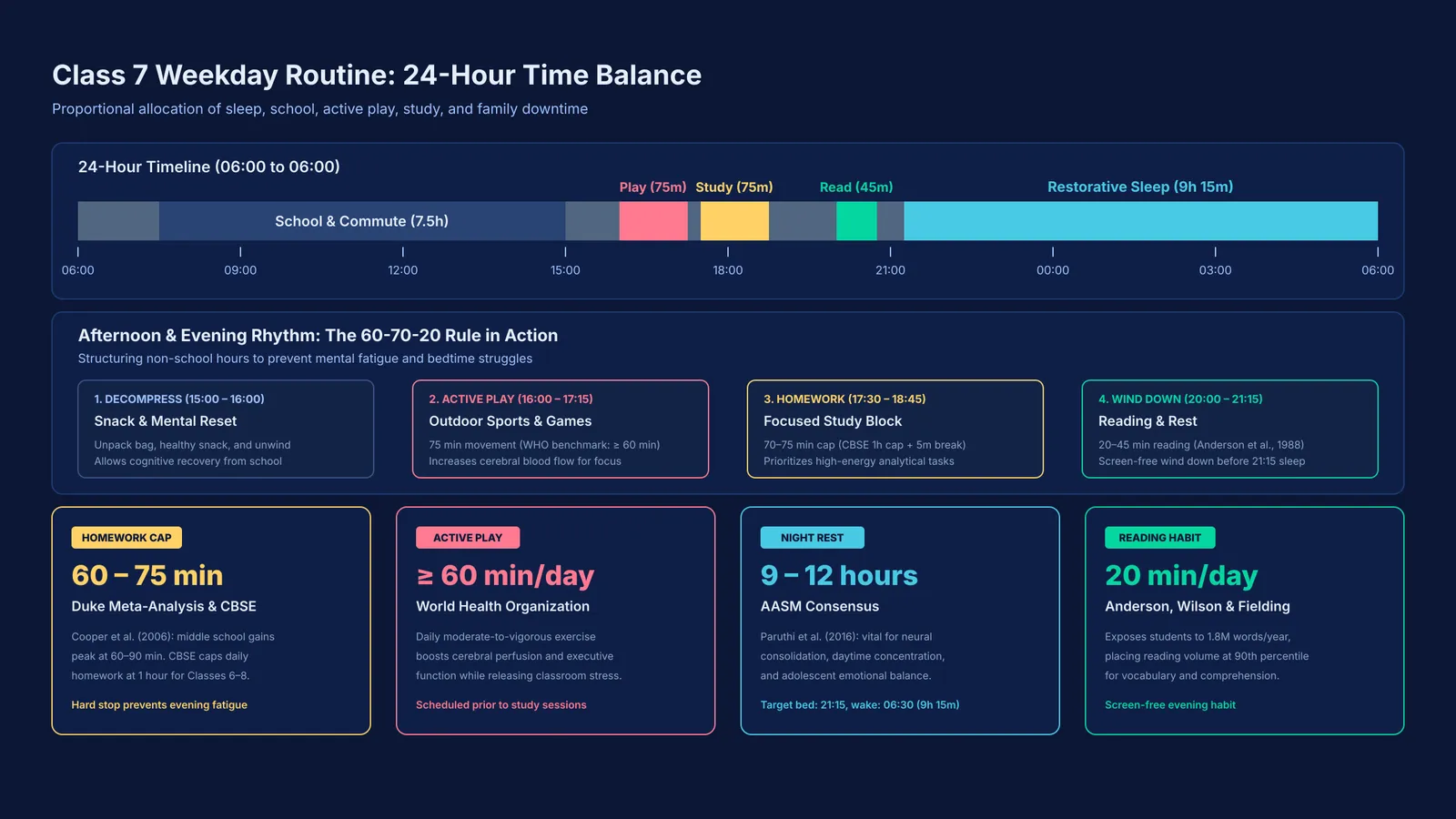
To translate the Central Board of Secondary Education homework limits and World Health Organization activity guidelines into an everyday Indian school schedule, an afternoon routine needs realistic buffers:
06:30 – 07:30: Wake up, breakfast, and school prep
07:30 – 15:00: School day and commute
15:00 – 16:00: Decompress, eat a snack, and talk about the day
16:00 – 17:15: Outdoor play or sports (at least 60 minutes of active movement)
17:15 – 17:30: Wash up, drink water, and clear the desk
17:30 – 18:45: Focused homework block (60 to 75 minutes, with a 5-minute breather)
18:45 – 20:00: Family dinner and unstructured downtime
20:00 – 20:45: Independent reading or a creative hobby
20:45 – 21:15: Pack bag, set out uniform, and wind down screen-free
21:15 – 06:30: Sleep (delivering 9 hours and 15 minutes of rest)
How can a weekly checklist build planning skills?
Seventh graders often know what homework they have, but struggle with task initiation and time estimation. As neuroscientist Adele Diamond (2013) notes in her review of executive functions, the prefrontal cortex—governing working memory and planning—undergoes extensive development during adolescence. Expecting middle schoolers to juggle multiple deadlines mentally leads to forgotten notebooks and evening stress.
An external visual scaffold provides the necessary structure. As detailed in our guide on building a study routine that lasts, habits stick when students help build them. Use this five-step checklist system:
Sunday backpack audit: Empty loose sheets, check stationery, and note weekly deadlines from the school diary.
Sort tasks: Separate daily assignments from weekly project milestones.
Estimate time: Write expected minutes next to each task before starting.
Track progress: Cross off completed items immediately to build momentum.
Friday review: Spend 5 minutes noting what worked, then reset for next week.
What should you do when homework gets stuck?
When a student hits a roadblock in maths or science, sitting in frustration without guidance destroys confidence. Looking up quick answers online bypasses conceptual understanding. Instead, students can consult the Fermi Problem Library, which provides worked problems with a step-by-step solver that explains the reasoning rather than printing an answer.
If the hurdle stems from a missed prerequisite, the Fermi Concept Library covers every concept in physics, chemistry, biology, mathematics and computing, each with its own lesson. When independent study feels unstructured, Fermi's AI tutor can work out what a student already knows, build a plan for the session, and notice where they get stuck to decide whether to explain, ask, or show.
A balanced Class 7 routine builds sustainable habits. By maintaining a research-backed hard stop at 75 minutes of homework (Cooper et al., 2006), families protect outdoor games, reading, and restorative sleep—laying the groundwork for academic stamina.


