

On this page
Board papers in physics and biology often ask you to “state” or “define”, and a close paraphrase can drop the one condition that makes the statement true. Here is a method for tonight: build a keyword skeleton, drill it with cover-and-write, and re-check it on a spaced schedule.
Why does exact wording matter for definitions?
Take Ohm's law as printed in the NCERT Class 10 Science chapter on Electricity (reprint 2026-27): “The potential difference, V, across the ends of a given metallic wire in an electric circuit is directly proportional to the current flowing through it, provided its temperature remains the same.”
It is easy to remember “V is proportional to I” and forget “provided its temperature remains the same”. Without that clause, your answer claims more than the law does.
Biology works the same way. The NCERT Class 10 Life Processes chapter says: “The loss of water in the form of vapour from the aerial parts of the plant is known as transpiration.” Leave out “in the form of vapour” or “aerial parts”, and you have described something vaguer than transpiration.
How do you build a keyword skeleton?
A keyword skeleton is the short list of words a definition cannot lose. You learn the skeleton first, then the connecting words around it.
Copy the definition exactly from your textbook (NCERT for CBSE; your own board's book otherwise).
Underline the words that carry meaning: the quantity, the relationship, every condition and every limit.
Write those words alone, in order, as a numbered skeleton.
Say out loud why each word is there. If you can't, that is a concept gap, not a memory gap.
Worked example, the Ohm's law skeleton:
potential difference, V
ends of a given metallic wire
directly proportional
current flowing through it
provided temperature remains the same
The transpiration skeleton:
loss of water
in the form of vapour
aerial parts of the plant
This is not the “keyword mnemonic” (linking a word to a vivid image), which a 2013 review of ten study techniques by Dunlosky and colleagues rated as low utility. Your skeleton is a checklist for marking your own answer.
If step 4 stumps you, say you cannot explain why Ohm's law needs a fixed temperature, the Fermi Concept Library has a lesson for every concept in physics, chemistry, biology, mathematics and computing, so you can fix the idea before you drill the words.
How does the cover-and-write drill work?
Read the full definition once, slowly, aloud.
Cover it and write it from memory on rough paper.
Uncover it and tick your skeleton words one by one. Circle any word you missed or changed.
Cover it again, wait a minute, and rewrite. Stop when you get two clean copies in a row.
Note the date and the number of tries in your definitions notebook.
Why write instead of reread? In Roediger and Karpicke's 2006 experiments, students who restudied did better on a test 5 minutes later, but students who had taken recall tests remembered more on tests 2 days and 1 week later. Restudying also made students more confident, which is the trap: rereading feels like learning.
A 2008 study in Science by Karpicke and Roediger found that once students could recall foreign-language words, extra studying had no effect on delayed recall, while extra testing had a large positive effect. So a definition you can already write still needs checks, not more rereading.
If you like brain dumps, the blurting revision method is the chapter-sized version of this drill.
When should you re-check a definition you already know?
In a study of more than 1,350 people by Cepeda and colleagues, the best gap between first study and review grew as the final test moved further away. For a test one week later, the best gap was about 20 to 40% of that week; for a test a year later, it was about 5 to 10% of the year.
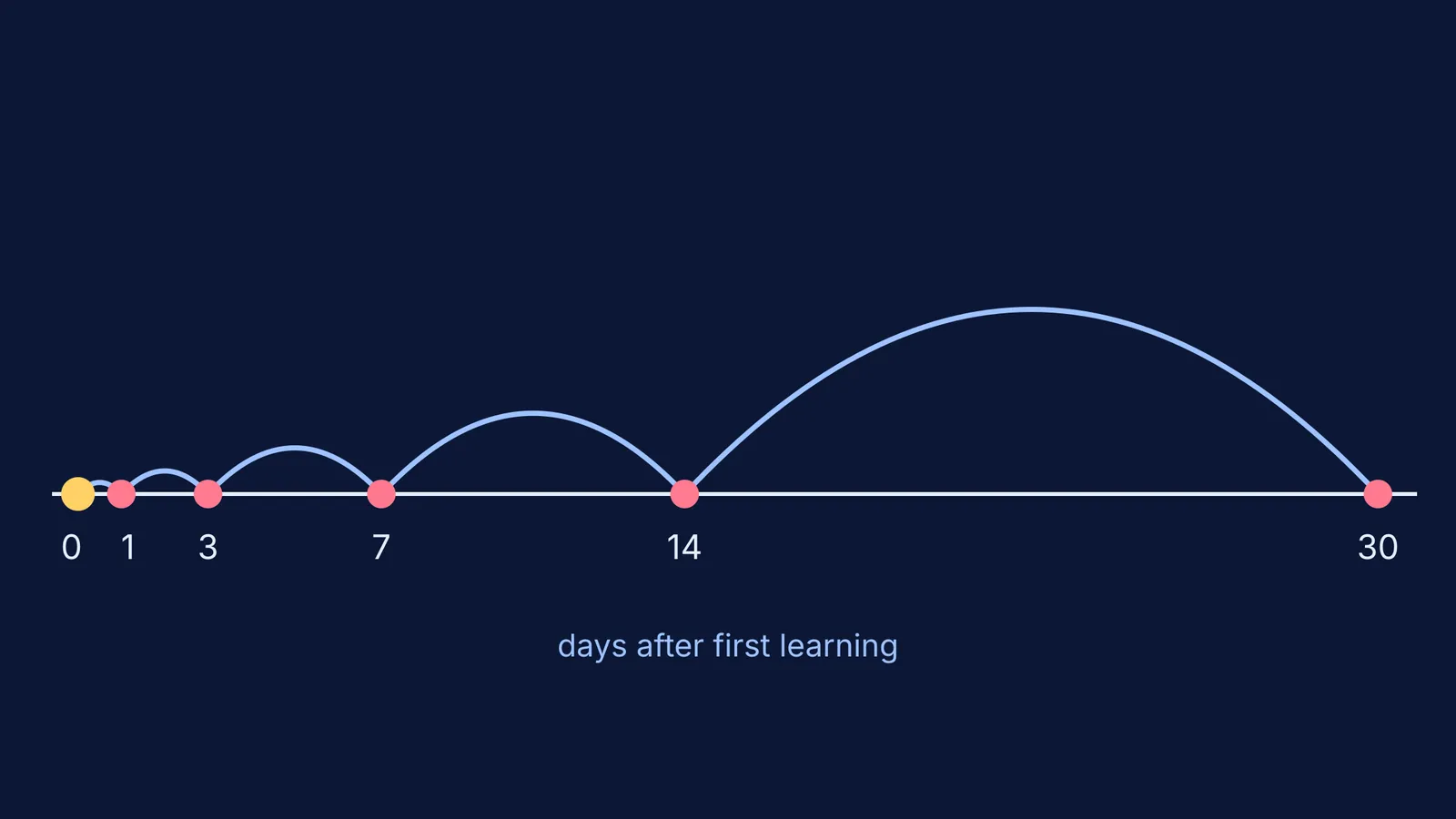
Board exams are months away, so gaps that grow make sense. Here is the plan we suggest (our rule of thumb, not a schedule taken from the study):
Day 0: build the skeleton and cover-and-write until two clean copies.
Day 1: one cold write, then tick the skeleton.
Day 3: one cold write.
Day 7: one cold write.
Day 14: one cold write.
Day 30, then once a month until the exam.
Any miss sends that definition back to day 1.
How can parents help without taking over?
Help with the check, not the drill. Hold the book, read out the skeleton words after your child has written the definition, and let them mark their own sheet. That keeps your child doing the remembering.
For a second pair of eyes on wording, see how to check your definitions with AI for missing keywords. For longer answers, read whether to memorise or understand physics derivations.
Pick five definitions from your next chapter, build their skeletons tonight, and put day 1 in your calendar.


