

On this page
You understand the concept perfectly. You can explain it to your younger sibling, and you can draw the diagram. But when you write the definition in an exam, the examiner awards you zero marks.
This is one of the most frustrating experiences in science exams. The problem is not your understanding. The problem is that exam boards do not mark you for what you know; they mark you for what you can prove you know using their specific vocabulary.
Why do I lose marks even when my definition is correct?
In science exams, missing keywords can significantly reduce your score in open-ended or structured questions. Examiners are instructed not to assume what you mean. Casual language is treated as an observation, not a scientific explanation.
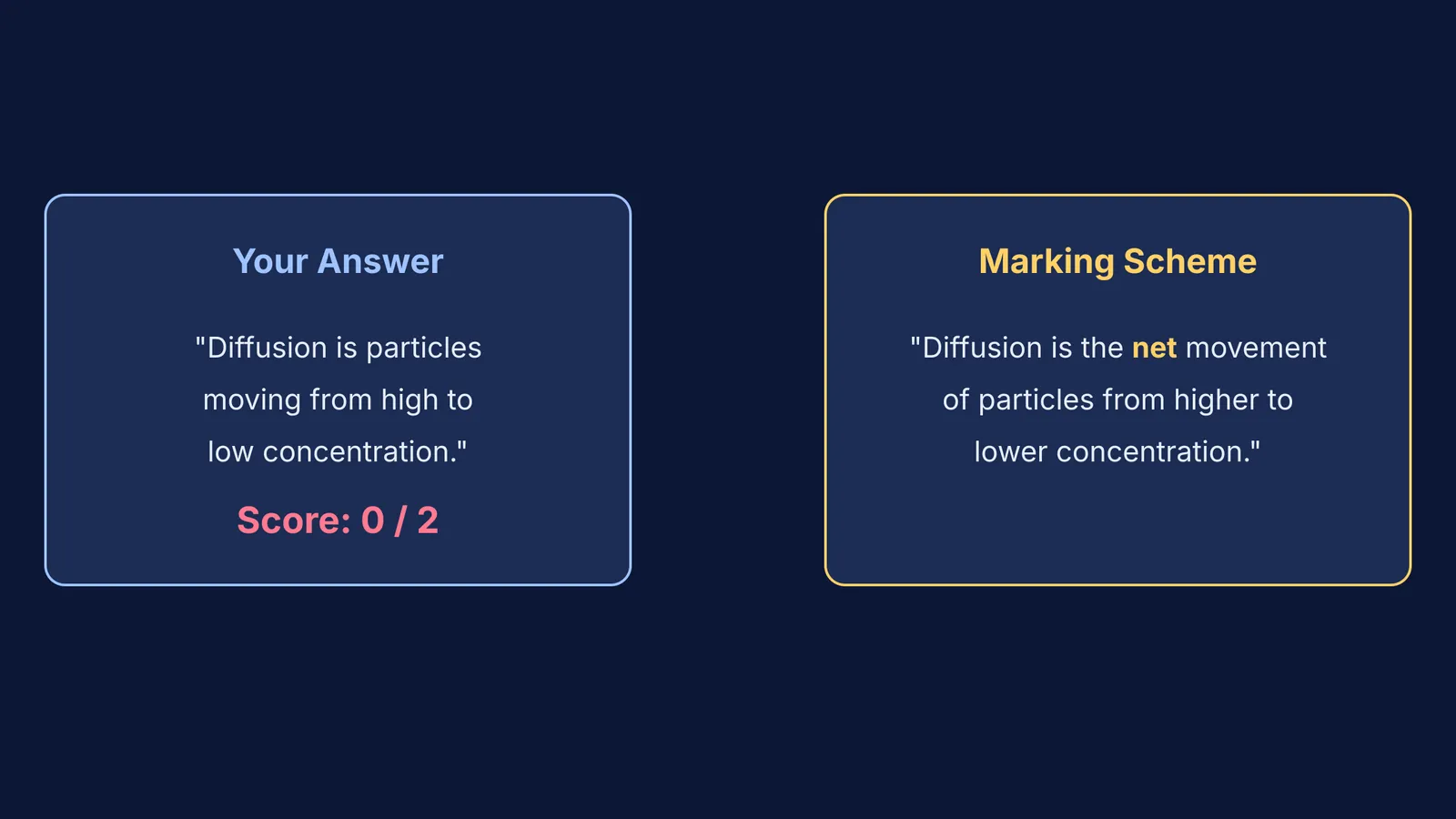
For example, if a question asks you to define diffusion, writing "particles moving from high to low concentration" shows you grasp the basic idea. But the examiner is looking for a specific technical boundary. If you omit the word "net", your answer implies that particles only move one way, which is scientifically false. The correct definition is the *net* movement of particles.
Similarly, describing a bulb glowing "because of electricity" is too vague for a Physics paper. The examiner expects precise terms like "current flowing through the filament" and "heating to incandescence". If your explanation relies on the examiner already knowing the science to make sense of your words, it is too vague.
What is the CBSE value point marking scheme?
Boards like the CBSE follow a strict step-marking policy where examiners do not look for a verbatim recitation of a textbook, but instead scan your answer for Value Points (CBSE Academic). A value point is a core idea, fact, or keyword that must be present in the answer.
If a question is worth two marks, it typically requires two distinct value points. If your definition of a respiratory quotient explains the volume of carbon dioxide evolved but forgets to mention the volume of oxygen consumed, you will lose a value point, even if the rest of your sentence is flawless.
This applies equally to numericals and diagrams. In Physics and Chemistry, value points are assigned independently to the formula, the substitution of values, and the final answer with units. Skipping the formula or forgetting the unit—writing "10" instead of "10 V"—results in an immediate deduction, regardless of how brilliant the mental math was.
The half-match penalty in scientific reasoning
Another hidden trap in the marking scheme is the "half-match" penalty. Students frequently describe what happens but fail to describe why it happens. Missing the "link" keywords—such as "therefore", "leading to", or "resulting in"—fails to show cause and effect.
If an examiner asks you to explain the dispersion of white light by a glass prism, stating that "different colours bend differently" is a half-match. You must link it to the root cause: "because different colours travel at different speeds in glass". Without the causal mechanism, the value point remains incomplete.
How to make the AI check your exact wording
When you study alone, it is hard to spot your own missing keywords. You read your answer, and because you know what you meant to say, your brain naturally fills in the gaps.
This is where you can use Fermi's AI tutor to act as a strict examiner. Instead of asking the AI to define a term for you—which only tests the AI's memory—you can ask it to evaluate *your* definition against the standard board requirements. The AI can compare your phrasing to the required value points and highlight exactly which technical terms you dropped.
A script to test your definitions with AI
To stop losing marks, you need to shift from passive reading to precise communication. Here is a practical prompt script you can use to check your exam readiness. Type this into the AI:
"I am studying for my Class 12 board exams. Act as a strict examiner."
"I will give you a scientific term and my definition of it."
"Do not rewrite the definition for me. Instead, compare my answer to the standard marking scheme."
"Tell me my score out of 2 marks, and point out any missing 'value points' or keywords I need to include to get full marks."
For example, if you are revising the formula for distance in the nth second, type in your explanation of the variables. The AI will tell you if you forgot to specify that the acceleration must be constant.
Practising this way trains you to spot the "weight-bearing" words in every topic. Once you know which keywords the examiner is scanning for, you can write shorter, sharper answers that guarantee full marks.


