

On this page
You have arrived in Kota, Hyderabad, Delhi or another coaching city. You know nobody and everyone looks busy. What works is quiet: the same people, in the same places, again and again, with a few rules so friendship helps your preparation.
How long does it take to make friends in a new city?
Longer than most people expect, so feeling alone in week two is normal. Communication researcher Jeffrey Hall studied adults who had recently moved and first-year university students, tracking how many hours they spent with new acquaintances (Hall, Journal of Social and Personal Relationships).
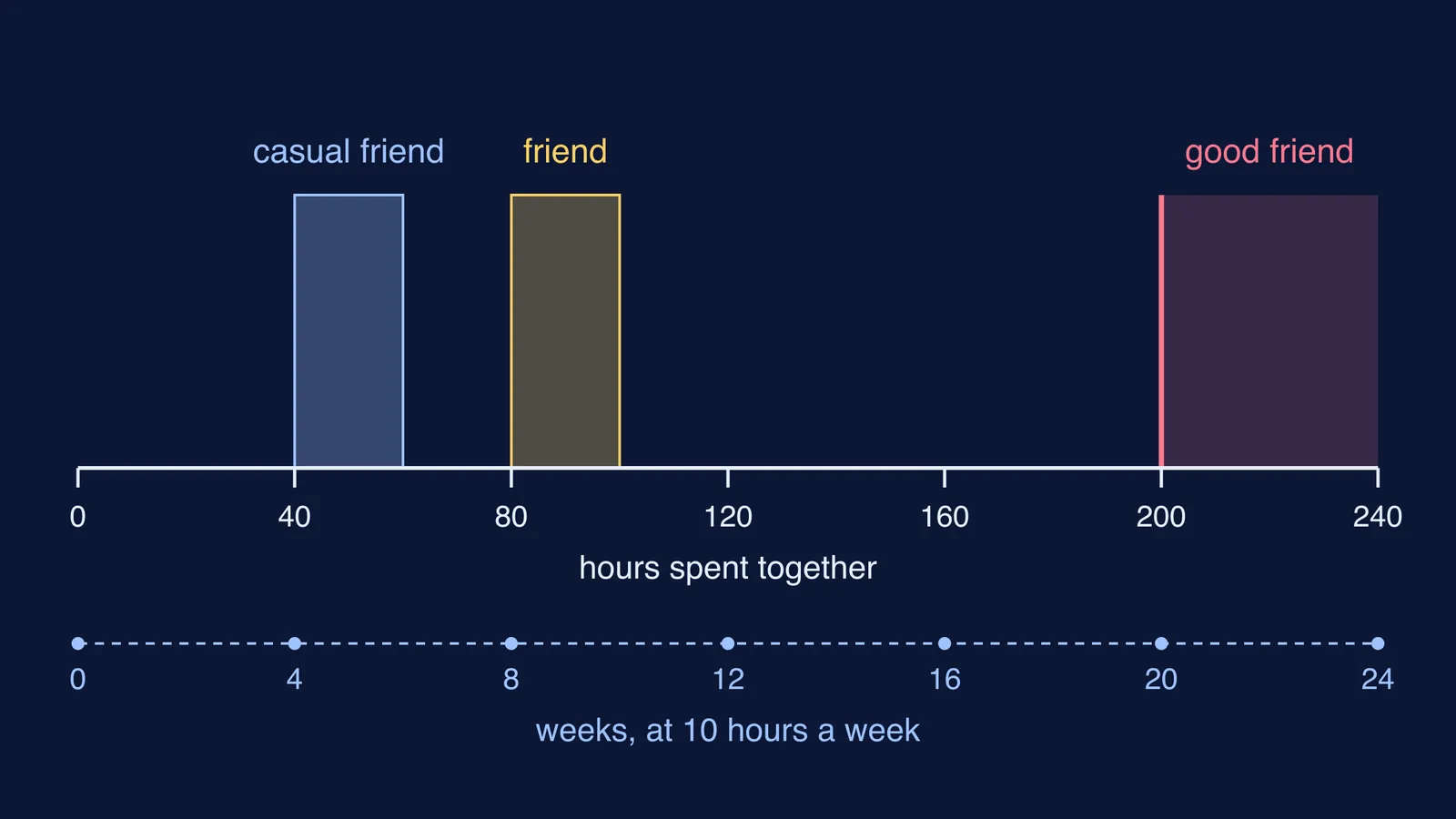
According to the University of Kansas summary of the study, it takes about 40 to 60 hours together to become casual friends, 80 to 100 hours to become friends, and more than 200 hours to become good friends. Not all hours count the same: time spent hanging out and joking around counted for more than hours spent working together, and some kinds of everyday talk also predicted growing closeness.
Where you sit matters too. In a study of 54 first-year students at the University of Leipzig, those randomly given neighbouring seats at a one-off introductory session gave each other higher friendship ratings one year later (ScienceDaily report on Back, Schmukle and Egloff, Psychological Science).
Where do you meet people in a coaching city?
You do not need extra outings. Make the hours you already spend repeat with the same faces.
Sit in roughly the same seat in class and in the self-study room.
Eat at the same mess table or tiffin spot at the same time.
Walk to and from class with whoever lives on your lane.
Go to the same doubt sessions as the people you sit near.
Here is a 10-hour week built from things you do anyway, checked against Hall's figures in the University of Kansas summary:
Walking to and from class with the same two people: 30 minutes a day, 5 days = 2.5 hours.
Lunch or dinner at the same table: 45 minutes a day, 6 days = 4.5 hours.
Two 90-minute study sessions with one partner = 3 hours.
At 10 hours a week you reach the casual-friend range in about 4 to 6 weeks, friend range in about 8 to 10 weeks, and the 200-hour mark in about 20 weeks. Treat these as rough guides: working hours count for less than relaxed time, so the walks and meals matter as much as the study sessions.
How do you find a good study partner in coaching?
A study partner gives you regular, useful hours with one person. Look for someone in your batch who turns up on time, works at a similar pace and is willing to explain as well as ask. Our guide on whether you need a study partner for JEE or NEET covers when pairing helps and when it slows you down.
A script you can use after class: "I'm planning to redo today's DPP in the self-study room at 6. Want to do it together and check answers at 7?" It is specific and easy to say no to, which makes yes easier.
When you are both stuck on the same idea, neither of you should guess. The Fermi Concept Library has a lesson for every concept in physics, chemistry, biology and mathematics, and the Fermi Problem Library has a step-by-step solver that explains the reasoning rather than printing an answer, so you can settle the doubt and get back to working together.
How do you keep coaching friendships low drama?
Coaching is ranked and high-pressure, so agree on a few rules early.
No mark comparisons unless both ask. Share what you learnt from a test, not your rank.
Protect silent hours. Decide together when you talk and when you only study.
Keep money simple. Split bills on the spot and avoid large loans.
Keep a wider circle. Three or four friendly faces are steadier than one best friend.
Fix small problems quickly. Say "That bothered me" the same day, calmly, in private.
If a falling-out does happen, our guide to solving fights between friends in a hostel walks through what to say.
What if you still feel lonely?
You are not unusual. The WHO Commission on Social Connection reports that 1 in 6 people worldwide is affected by loneliness, and that between 17% and 21% of people aged 13 to 29 report feeling lonely, with the highest rates among teenagers.
Keep up regular calls home, keep your routine, and give the hours time to add up. Our piece on homesickness in a coaching hostel has more everyday steps.
The Tele MANAS number and hours are listed by the Press Information Bureau. Start this week with one repeated seat, one shared meal and one study invitation.


