

On this page
Many JEE and NEET students can't say, chapter by chapter, which topics they have only heard in class and which they have actually tested themselves on. A syllabus tracker puts that on one sheet and tells you what each week should hold.
What is a syllabus tracker?
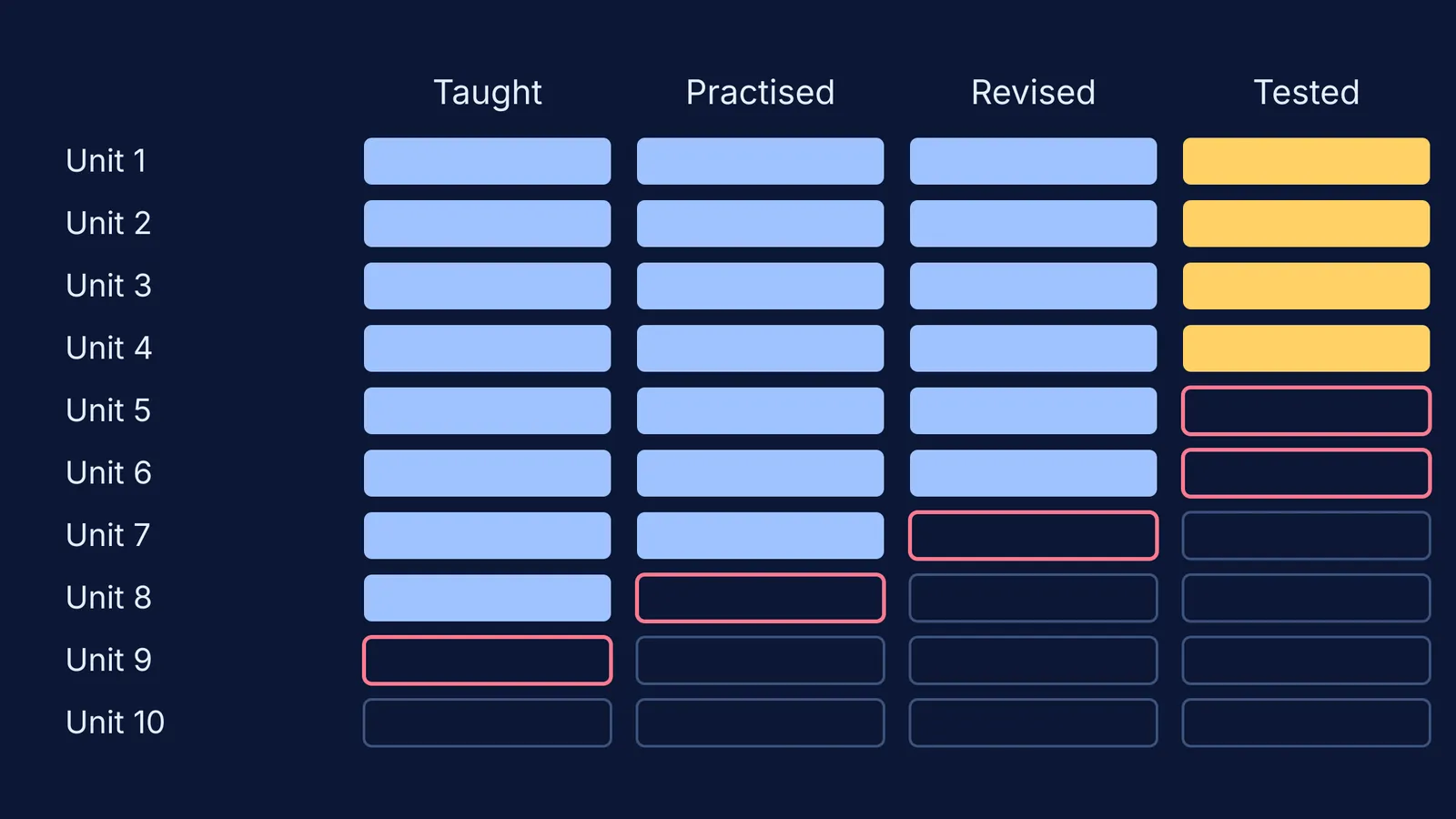
A syllabus tracker is a one-page grid with every chapter of your exam syllabus in rows and four status columns: taught, practised, revised and tested. You write a date, not a tick, in each cell when you finish that stage, so you can see which chapters you have not touched for weeks.
A 2013 review of ten study techniques by Dunlosky and colleagues in Psychological Science in the Public Interest rated only two as high utility: practice testing and distributed practice, which means spreading study out over time. It rated rereading and highlighting as low utility, though most students report using them. The last three columns push you towards testing and spacing.
How do you make a syllabus tracker for JEE or NEET?
Start from the current official syllabus, not a coaching list. The NTA JEE Main website carries the JEE (Main) 2027 syllabus. For NEET (UG), an NTA notice of 8 January 2026 says NEET (UG) 2026 follows the syllabus finalised by the National Medical Commission, so check the NTA NEET website for your exam year's version.
Copy the units into rows, one sheet per subject. The JEE (Main) 2027 syllabus lists 14 mathematics units and 20 physics units, so one A4 page each is enough.
Add four columns, T (taught), P (practised), R (revised) and X (tested), plus a narrow one for the test score.
Date what is already true, strictly: only if you could show the evidence.
What do the four status codes mean?
Fix the definitions once, so a date always means the same thing:
T, taught: you attended the class or read the NCERT chapter and made notes.
P, practised: you solved a set of the chapter's questions without looking at the solutions first.
R, revised: days after P, you wrote the key ideas and formulas from memory, then checked your notes.
X, tested: you took a timed chapter test or a past-paper set and wrote the score in the last column.
R and X both make you pull the chapter out of memory. In an experiment by Roediger and Karpicke (2006), students who restudied prose passages did better on a test five minutes later, but students who had been tested on them remembered substantially more after two days and after one week. The gap between your P and R dates is spacing. A meta-analysis by Cepeda and colleagues pooled 839 assessments of spaced practice in verbal recall tasks from 317 experiments and found that the best gap between study sessions grew as the time until the final test grew.
How do you use the tracker to plan each week?
Every Sunday, take the sheet and a pencil and fill the week in this order:
New T rows: whatever school or coaching teaches this week. You don't choose these, so they go in first.
T without P: chapters taught over a week ago with no practice date.
P without R: chapters practised two or more weeks ago. Book a blank-page revision.
R without X: chapters revised but never tested. Add one or two chapter tests.
Low scores: a weak X score sends that chapter back to P.
A worked example: it is October, you are in Class 12 preparing for JEE Main, and your physics sheet shows Units 1 to 4 fully dated, Units 5 and 6 revised but untested, Unit 7 practised in September, Unit 8 taught last week, and coaching starts Unit 9 this week. This week's plan: attend Unit 9 (T), practise Unit 8 (P), revise Unit 7 from a blank page (R), and take a timed test on Units 5 and 6 (X).
If there are more empty cells than weeks, work out how many chapters per day you need to finish the syllabus and how to split time between revision and new topics. When most rows have an X date, this month-by-month plan for chapter tests and full mocks shows when to move to full papers.
When a row stays stuck at P because the idea never made sense, more questions will not fix it. The Fermi Concept Library gives each concept its own lesson, and Fermi's AI tutor can work out what you already know and build a plan for the session, so you start from the gap rather than page one.
What should parents look for on the tracker?
Look at dates, not filled cells. Many T dates with few P dates means classes are outrunning practice: a planning problem, not laziness. Ask "Which row worries you most?" rather than "Why isn't this done?", and let your child make the plan. If exam worry affects sleep or mood, talk to a school counsellor or call the government's Tele MANAS helpline on 14416.
Print the sheet tonight, date what is already true, and make your first plan this Sunday.


