

On this page
Most students answer "how many chapters a day?" by dividing chapters left by days left. That number is usually too small, because it assumes every day goes to plan. Here is a pace you can keep, plus a five-minute weekly check.
Why does the simple chapters-per-day sum fail?
People tend to be optimistic about their own deadlines. Roger Buehler, Dale Griffin and Michael Ross studied this "planning fallacy" in a 1994 paper in the Journal of Personality and Social Psychology.
In their first study, 37 psychology students predicted when they would submit their final-year thesis. Among those who had submitted, best guesses averaged 33.9 days, the real average was 55.5 days, and only 29.7% finished by the date they had predicted. Even when asked for a worst-case date, fewer than half (48.7%) made it.
In a later experiment in the same paper, the optimistic bias disappeared for people who were told to connect relevant past experiences to their prediction. The fix is building your own history into the plan and leaving room for what always happens: a fever, a family wedding, a forgotten school test.
How do you calculate the pace you need?
Fix the syllabus deadline, not the exam date. If you want the last four weeks for revision and mocks, your deadline is four weeks before the exam.
Weigh the chapters. Count a short or familiar chapter as 1 unit and a long or hard one as 2. Units are closer to hours than chapter counts are.
Count usable weeks. Remove the weeks you already know are lost: school exams, festivals, travel.
Hold back about a third as buffer. Plan the work to fit in two-thirds of your usable weeks. That absorbs work taking up to 1.5 times as long as planned; in the thesis study the gap was about 1.6 times, so treat this as a minimum.
Divide. Weekly pace = total units divided by planned weeks. Spread that across your study days.
What does this look like for a real syllabus?
Take Riya, in Class 12, with 27 chapters left across physics, chemistry and maths. She marks 9 as heavy (2 units) and 18 as light (1 unit): 36 units.
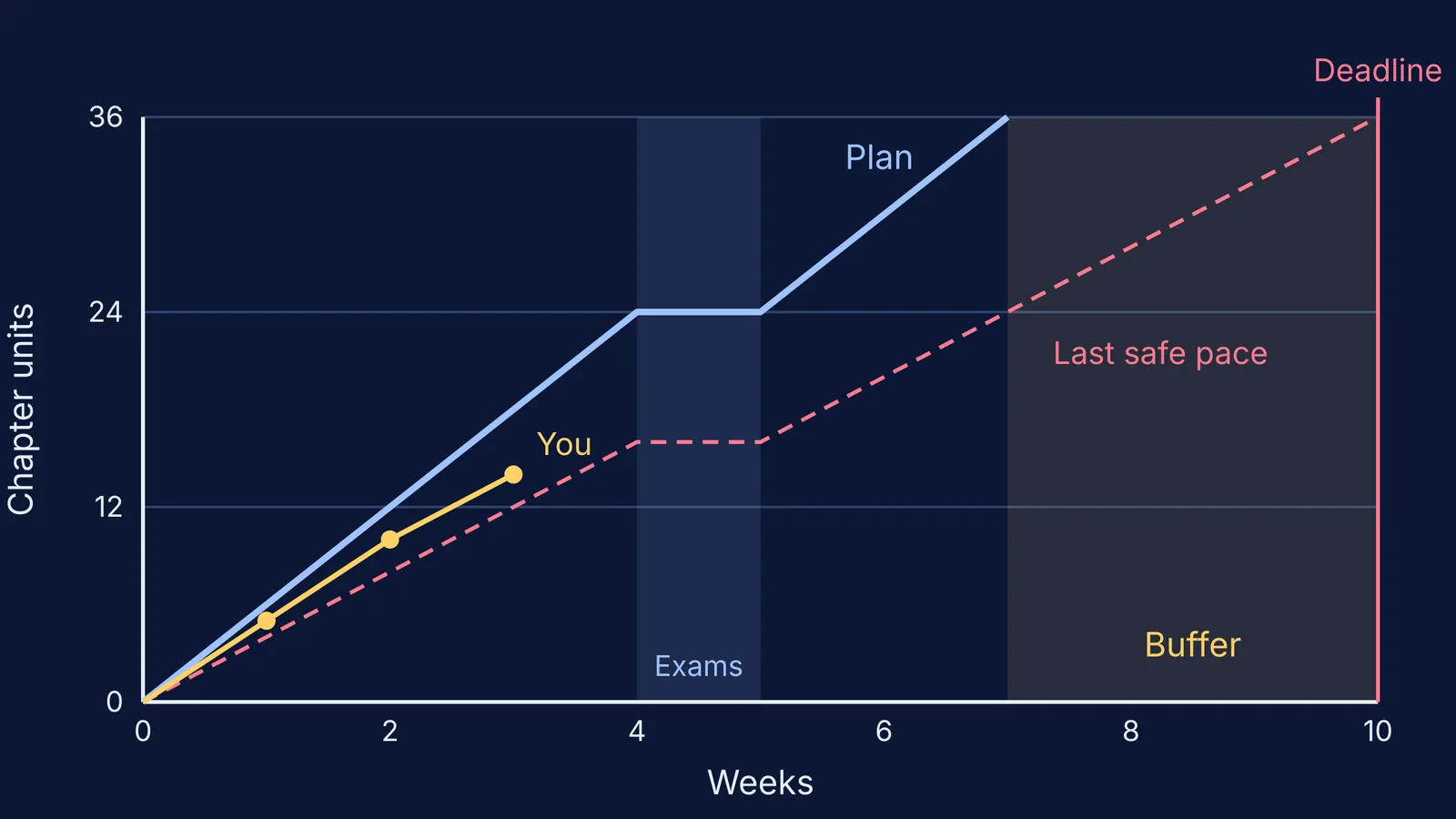
Her board exams are 14 weeks away and she wants 4 weeks for revision, so her syllabus deadline is in 10 weeks. Pre-boards take one, leaving 9 usable weeks. Two-thirds of 9 is 6.
Her pace is 36 / 6 = 6 units a week. Studying six days a week, that is one light chapter a day or one heavy chapter every two days. On plan, she finishes in week 7 with three spare weeks.
She also notes her last safe pace, which only just makes the deadline using every usable week: 36 / 9 = 4 units a week.
How do you check each week if you are on track?
Every Sunday, write down three numbers: units done, units your plan said by now, and units on your last-safe-pace line. A meta-analysis of 138 studies with 19,951 participants found that monitoring progress helped people reach their goals, and the effect was larger when progress was physically recorded or reported to others.
Then read your status:
Green: at or ahead of the plan line. Keep going.
Amber: behind plan, above the last safe pace. You are spending buffer. Fix the cause (one heavy chapter, a lost weekend), not the whole plan.
Red: at or below the last safe pace. Re-plan now: add a session, ask your teacher which topics matter most, or move a chapter into revision weeks on purpose.
At the end of week 3, Riya has done 14 units. Her plan said 18 and her last safe pace said 12, so she is amber. Her 22 remaining units fill about 3.7 of her 6 usable weeks at planned pace, so her buffer has shrunk from three weeks to just over two. Heavy chapters are also taking her more than two days, which goes into next Sunday's plan.
What if one chapter keeps eating your week?
Overruns often come from a few stubborn chapters. If half-done chapters are piling up, our guide to clearing a chapter backlog shows how to sort them. To give your daily units a fixed slot, try weekly time blocking. When the first pass is done, use your revision weeks with a spaced revision schedule.
When a chapter stalls because one idea will not click, the Fermi Concept Library has a lesson for every concept in physics, chemistry, biology, mathematics and computing, so you can fix the gap instead of rereading the chapter. If you do not know where to start, Fermi's AI tutor works out what you already know and builds a plan for the session.
If the plan is making you anxious or costing you sleep, talk to a parent or teacher, or call Tele MANAS, the free 24x7 helpline run by the Ministry of Health and Family Welfare, on 14416.
Write your three numbers down this Sunday.


