

On this page
A coaching centre two hours away can look like the obvious choice: the famous name, your friends go there. But the ride costs you something every day, and families rarely count it. Here is how to put a number on it.
Is it worth travelling two hours daily for coaching?
Sometimes, but only if the far centre gives you something you can't get closer, such as a teacher who explains your weak subject far better. If the classes and tests are much the same as a nearer option, the travel is mostly a loss.
Two things usually pay for the travel: self-study and sleep. Sleep is the one families forget. The American Academy of Sleep Medicine's consensus statement says teenagers aged 13 to 18 should sleep 8 to 10 hours per 24 hours. The same statement says that regularly sleeping less is linked to attention, behaviour and learning problems.
Fatigue matters too. A 2026 study in Frontiers in Psychology looked at 9,449 eighth-grade students in China and found that longer commutes went with lower scores in Chinese, maths and English. Part of that link ran through psychological fatigue and lower engagement with learning. It was a correlational study of school travel, not coaching, so treat it as a warning sign rather than a verdict.
What does a long commute actually cost you?
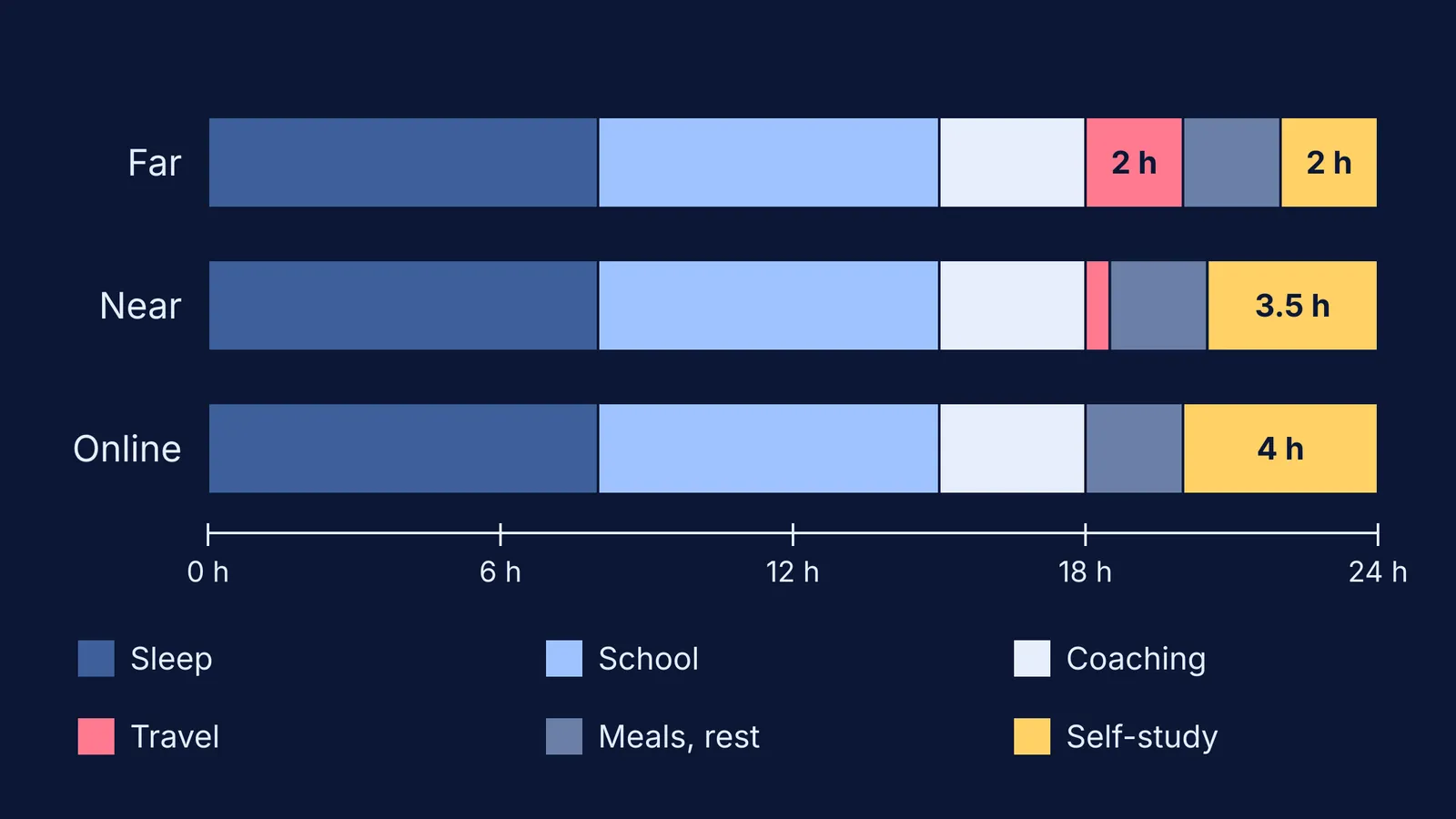
Here is a worked example. These are sample numbers, so swap in your own.
Sleep: 8 hours (the bottom of the recommended range for teenagers)
School, including getting there: 7 hours
Coaching class: 3 hours
Meals, bath, rest: 2 hours
Travel to coaching and back: 2 hours (far centre), 30 minutes (near centre) or none (online)
That leaves 2 hours of self-study with the far centre, 3.5 hours with the near one and 4 hours online. With coaching six days a week, the far centre costs 9 more hours of self-study each week than the near one. If you try to keep the same study hours anyway, the time has to come from sleep, and then you are tired in class.
When is the long trip worth keeping?
Go through this checklist together as a family. If you answer "no" to three or more, look seriously at the alternatives.
Is there a specific teacher or subject here that you can't get nearer?
Can you do useful work on the way, such as a seated train or a bus with no changes?
Do you still get at least 8 hours of sleep on coaching days, the minimum for teenagers?
Do you finish homework and revision most days, not just some?
Is the route safe at the time you come home? Our guide to staying safe on the coaching commute covers late batches and travel alone.
A parent can open the conversation like this: "We're not judging the centre. Can we track one normal week of travel, sleep and study, and decide together?"
Are a nearer centre or online classes a real alternative?
A nearer centre with decent teachers can beat a far one with excellent teachers, because you arrive awake and get home with time to practise. Online classes cut travel to zero but need more self-discipline, since nobody notices a skipped recording. Some families move closer instead. Our comparison of living as a day scholar or in a hostel in a coaching city walks through that choice.
Whichever you pick, the hours you win back only help if you spend them on active practice. If you sit down and don't know where to start, Fermi's AI tutor works out what you already know and builds a plan for the session.
How do you make a long commute work if you keep it?
Use the ride for retrieval, not new learning. A major review by Dunlosky and colleagues rated practice testing and spreading study out over time as high-utility techniques. It rated rereading and highlighting as low utility.
Seated: quiz yourself from flashcards of formulas, reactions or definitions, then check.
Standing or crowded: close your eyes and recall the steps of one worked example from class.
Walking or crossing roads: nothing. Put the phone away.
Some days, just rest. On a safe, seated ride, a short nap may leave you fresher for evening study.
Then guard the evening: eat, do one short block of the day's problems, and stop at a fixed time. Our evening routine after coaching lays out a version you can copy. When a problem from class still doesn't make sense, the Fermi Problem Library has a step-by-step solver that explains the reasoning rather than printing an answer.
If the tiredness turns into constant low mood, dread or trouble sleeping even on weekends, talk to a parent, a school counsellor or a doctor. You can also call Tele MANAS on 14416, the free national mental-health helpline that runs 24x7.
Track one normal week this Sunday, do the sum and decide with numbers in front of you.


