

On this page
Moving to a major coaching city for JEE or NEET preparation forces families to make a critical decision: should the student move into a hostel, or is it better to commute daily as a day scholar? Each path offers a different environment for study habits, independence, and daily supervision.
The choice often comes down to the distance between your home and the coaching centre, the quality of local hostels, and how well the student manages their own time when parents are not around.
Does a long commute affect academic performance?
The biggest drawback of being a day scholar is the time and energy spent travelling. Every hour spent in a bus or auto-rickshaw is an hour not spent studying or resting.
Commuting takes a measurable toll on energy levels. A 2025 study of 244 engineering students at an Indian private university found that commuting time had a negative correlation and a weak or moderate effect on academic performance, with 53% of students reporting that the daily journey hindered their punctuality and regularity. The physical exhaustion of navigating traffic, especially in a busy coaching hub, can leave you with less focus for evening self-study.
If your commute takes more than 45 minutes each way, you will need to plan your week carefully. You can make use of the travel time by reviewing flashcards or mentally recalling formulas, but you must still ensure you have enough energy left for deep work once you get home. For guidance on structuring your limited time, read our guide on Time blocking for students juggling school and coaching.
Hostel vs day scholar: which is better for academics?
While day scholars lose time to commuting, they benefit from a stable home environment. Hostels eliminate the commute, placing you right next to your classes, but they introduce new challenges like homesickness, sharing a room, and managing your own schedule.
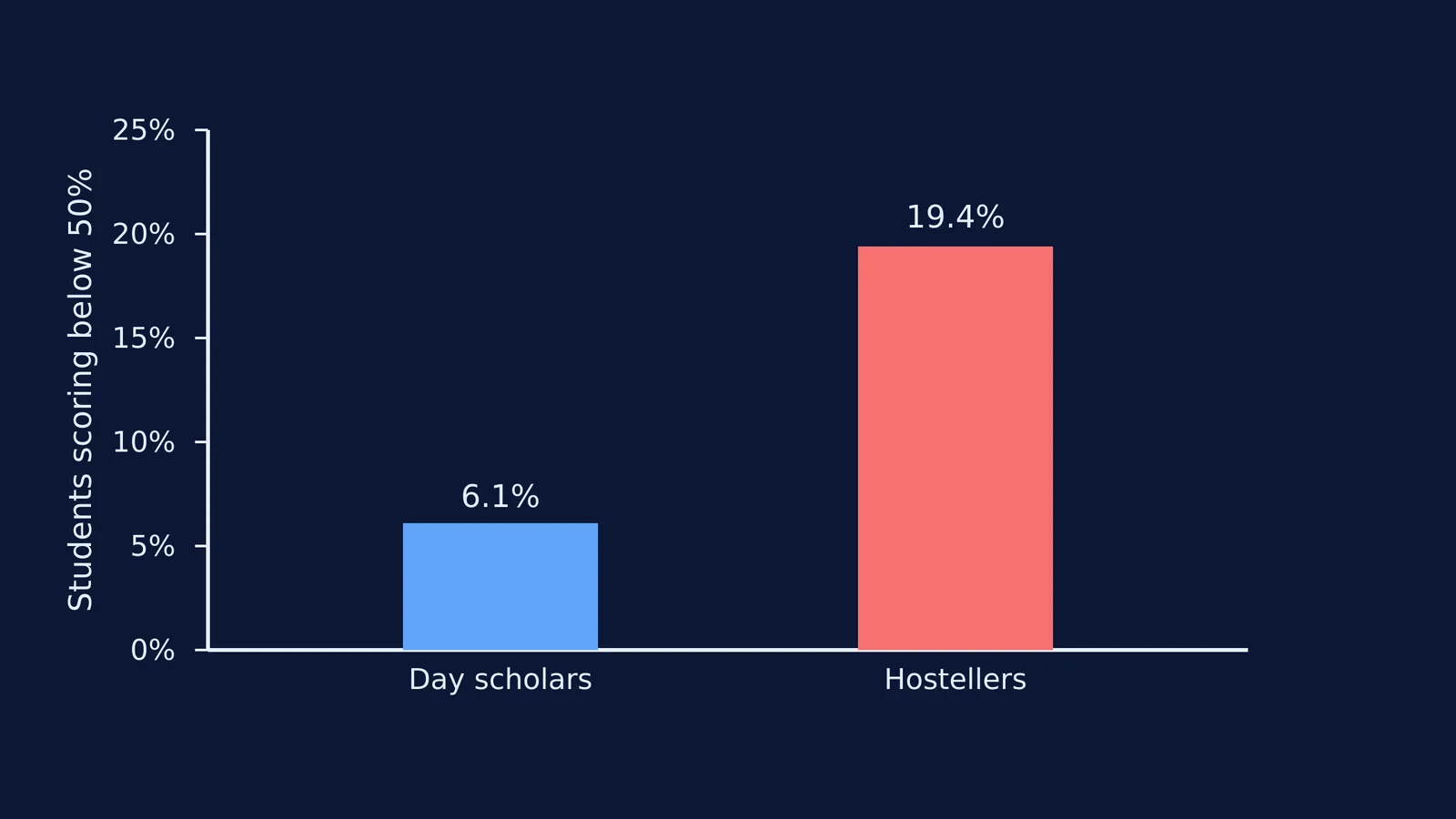
Research suggests the home environment often provides a strong academic advantage. A 2023 study at Saveetha Medical College in Chennai compared the academic performance of 149 first-year students and found that day scholars performed significantly better than hostellers. In their theory exams, only 6.1% of day scholars scored below 50%, compared to 19.4% of the hostel students.
This difference often stems from the emotional support and established routines that come with living at home. In a hostel, you have the independence to study late into the night, but without supervision, it is also easier to lose focus or adopt irregular sleep habits. To maintain consistency, you might want to learn How to build a study routine that lasts longer than a week.
How do food and supervision differ?
Nutrition and health are major factors in exam preparation. At home, you get familiar, home-cooked meals and parents who can immediately help if you fall ill. In a hostel, adjusting to the mess food can take time, and stomach issues are a common complaint during the first few months.
Supervision is another critical difference. Day scholars have daily check-ins with their parents, who can notice signs of burnout or stress. In a hostel, you must advocate for yourself. If you are struggling with a concept late at night, you cannot simply ask a parent. In these situations, Fermi's AI tutor can be a lifeline; it can work out what you already know, build a plan for the session, and explain difficult concepts step by step without you needing to leave your room.
What is the best choice for you?
When deciding between a hostel and being a day scholar, weigh the commute against your ability to self-manage:
Calculate the daily travel time: If the commute is over 90 minutes round-trip, the physical fatigue might outweigh the benefits of home food.
Evaluate your self-discipline: Are you able to stick to a study schedule without being told? If you struggle with procrastination, the structure of a home environment might be necessary.
Consider the hostel environment: Visit the hostel beforehand to check the food quality, room crowding, and noise levels. If you decide to stay in one, read about Studying in a hostel or PG: a setup that works for exam prep.
Plan for backup support: If you choose a hostel, establish a daily phone call routine with your parents to maintain a support system.
Ultimately, the best choice is the one that gives you the most consistent energy and the fewest daily distractions.


