

On this page
No single step of the Krebs cycle is hard. The trouble is that there are many steps, each with a long name, and the exam wants them in order. Rereading feels like progress, but the sequence falls apart when you shut the book. The fix is to stop treating a pathway as one long list.
Why do long biology processes slip out of memory?
Your short-term memory holds very little at once. After reviewing a wide range of capacity studies, psychologist Nelson Cowan concluded that the limit averages about four chunks, fewer than the seven that George Miller wrote about in 1956. A chunk is a group of items you have already bound together, so you can handle it as one unit.
Eight separate names are about twice that limit. Two chunks of four, once each is learned as a unit, sit well inside it.
How do you break a cycle into chunks of three or four steps?
Cut the pathway where something changes: a product leaves, a different kind of reaction starts, or a molecule comes back. Give each chunk a short name that says what happens in it.
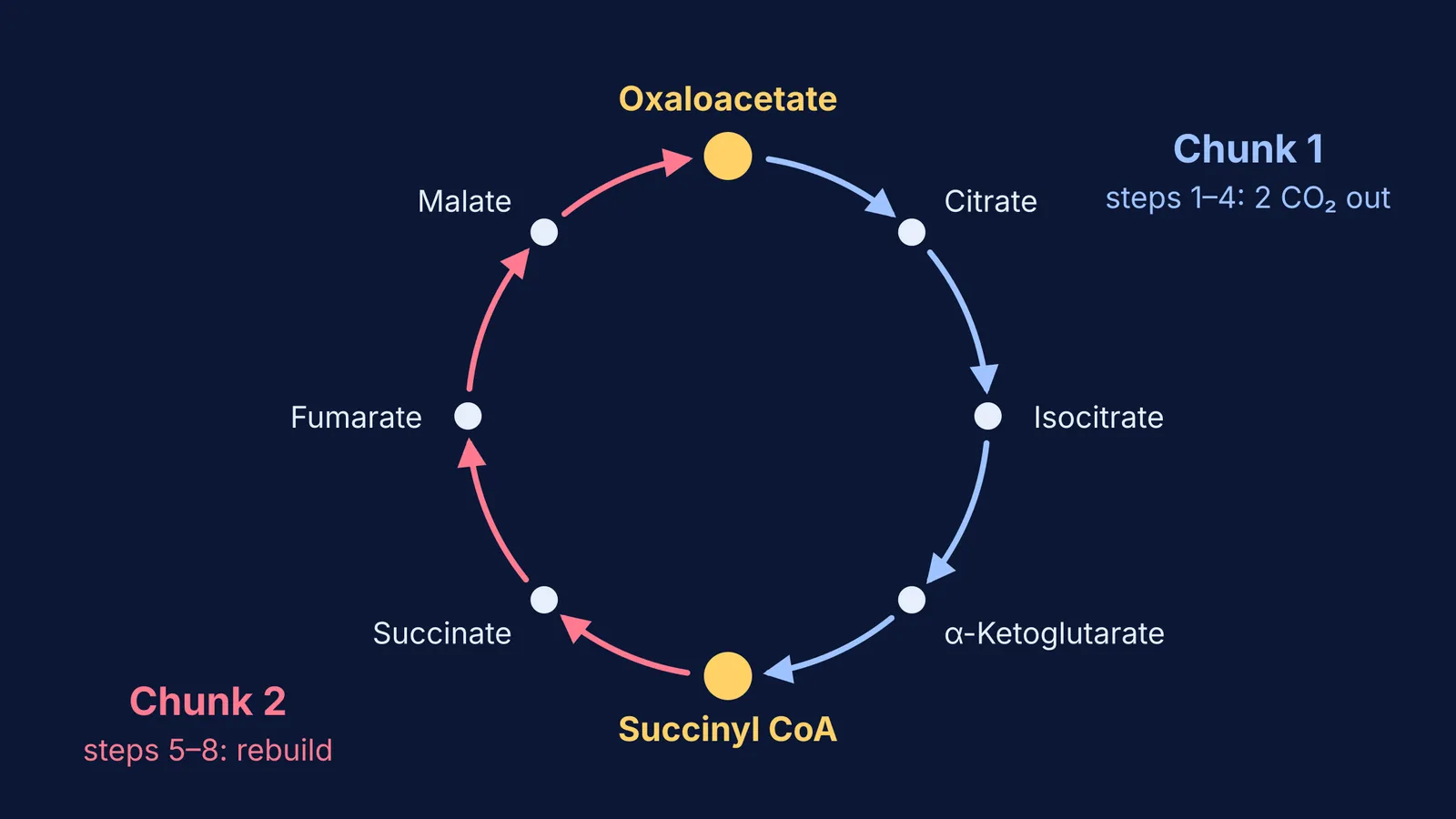
Take the citric acid (Krebs) cycle. OpenStax Biology 2e describes it as eight steps, starting when an acetyl group joins four-carbon oxaloacetate to form six-carbon citrate. One way to chunk it:
Chunk 1, "carbon out" (steps 1 to 4): oxaloacetate + acetyl CoA, citrate, isocitrate, alpha-ketoglutarate, succinyl CoA. Both CO2 molecules leave here, at steps 3 and 4, each with an NADH.
Chunk 2, "rebuild" (steps 5 to 8): succinyl CoA, succinate, fumarate, malate, oxaloacetate. This half makes the GTP/ATP, the FADH2 and the last NADH, and brings the cycle back to its start.
Succinyl CoA ends chunk 1 and begins chunk 2. Oxaloacetate ends chunk 2 and begins chunk 1. These shared molecules are the hinges. For the full product count, see our post on counting NADH, FADH2 and ATP per turn of the Krebs cycle.
Use the same cut on any long NCERT process. If a chunk still has six or more items, split it again.
How do you test yourself on a pathway from a blank page?
Close the book and draw the cycle on a blank sheet from memory. Then open the book and mark, in another colour, what you missed or misordered. Tomorrow, redraw from blank, not from your corrected copy.
This works because recall is itself practice. In Roediger and Karpicke's 2006 experiments, students who took recall tests remembered more of a passage after 2 days and after 1 week than students who restudied it, even though restudying made them feel more confident. In two later studies with 200 students in total, a university press release reports that those who practised freely recalling science texts showed a 50 percent improvement in long-term retention a week later over those who studied by building concept maps. A major review rated practice testing and spaced practice as high-utility techniques, and rereading and highlighting as low-utility.
The lesson: a diagram you copy is just more reading, but a diagram you rebuild from memory is a test. For the full method, see the blurting method for revising from a blank page, and if your drawings get messy, try this simple method for biology diagrams.
What should you test between chunks?
Most mistakes happen at the joins. You can know both halves and still freeze where one hands over to the next. After each redraw, answer these out loud:
Which molecule ends this chunk and starts the next?
What leaves or enters at the join?
How many carbons does the molecule have on each side of the join?
If this step stopped, what would pile up before it?
Where do this chunk's products go next in the chapter?
A five-day plan for one long pathway
Day 1: Read the pathway once with the book open. Mark your cut points and name each chunk. Draw chunk 1 from memory three times, checking after each try.
Day 2: Do the same for chunk 2. Then draw both chunks together from blank.
Day 3: Full redraw from blank, no peeking. Correct in colour and answer the five link questions.
Day 4: Leave this pathway alone. The gap is part of the method.
Day 5: Full redraw again, then explain it out loud, chunk by chunk, in under two minutes.
Parents need no biology to help with Day 5. Hold the book and ask, "What comes after succinyl CoA?" or "Where do the two CO2 leave?", then check the answer against the page.
If a single step still makes no sense, the Fermi Concept Library has a lesson on each biology concept and shows its place in the map, so you can fix the idea before you drill the order. If you are not sure where to start in a long chapter, Fermi's AI tutor works out what you already know and builds a plan for the session.
Pick one pathway from this week's chapter, cut it into chunks tonight, and redraw it from blank tomorrow.


