

On this page
If you lose marks because your heart looks like a potato and your ray diagrams wander off the page, the problem is usually method, not talent. An examiner wants a diagram that is correct, in proportion and clearly labelled. Nobody is grading it as art.
Do you need to be good at drawing for biology and physics?
No. Researchers Jeffrey Wammes, Melissa Meade and Myra Fernandes ran seven experiments comparing drawing with writing, and found that drawn words were remembered better than written ones (Quarterly Journal of Experimental Psychology, 2016).
The University of Waterloo's report on the study says participants often recalled more than twice as many drawn words as written words, and that the quality of the drawings did not seem to matter (University of Waterloo). A later review by the same team reports that the benefit extends to textbook definitions (Current Directions in Psychological Science, 2018). In Science, Shaaron Ainsworth, Vaughan Prain and Russell Tytler argued that drawing should be explicitly recognised as a key element of science education (Science, 2011).
A rough sketch helps you learn; a clean one gets you marks. Both can be practised.
What makes an exam diagram clear?
Three things matter more than a steady hand.
Simple shapes. Most school diagrams are built from circles, ovals, rectangles, straight lines and a few curves. A plant cell is a rectangle with an oval nucleus; a neuron is a circle, a long line and some branches.
A fixed drawing order. Drawing in the same sequence every time helps stop you freezing and keep proportions right.
Pencil labels. A sharp pencil, ruled label lines, names in a neat column on one side, and no lines crossing.
What order should you draw a diagram in?
Use the same five steps for every diagram, in biology or physics.
Frame. Decide the size first: roughly a third to half a page. Draw the outer boundary or the main axis lightly.
Big shapes. Add the largest parts in their correct positions and relative sizes, still light.
Details. Add smaller structures, rays or field lines. Use a ruler for every straight line.
Darken. Go over the correct lines firmly and erase the guides.
Label. Draw label lines with a ruler, write the names in a column and add a title underneath.
How do you draw a convex lens ray diagram step by step?
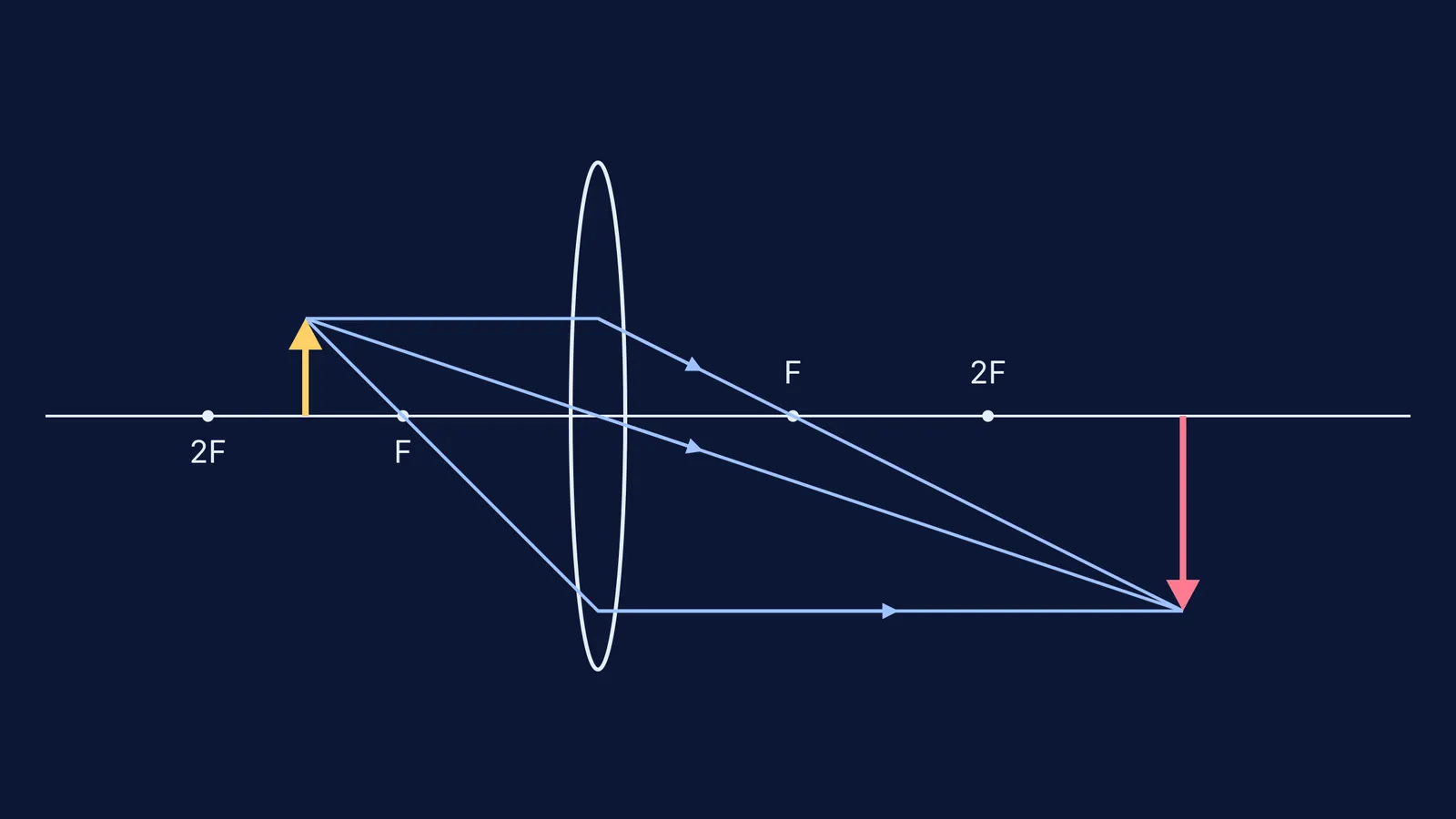
The image at the top of this page follows this order. Frame: a straight principal axis. Big shapes: a tall oval lens, with F and 2F marked at equal distances on both sides. Details: the object arrow between F and 2F, then three rays from its tip: parallel to the axis and bending through F, straight through the centre, and through F leaving parallel. Darken: the rays meet beyond 2F, so the image goes there, inverted and larger. Label last.
For biology, the same order turns a heart into a rounded outline, then four chambers, then the vessels, then labels. Our guides to diagrams for NEET biology and CBSE Class 10 science diagrams list which diagrams come up most often.
How can I get better at diagrams in two weeks?
Spend 15 to 20 minutes a day. Pick eight to ten diagrams from your syllabus, half biology and half physics.
Days 1 to 2: Copy two diagrams a day from your textbook using the five steps, naming the simple shapes as you go.
Days 3 to 5: Draw two a day from memory, compare with the book and fix errors in another colour.
Days 6 to 7: Redraw every diagram you got wrong, then time yourself on three.
Days 8 to 10: Draw from memory and check every label line is straight and points to the right part.
Days 11 to 12: Answer past board questions that ask for a labelled diagram, in exam time.
Days 13 to 14: A friend or parent calls out any diagram from your list; draw it in under two minutes and mark it against the book.
Parents help most by playing examiner: check that labels are readable and in the right place, not whether the drawing is pretty.
What if you cannot picture what you are drawing?
Sometimes the drawing is fine but the idea is fuzzy. Pair words with pictures, as in our post on dual coding in your notes. When a process is easier to see moving, the Fermi Simulation Lab has interactive simulations for ideas that are easier to see than to read. If you are stuck on a concept, Fermi's AI tutor can draw the figure and check your understanding as it goes, so you can then draw it yourself.
Start today: pick one diagram you avoid, and draw it in five steps.


