On this page
Your guide wants a literature review, and you have a folder of PDFs. A school-level review is short and structured, and it gets easier once you stop treating it as a list of summaries.
What is a literature review?
The UNC Chapel Hill Writing Center defines it as writing that "discusses published information in a particular subject area". The same handout draws the line that matters most: a summary recaps a source, while a synthesis is "a re-organization, or a reshuffling, of that information". A review is organised around ideas, not around the sources one by one, unlike an annotated bibliography.
Marco Pautasso put it more bluntly in Ten Simple Rules for Writing a Literature Review (PLOS Computational Biology, 2013): "Reviewing the literature is not stamp collecting." A good review, he writes, discusses the literature critically, points out methodological problems and identifies research gaps.
Grant and Booth analysed 14 review types in a 2009 paper. A school or olympiad project needs the simplest: a focused account of what is known, what is disputed and what is missing.
How do you find sources for a school research project?
Start with a narrow question. Pautasso's first rule asks for "a well-defined issue", because a vague topic pulls in far more papers than you can read. "Does light colour change how fast Hydrilla releases oxygen?" is workable; "photosynthesis" is not.
Then search in two places:
Google Scholar. Its help page explains that "Cited by" under a result shows newer papers that referenced it, and that a "[PDF]" link or "All versions" often leads to a readable copy when the publisher's page asks for a subscription.
The National Digital Library of India. NDLI is funded by the Ministry of Education and run from IIT Kharagpur, and it gathers freely available and institutionally contributed material in one search.
Keep a search log: the words you searched, where, and the date. Pautasso recommends tracking search terms so your search can be repeated, and keeping a list of papers you could not open yet.
Read the abstract, figures and conclusion first; our guide on using AI to understand a research paper abstract shows how to check a summary against the original.
If an abstract leans on a term you have not studied, look it up in the Fermi Concept Library, which has every concept in physics, chemistry, biology, mathematics and computing with its own lesson, before you write your summary line.
What goes in a literature review summary table?
Pautasso's third rule is to take notes while reading and to record references at that stage, using quotation marks for anything copied word for word. A summary table does both. Give each source one row and these columns:
Source: author, year, title, link.
Question: what the authors wanted to know, in your words.
Method and sample: what they did, on what, and how much.
Key finding: one sentence, with a page or figure number.
Limits: what they did not control or test.
Theme: a short tag you will group by later.
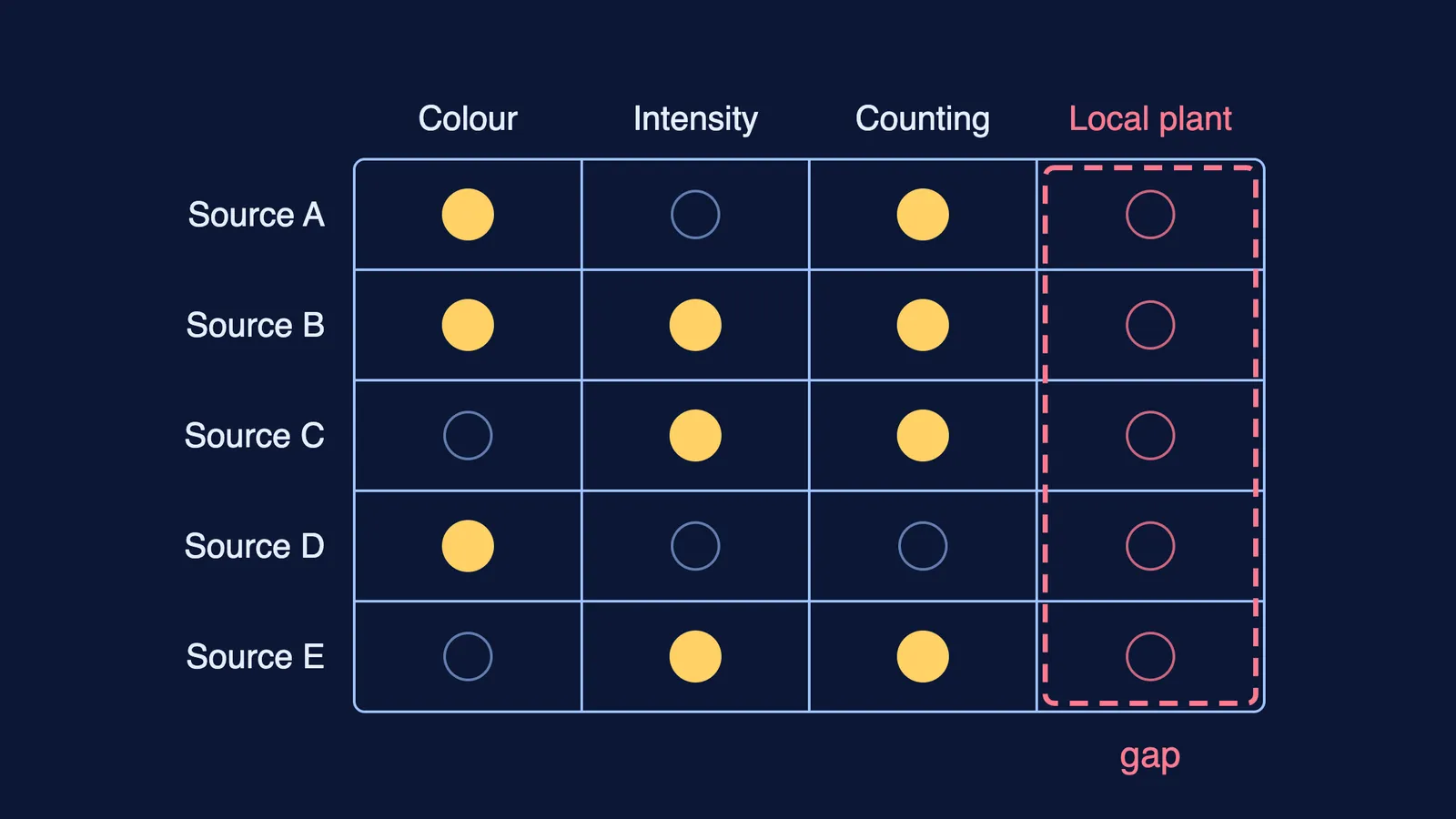
Here is how it works for a Hydrilla project like the one in our Hydrilla bubble experiment guide. Imagine placeholder sources A to E, tagged by light colour, light intensity, how bubbles were counted, and local plants. Mark which source touches which theme and a pattern appears: nobody tested plants from your area under coloured light. That empty column is your gap.
How do you write a literature review paragraph?
Use one paragraph per theme, built in four moves:
Claim. Your own topic sentence about the theme.
Evidence. The sources that agree, grouped in one sentence.
Contrast. The source that disagrees, and a likely reason, often a difference in method.
Gap. What remains unknown, linked to your project.
With placeholder sources it reads like this: "Light colour appears to affect oxygen release in water plants. Sources A and B both recorded more bubbles under red and blue light than under green. Source D found no clear difference, but it counted bubbles by eye over short intervals, which may hide small changes. None of these studies used plants collected locally, which is what this project tests."
This mirrors an example in the UNC handout, where the writers keep their own voice by starting and ending the paragraph with their own words. The handout says a review's body can be organised chronologically, thematically or methodologically. For a school project, the themes from your table usually work best.
What should you check before you submit?
Every claim has a citation, and every citation is in your reference list. Our guide to writing a school project bibliography shows how to check each entry exists.
No paragraph is about a single source.
Disagreements are explained, not hidden.
The last paragraph states your gap and your question.
If you are stuck on where to begin, Fermi's AI tutor can work out what you already know and build a plan for the session, so you start with a clear first step. Then open a blank table and add your first row.