

On this page
Most students check an MCQ, see the tick or cross, and move on. A four-option question has three wrong options, and in a well-made paper each one is usually built around a mistake real students make. Ten minutes on those three can teach you as much as the right answer did.
Why study the options you did not pick?
Memory research points the same way. In two experiments reported in Psychological Science in 2012, Jeri Little, Elizabeth Bjork, Robert Bjork and Genna Angello found that multiple-choice tests with plausible wrong options helped students later recall information about those wrong options, while cued-recall (short-answer) tests did not. The researchers made the options plausible enough that students had to work out why the wrong ones were wrong.
There is a catch. Henry Roediger and Elizabeth Marsh, writing in 2005 in the Journal of Experimental Psychology: Learning, Memory, and Cognition, found that reading more multiple-choice lures made students more likely to give those lures as answers on a later test: MCQs can create false knowledge. A follow-up by Andrew Butler and Henry Roediger in Memory & Cognition found that feedback, given immediately or after a delay, raised correct answers and reduced lure intrusions on a later test.
So the wrong options teach you something either way. Your job is to make sure they teach the right thing: look at them on purpose, with the answer key open.
How do you learn from wrong options in MCQs?
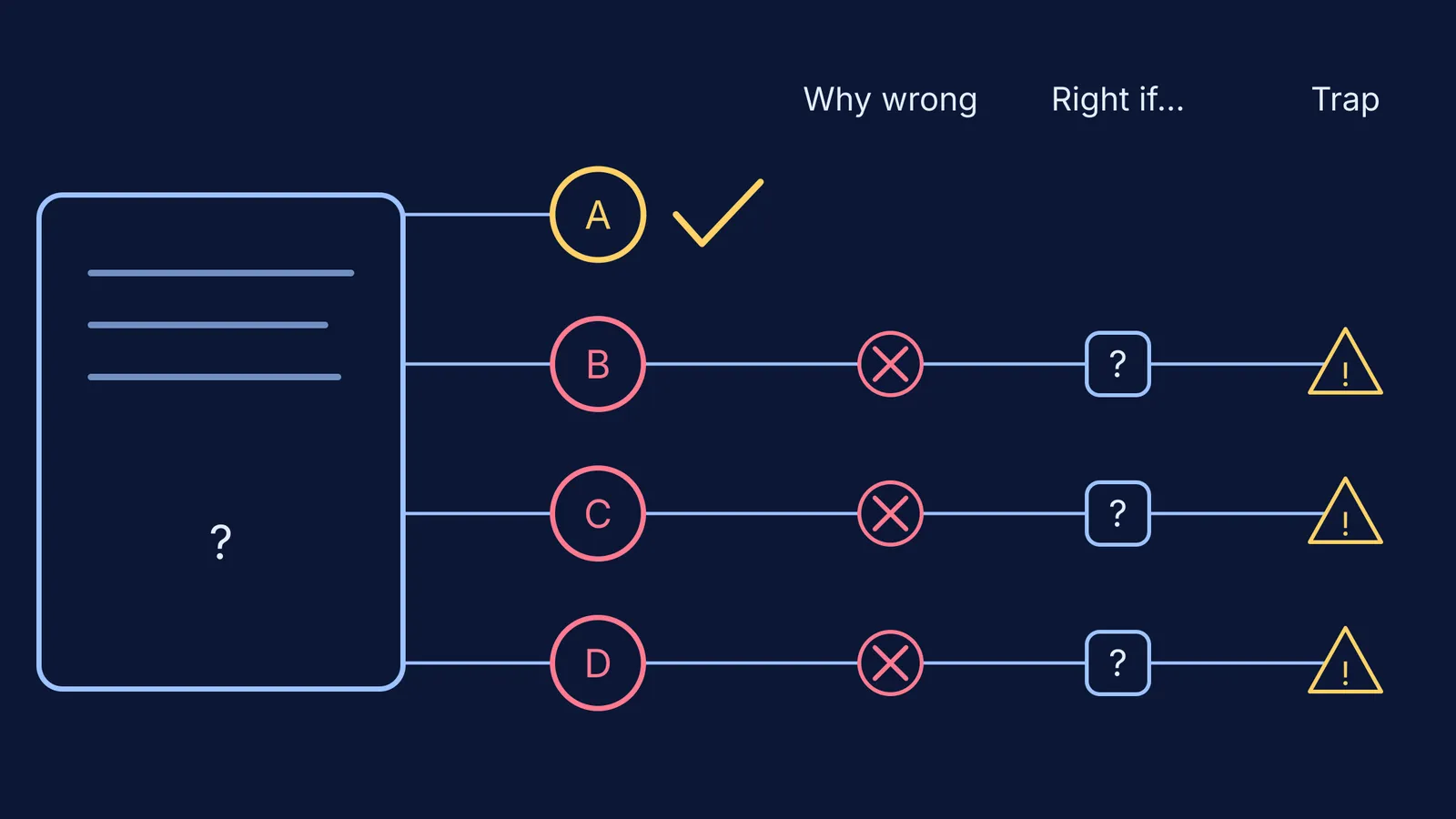
For each wrong option, write one line for each of three questions:
Why is it wrong? Name the exact step, not "silly mistake": wrong formula, dropped factor, wrong unit, wrong sign, or a true statement that does not answer this question.
What question would make it right? Change the question, not the answer, until this option becomes correct. This is the step that is easiest to skip, and the one that makes you rebuild the idea from the other side.
What trap does it set? Say who would pick it and why: the student who rushes, who remembers half a formula, or who reads "not" as "now".
A worked example: one physics MCQ, four lessons
A ball is thrown straight up at 20 m/s. Take g = 10 m/s² and ignore air resistance. How high does it rise? (A) 20 m (B) 40 m (C) 2 m (D) 10 m
The answer is (A). At the top the speed is zero, so v² = u² − 2gH gives H = u²/2g = 400/20 = 20 m.
(B) 40 m. Why wrong: it is u²/g, with the 2 dropped. Right if: the same throw happened where g = 5 m/s². Trap: half-remembered formulas.
(C) 2 m. Why wrong: it is u/g, which is a time in seconds, not a height. Right if: the question asked how long the ball takes to reach the top (2 s). Trap: choosing a number without checking its unit.
(D) 10 m. Why wrong: it is half the maximum height. Right if: the question asked the height at which kinetic and potential energy are equal (ground as zero), because the energy is shared equally at H/2. Trap: assuming "halfway" is the answer.
One question became a revision of the height formula, time to the top, units and energy conservation.
How do you make this a habit without it taking all evening?
You do not need to do it for every question. A plan that fits a normal study day:
After a practice set or mock, pick 3 to 5 questions: ones you got wrong, and ones you got right by guessing.
Write the three lines for each wrong option with the solution open, so no lure goes unchecked.
Keep the lines in one notebook, grouped by trap type rather than by chapter. After a few weeks you will see which traps catch you most.
Before your next test, read only the trap lines. It takes five minutes.
When you cannot explain why the right option is right, the Fermi Problem Library has worked problems with a step-by-step solver that explains the reasoning rather than printing an answer, so you can find the exact step where your method went off.
For using the options during the exam itself, see our guide on using the options to solve JEE MCQs faster. The method here is for after the paper.
What if a wrong option still looks right to you?
If you cannot write the "why wrong" line, the problem is usually a concept, not carelessness, so look the idea up before doing more questions. The Fermi Concept Library has a lesson for every concept in physics, chemistry, biology, mathematics and computing. Our posts on what to do when you are stuck between two similar options and on asking why your wrong idea seemed right go further.
Parents can help with one question at dinner: "Which wrong option nearly got you today, and why?" It turns a score into a conversation about thinking.
Tonight, take one question from your last test and write the three lines for each of its wrong options.


