

On this page
You've spent four minutes on an MCQ and your answer isn't among the choices. The options were clues all along. Here are four ways to use them.
How many JEE Main questions can the options help with?
In JEE Main 2027 Paper 1, each of mathematics, physics and chemistry has 20 multiple-choice questions in Section A and 5 numerical-value questions in Section B, 75 questions in all, according to NTA's JEE (Main) 2027 Information Bulletin.
A correct MCQ answer earns +4 marks, an incorrect one costs −1, and an unanswered question scores 0, according to the same bulletin. Paper 1 lasts 3 hours, so you have about 2.4 minutes per question on average.
So 60 of the 75 questions come with options. In Section B you type in an integer, so there is nothing to test, and a wrong entry also costs −1.
How do you back-substitute options in a maths MCQ?
Back-substitution means putting each option into the question to see which one works. It suits 'solve for x' questions, where checking is quicker than solving.
Worked example. Solve √(2x + 1) = x − 1. Options: (A) 0 (B) 2 (C) 4 (D) 0 and 4.
Try 4: √9 = 3, and 4 − 1 = 3. It works.
Try 0: √1 = 1, but 0 − 1 = −1. It fails, so (A) and (D) are out.
Try 2: √5 is not 1, so (B) is out. Answer: (C).
Squaring both sides gives x² − 4x = 0, so x = 0 or x = 4. A student who skips the final check picks (D). Back-substitution avoids that trap because the check is the method.
What are special values, and when should you use them?
If a result holds for every n or every x, the right option must hold for each value too. Pick a small value you can work out in your head and see which option survives.
Worked example. 1·1! + 2·2! + … + n·n! equals (A) (n + 1)! (B) (n + 1)! − 1 (C) n! + 1 (D) (n + 1)! + 1.
Put n = 1. The left side is 1. The options give 2, 1, 2 and 3, so only (B) matches. If two options tie, try n = 2 (left side 5) rather than guessing.
How do limiting cases catch wrong physics formulas?
A limiting case pushes one quantity to an extreme where you already know the answer: a mass to zero, two masses equal, an angle to 0° or 90°. A correct formula must give the right result there too.
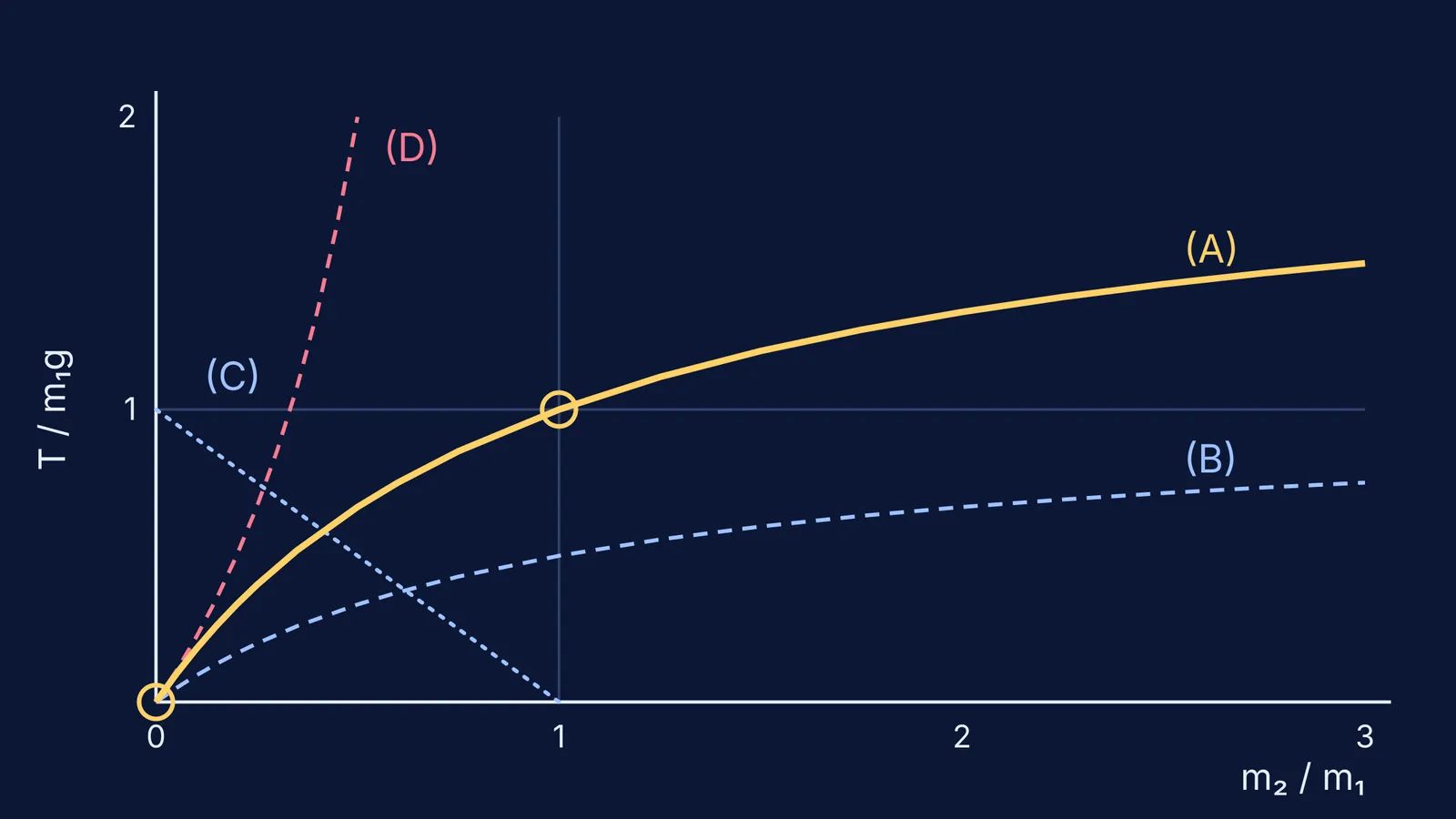
Worked example. Masses m₁ and m₂ hang from a light string over a light, frictionless pulley. The tension is (A) 2m₁m₂g/(m₁ + m₂) (B) m₁m₂g/(m₁ + m₂) (C) (m₁ − m₂)g (D) 2m₁m₂g/(m₁ − m₂).
Make the masses equal (m₁ = m₂ = m). Nothing accelerates, so the tension equals the weight, mg. (A) gives mg; (B) gives mg/2, (C) gives 0 and (D) divides by zero.
Confirm with m₂ = 0. Nothing hangs on the other end, so the tension is zero, and (A) gives 0. Answer: (A).
The diagram above plots all four options; only (A) passes both circled check points. Angle limits often need sin θ ≈ θ, which our guide to small-angle and binomial approximations for JEE physics covers.
How do units rule out options?
Every term in a correct physics formula has the same dimensions. Work out each option's units and cross out any that don't match the quantity asked for.
Worked example. The escape speed from a planet of mass M and radius R is (A) √(2GM/R) (B) √(2GMR) (C) 2GM/R (D) √(2GM/R²).
To avoid G's awkward units, use g = GM/R², so GM/R = gR, in m/s² × m = m²/s². Then √(GM/R) is in m/s, a speed. (B) is √(2gR³), in m²/s. (C) is in m²/s². (D) is √(2g), in √m/s. Only (A) is a speed.
Units cannot separate √(2GM/R) from √(GM/R), because the 2 has no units. When options differ only by a number, you need the physics. Our 30-second dimensional analysis check has more practice.
When should you stop using the options?
These tactics are checks, not a replacement for knowing the method. Stop and solve when:
two or more options pass every quick check
the options are close numbers, so testing one takes as long as solving
the question is in Section B, where there are no options
If you're down to two options and still unsure, whether to answer depends on the +4/−1 marking. Our post on negative marking and when guessing is worth it does the arithmetic.
After each mock, solve fully every question you answered from the options. Where the method breaks down, you've found a gap. The Fermi Problem Library has worked problems with a step-by-step solver that explains the reasoning rather than printing an answer. If a check failed because you couldn't remember what a formula means, look up the idea in the Fermi Concept Library.


