

On this page
The multiple-choice question (MCQ) is the foundation of competitive exams like JEE Main and NEET-UG. You read the question, eliminate two obviously wrong distractors, and stare at the remaining two options. Do you skip it to avoid negative marking? Do you take a blind guess? And if you do choose one, should you ever go back and change it?
By combining the mathematics of exam marking schemes with the psychology of test-taking, we can build a clear set of rules for what to do when you are stuck between two options.
Should you guess or skip when two options remain?
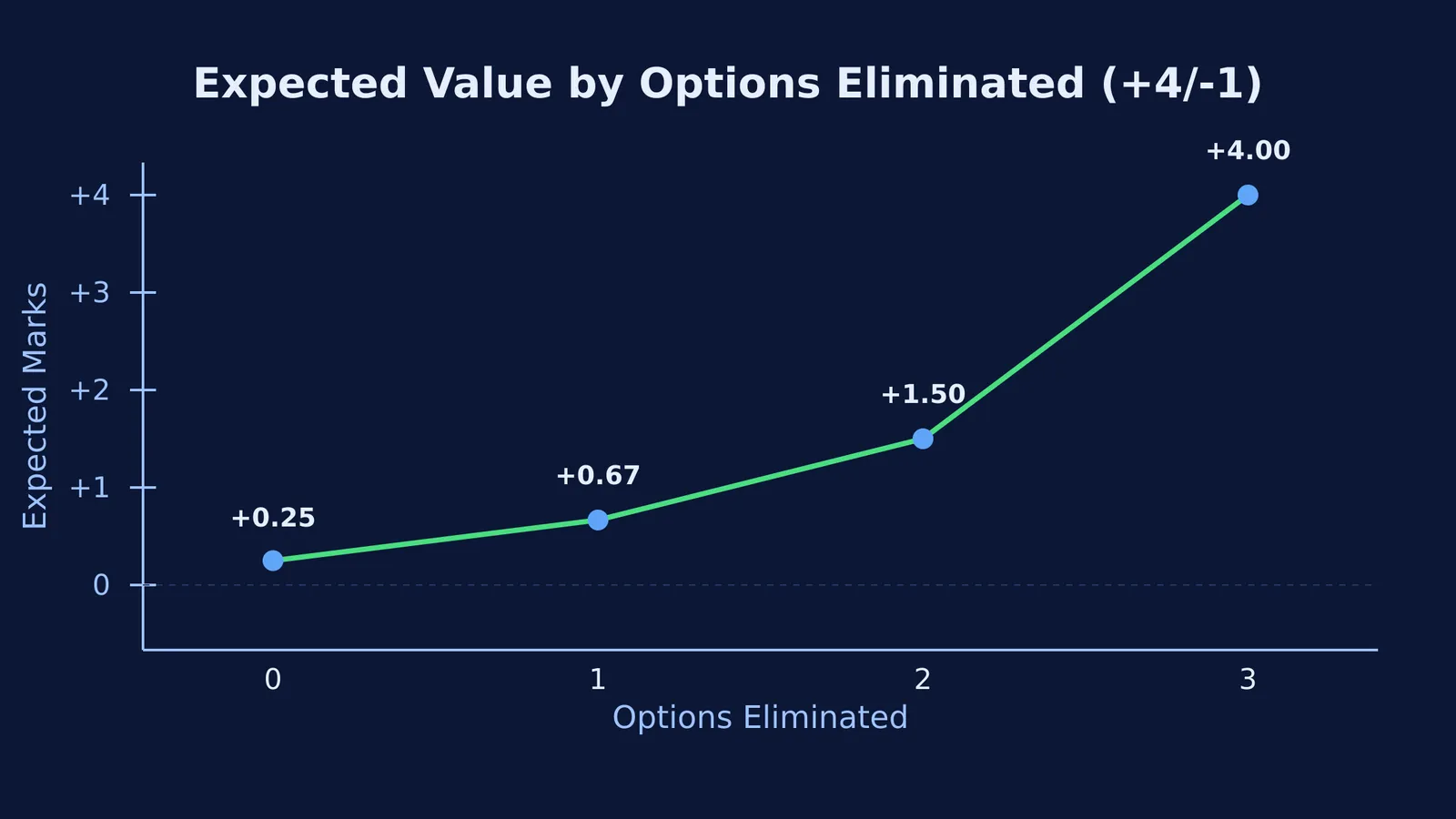
To decide whether to guess, you must look at the mathematical expected value of your decision. The National Testing Agency (NTA) uses a standard marking scheme for MCQs in both JEE Main and NEET-UG: +4 marks for a correct answer, -1 mark for an incorrect answer, and 0 marks for a question left unanswered (Vedantu).
If you are guessing blindly among all four options, your probability of getting it right is 1/4. However, if you have confidently eliminated two incorrect options, your probability of choosing the correct answer from the remaining two is 1/2.
We can calculate the expected marks per question using the formula for expected value: `Expected Value = (Probability of Correct × Marks Gained) + (Probability of Incorrect × Marks Lost)`
Plugging in the numbers for a 50/50 guess: `Expected Value = (0.5 × 4) + (0.5 × -1) = 2.0 - 0.5 = +1.5 marks`
Mathematically, guessing between two options yields an expected gain of +1.5 marks per question. Leaving the question blank guarantees exactly 0 marks. Over the course of an exam, if you narrow down 10 questions to two choices and guess on all of them, probability suggests you will get 5 right and 5 wrong. You will earn 20 marks and lose 5, netting +15 marks. Therefore, if you can eliminate two options, you should always mark an answer.
Is it bad to change your answer?
A very common piece of exam advice from parents and teachers is to "trust your gut" or "stick with your first instinct". However, decades of research prove this advice is completely wrong.
In a seminal 2005 paper titled "Counterfactual Thinking and the First Instinct Fallacy," published in the *Journal of Personality and Social Psychology*, researchers Justin Kruger, Derrick Wirtz, and Dale T. Miller found that changing answers on a multiple-choice test usually improves scores. Across numerous studies, approximately 51% to 59% of answer changes go from an incorrect answer to a correct one, while only about 20% go from correct to incorrect (APA PsycNet).
Why does the myth persist? The researchers attribute it to the "first instinct fallacy", which is driven by memory bias and counterfactual thinking. Changing a correct answer to a wrong one causes intense psychological regret ("If only I had left it alone!"). Because that regret is so painful, those failures become highly memorable. In contrast, changing a wrong answer to a right one feels like normal problem-solving and is easily forgotten. This creates the false illusion that changing answers is dangerous.
If you review a question and find a logical reason to doubt your initial choice, you should definitely change your answer.
How can you test the remaining options?
Before you resort to a pure 50/50 guess, try to break the tie using active reasoning. Often, the confusion stems from how you parsed the problem, rather than a lack of subject knowledge.
Re-read the question stem: Exam setters design distractors to catch students who read too quickly. Look for critical qualifying words that flip the meaning of the question, such as "not", "incorrect", "except", or "always".
Test each option against the condition: If you are left with two numerical values or expressions, plug both back into the original condition. One will often violate a basic physical constraint, such as requiring a negative mass or breaking a fundamental conservation law. If you are struggling with graphing problems, visualising the constraints can help you determine how many roots are possible.
How can you avoid getting stuck between two options?
Guessing smartly is an essential test-day strategy, but finding yourself stuck between two options frequently is a signal that your conceptual understanding is slightly blurred. It often means you have a partial grasp of the concept but lack the final connecting detail that separates the correct answer from the cleverly designed distractor.
The Fermi Problem Library has worked problems with a step-by-step solver that explains the reasoning rather than printing an answer. When you review your mock exams, do not just look at the correct option and move on. Trace your logic to understand exactly why the other option was wrong. Fermi's AI tutor teaches — it holds a line of reasoning across a whole session, notices where a student is stuck, and decides whether to explain, ask, or show. By understanding the distractor, you ensure you will not be stuck between those two options again.


