

On this page
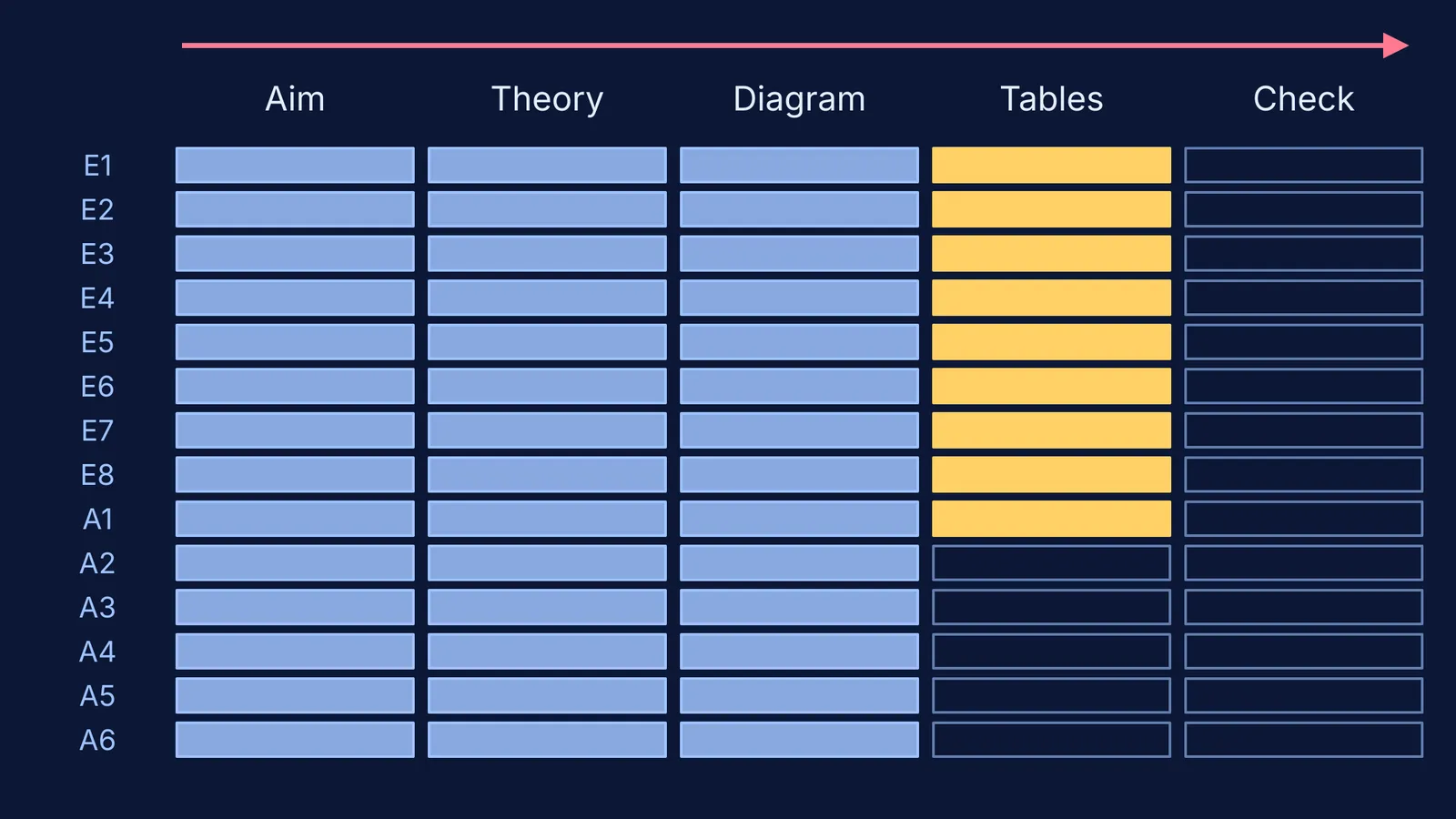
Practical file half-empty and the exam coming up? Writing faster won't fix that; changing the order will. Instead of finishing one experiment before starting the next, do one kind of work across every entry at once: all the aims, then all the theory, then all the diagrams.
The file is worth real marks. In the CBSE Physics curriculum for 2026-27, the practical record (experiments and activities) carries 5 of the 30 practical marks. In the CBSE Chemistry curriculum for 2026-27, class record and viva together carry 4 of the 30 practical marks.
What must a Class 12 practical file contain?
Start with the official list. The CBSE Physics curriculum says the record you submit at the annual exam must include at least 8 experiments (4 from each section), at least 6 activities (3 each from sections A and B) and the report of your project. It also says these are "to be performed by the students", so the readings in your file should be the ones you took in the lab.
For what goes inside each entry, CBSE's guidance on practical files lists aim, apparatus required, simple theory, procedure, related practical skills and precautions. That wording sits in the guidelines for visually challenged learners in the Chemistry curriculum, and many school formats also ask for observation tables, calculations, a result and a diagram or graph. If your teacher's format differs, follow it.
Why does writing in batches save time?
Switching between kinds of work has a cost. In four experiments, psychologists Joshua Rubinstein, David Meyer and Jeffrey Evans found that switching between tasks cost time, and the cost grew as the rules got more complex (Rubinstein, Meyer and Evans, 2001). Their participants classified shapes and solved arithmetic problems, not lab files, so treat this as a reason to try batching, not a measured saving.
A practical file is full of these switches. Copying an aim needs little thought, theory needs careful thinking, a ray diagram needs pencil and ruler, and a table needs your rough notebook open. Doing all four per experiment means changing modes dozens of times. Our guide to batching similar study tasks explains the same idea for everyday study.
How do you complete a practical file fast?
Keep your lab manual, rough notebook and file in front of you, and work in this order:
Master list. On a rough sheet, list every experiment and activity in your index order, with columns for aim, theory, diagram, table and signature.
Aims and apparatus. Write these for every entry in one sitting. It is mostly copying, so do it when tired.
Theory and formula. The principle, the formula with each symbol named, and nothing you could not explain in the viva. Do this pass when fresh.
Diagrams and graphs. Pencil and ruler out: draw every circuit, ray diagram and set-up together, then plot every graph. Our guide to drawing a graph in your physics practical file covers scales, axes and the best-fit line.
Tables, results and precautions. Copy your real readings from your rough notebook, do the calculations, and write each result with units, followed by the precautions.
Tick the master list after each pass. Then do the final check against your school's index: missing units, unlabelled diagrams, blank result lines and pages your teacher has not signed.
What does a four-day catch-up plan look like?
The CBSE Physics curriculum asks for at least 8 experiments and 6 activities. Say you have done all 14 in the lab but written up only 3. One way to split the other 11:
Day 1: the master list and every aim and apparatus list.
Day 2: theory for all 11, in two blocks with a break between them.
Day 3: every circuit and ray diagram, then all the graphs.
Day 4: tables, calculations, results and precautions, then the final check.
If one theory section stalls you, such as why the balance point of a metre bridge gives the unknown resistance, mark it on the list and move on. If the idea itself is the problem, the Fermi Concept Library has a lesson for every concept in physics, chemistry, biology, mathematics and computing, so you can understand it before you write it. For ideas easier to see than read, try the Fermi Simulation Lab.
Which shortcuts cost you marks?
Borrowed readings. CBSE says the experiments are to be performed by students, and in physics the viva covers experiments, activities and the project (CBSE Physics curriculum). An examiner can ask how you got a value.
Theory you cannot explain. Shorter and clear beats longer and copied.
Signatures left to the last week. Get pages signed as you finish each batch.
Decoration. The evaluation scheme gives marks for the record, not for borders. Spend that time on the final check.
If your practical exam falls close to JEE Main, our week-by-week plan for board practicals and JEE Main shows where the file fits.


